
In many applications, dedicated grading machines just aren't a practical alternative, whether it's due to space constraints or utilization requirements. In these instances, a compact machine with the proper grading attachment may provide the perfect solution. They offer a much lower acquisition cost and, when not needed for grading, the attachment can be quickly swapped out to keep the carrier productive.
Today's compact machines also produce more power - in some cases, more than the previous generation of full-size machines used to install the country's infrastructure. "Compact equipment of today is larger than [the equipment] the railroads and early roads were built with," says Darrell Hoelscher, Hoelscher Inc. "So the only limitation is the time available to do a job."
Another advantage is maneuverability. For example, Hoelscher Inc. offers graders, scrapers and rollers for use with compact tractors. These attachments use the tractor's three-point arms to control depth of cut.
"Our equipment is designed for use in tight quarters," says Hoelscher. "Our products are unique in that we can fit into areas where others can't. These machines are made for development areas, parking lots, driveways, etc. They allow a contractor to perform jobs too small for conventional equipment, [and they] are more productive and controllable than a bucket on a skid steer.
"Very few operators are capable of producing an acceptable grade with a bucket," he adds. "A pull-type compact unit allows for quick finishing with less operator skill."
Lasers heighten accuracy
When it comes to achieving grade specs on smaller jobsites, there is no substitute for the proper grading attachment.
"A compact power unit paired with a grading/scraping attachment allows for greater accuracy," says Glen Parrett, HitchDoc. "Accuracy is an absolute necessity when talking about subgrade surface preparation. Conventional buckets or larger grading tools won't provide the fine grade necessary for concrete flatwork. The compactness of the attachment paired with a compact power unit make this machine extremely maneuverable, particularly in confined areas."
Laser-guided attachments are also becoming increasingly popular in the compact equipment market. A laser-guided box blade or grader attachment can provide accuracies as precise as +/- 0.25 in.
"As equipment technology has improved, yesterday's limitations have become today's opportunities," says Parrett. "Technology has given contractors the capability of not having to seek outside services such as engineers or surveyors."
HitchDoc designed its Dual Dozer to take advantage of the accuracies possible with laser systems. "Our product attaches to a tractor three-point hitch and most major brand skid-steer loaders, and is equipped with two blades, which allows forward and reverse grading," says Parrett. "It is designed to utilize dual independent laser controls."
The attachment was actually built around the laser control system. "The mount allows the blade to operate independent of the power unit, and holds a precise grade level by receiving a laser signal simultaneously to each laser receiver sensor," Parrett explains. This results in accuracies within 1/8 in.
Subgrade surface preparation for slab floor flatwork is a specialty of the Dual Dozer attachment. "Subgrade surface preparation is not only a major time and cost component of slab floor flatwork, but it is also a key factor in concrete yield, slab fitness and ultimately slab performance," says Parrett. "This attachment allows you to complete jobs faster with fewer re-work corrections. There is reduced staking and a higher level of accuracy over conventional methods."
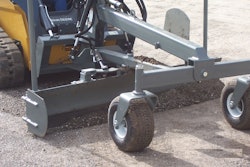
SitePro, a division of Worksaver Inc., offers the SSGB-8 Grader Blade for asphalt, landscaping and concrete flatwork contractors. It features an 8-ft., six-way hydraulically controlled moldboard with 25° rotation/tilt. "This unit can be equipped with a laser system to hold grade," says Mike Kloster, president, Worksaver. "With a laser system, it can maintain closer tolerances, saving material costs."
This grader blade offers many advantages over a conventional bucket. "The 8-ft. grader covers more area, reducing the number of passes required," says Kloster. "With laser control, the materials are spread evenly across the jobsite." The only limitations would be in very confined areas.
Ask questions
When researching grading attachments, one thing you should investigate is the ease of control. "Is the valve laser ready? Are laser poles available from the manufacturer?" Kloster asks. "Can it be equipped with end plates?"
Parrett agrees, adding that it's important to know exactly what you are getting for your investment. "Is the attachment complete with pre-programmed laser receivers, poles, hydraulic hoses and tips, ready to install on a power unit and put to use?" he asks. "Does the attachment have the versatility of adapting to both compact tractors and skid-steer loaders? Can it grade both forward and reverse? Are the cutting edges easily replaceable? How well is the attachment constructed and will it give the user many years of use?"
Just because the attachment is made for compact equipment, no corners should be cut. "A compact unit should have comparable features of larger, conventional machines," says Hoelscher. For example, Hoelscher Inc. offers replaceable heat-treated cutting edges.
"Look for the quality of manufacturing and thickness of material used," he emphasizes. "For years, equipment available for compact tractors has been made extremely light and crude. Without the weight and quality design, an attachment will not do an acceptable job."
Attachments Are Up to the Task
Jim Beuter in Perry, IA, has been able to create a successful business based on a 55-hp John Deere Model 2355 tractor, a Hoelscher 6-ft. wide dump scraper and 8-ft. grader attachment, plus some other pieces of equipment. For example, he built a sports complex for the community high school, completed projects for the city and developed a grading business for residential home builders.
The sports complex covered approximately 18 acres and consisted of a baseball diamond, softball diamond, golf driving range and soccer field, all of which called for "a lot of grading," Beuter notes. The project was spread over a three-year period, but the size of the equipment wasn't the limiting factor. Rather, the work was completed as school finances allowed.
Meeting the design specs was critical. "You had to get all of the drainage right so you didn't have ponds anywhere," says Beuter. "I had to use some transits and measuring sticks to make sure the fall was correct.
"Baseball diamonds and softball diamonds require a lot of accuracy," he notes. "The architects had designed these so that you could get an inch of rain and then be able to play on them an hour later. So we had to get soil amendments mixed in the right percentages."
First, the grades had to meet specs. "On the baseball diamonds, of course, I had to use grade stakes," says Beuter. Then, a mixture of sand, Turface and soil had to be precisely mixed for the skinned areas. "There has to be anywhere from 70% to 90% sand on the infield."
The sand, Turface and soil were applied with the dump scraper. "I could measure the weight of the bags and then I measured the volume of the dump box," Beuter recalls. "I could determine the number of dumps and the amount of sand to put in there. I could also determine how many dumps of soil to put in there. I had the DB apron on the DB6 dump box, so by adjusting the apron opening and the dump box tilt angle I was able to meter and spread the amendments uniformly. I then mixed the amendments with a heavy-duty rototiller and leveled with the GR-8 grader. That is how I got my ratios right. I ended up with 70% sand."
Beuter says the attachments worked effectively. "It is really well-built equipment and it does the job they claim it will do," he states. "On the scraper, I moved a lot of soil. I put probably close to 1,000 hours on it. There are times when I hit rocks that were buried in the soil. I hit them hard and stalled the tractor, and it never hurt the equipment."