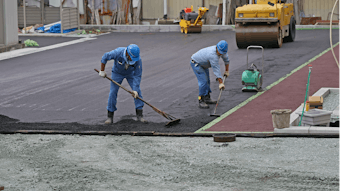
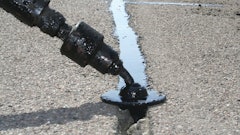
Reconstruction of Robert Bosch's Vehicle Dynamic Area (VDA) at the Flat Rock Proving Grounds in Ash Township, MI, provided another opportunity for Ajax Paving Industries to demonstrate its unique skills in precision track paving and design. The project included removal and reconstruction of the existing VDA and construction of a new 30-degree banked, high-speed parabolic (pavement curve is similar to inside a bowl) return road.
The existing VDA was constructed by Ajax in the early 1980s and was in dire need of upgrading. The newly designed 139,000-square-yard VDA pad called for installation of 12 inches of crushed limestone base and 5 inches of hot mix asphalt pavement. The wearing surface consisted of 1 1/2 inch HMA Superpave mixture specifically designed to achieve a surface coefficient of friction of 90mu.
Stringent ride quality specifications called for an International Roughness Index (IRI) of 30 measured both longitudinally and diagonally.
Another unique aspect of the project called for recycling another portion of the existing asphalt pavement, mixing it with on-site materials, and installing the reclaimed asphalt as "green" shoulders around the track. The recycling effort was and is part of Bosch's green initiative.
Ajax helped Bosch achieve that particular objective. And, since the paving contractor was involved in the project from design through construction, Bosch was assured the final product would be delivered at the highest quality.
Bosch's perspective
Meeting the performance demands of the testing facility was top priority for Bosch in the design and construction of the VDA and return road, according to Gary Champine, manager of Bosch's Chassis Systems Control Product Division's test track facilities.
"Smoothness and the surface coefficient (friction characteristics) are critical when testing chassis control systems," Champine notes.
Bosch designs and manufactures antilock braking systems (ABS), traction control systems (TCS), electronic stability control (ESC) and sensors used in vehicle chassis control systems.
"We decided to go with a parabolic design on the banked return road to provide an optimal sensitivity testing of our sensors," Champine says. "The parabolic design has a way of fooling the sensors because of the curved surface vehicles have to travel over during testing at the facility. It's just another design element that allows us to test our products.
"It was also very important that we designed and built a test facility that would provide longevity while withstanding a variety of load requirements of different vehicles that would be used during testing," Champine adds. "Our sensors and chassis control systems our used on different vehicles (consumer and commercial) and we also lease the facility to other vehicle (component) manufacturers for testing purposes, so it was very important to design and build a top-notch and reliable testing facility."
Placing the pavement
A standard Michigan Department of Transportation mix design was specified for the project, with three lifts required to achieve the 5-inch-thick pavement. A 2-inch base course was placed over the aggregate, followed by 1 1/2-inch leveling course and a 1 1/2-inch wearing/surface course. All contained a PG 64-22 AC binder, with the wearing course modified to achieve the friction coefficient specified by the project design.
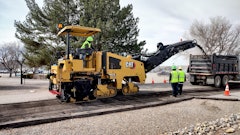
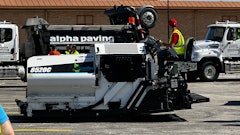
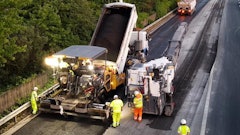
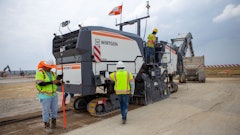
For the construction of the VDA pad, Ajax's paving crew placed each sequential lift diagonally across the previous lift to ensure longitudinal joints would be constructed with minimal ride smoothness degradation. Making runs without stopping were also imperative to minimize creating any smoothness deviations to the pavement surface.
"We paved continuously without stopping the paver to avoid any bumps or dips that could result from stopping the paver and allowing the screed to settle into the mat," explains Dave Marshall, project manager. "We used a material transfer device to maintain a continuous paving process and prevent trucks from bumping into the paver. We also paved in different directions with each lift to achieve additional smoothness results."
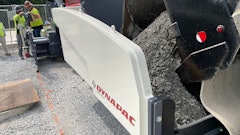
On the banked parabolic return road, the paving crews faced additional challenges in placing a new asphalt surface. To place the MDOT 5E3 Superpave base course containing 30% reclaimed asphalt pavement, the leveling course containing 20% RAP, and the modified virgin wearing course, equipment and technique proved essential in the application on the 30-degree banked portion of the track. As with other banked track projects the paving contractor has delivered in the past, the Vogele paver and screed were secured with cable to another paver traveling in tandem on the above flat surface surrounding the curved track. The roller operators used outriggers to ensure compaction contact (and prevent the rollers from tipping over) as they maneuvered the banked portion of the track.
"This was the first parabolic project for the architects hired to design it and their original design called for a high-bank curve, but we worked with them from the beginning and assured them that the parabolic design was a better way to go, and that we could deliver the project," explains Clarence Jones, Ajax estimating manager. "The Vogele screed we used on the project is specially designed with 2-foot sections that can flex into the parabolic shape of the track. With the tamper compaction of the screed we were able to achieve 90% density of the mat before the roller operators took over."
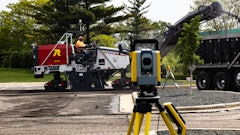
To further guarantee the successful outcome of the complicated 30-degree banked parabolic design, Ajax performed the final grade of the limestone base and used GPS technology to make sure the geometric details were exactly where they needed to be before placing the first lift.
"We had to pay close attention to the transition areas going in and out of the banked area to make sure we were delivering a continuously smooth pavement," Marshall notes. "This was the third project of this type that the paving crew executed and they really did a great job."
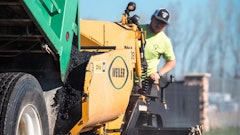
Also worth noting, the Ajax paving crew relied on a Roadtec material transfer vehicle equipped with a 40-foot conveyor to feed the paver with a continuous supply of mix that would also ensure a smooth finish and transition to the VDA pad.
According to Marshall, Ajax's specialized track paving crew achieved an extremely smooth surface, exceeding the targeted smoothness specifications Bosch requested in the project design.
"We even achieved exceptional smoothness results across the longitudinal joints of the final lift," Marshall says.
Facility demands high standards
While ride smoothness was critical to the quality of the final surface, so was the friction coefficient that needed to be achieved. As a test facility designed to evaluate safety devices designed for motor vehicles, achieving the right surface friction was equally as critical for the paving contractor. For Bosch and other vehicle component suppliers, the friction coefficient of the testing facility is vital in evaluating the performance of many vehicle control/safety systems, such as anti-lock braking systems (ABS), traction control and 4WS systems.
Bosch's Automotive Proving Grounds provide the controlled environment necessary to develop and test technology that can improve the overall safety and performance of a vehicle. For example, before a technology like electronic stability program (ESP) can go into mass production, a long development and testing phase is required at a proving ground like Flat Rock to ensure the technology will perform as designed under any environmental situation.
The Flat Rock Test Facility not only serves Bosch's product development needs, but also those of automotive manufacturers and their suppliers, technical approval and control institutes, providers and engineering services, and educational institutions. From passenger cars, light trucks and SUVs to trailers and motorcycles, Flat Rock provides a controlled venue to evaluate vehicle performance in a variety of environmental situations.
"We're testing in wet and dry conditions to see how our products perform in different environments, so having optimal surface conditions is important to evaluate how those products perform," Champine says. "When you're developing products, you need to put those products through the same testing procedures to evaluate the performance of one design over another. That's what makes a testing facility like this so important, and this facility was designed and built with that in mind."