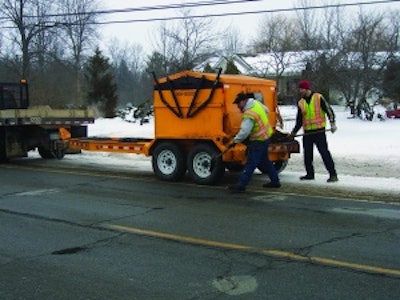
If I'm a contractor and I could only own one piece of equipment that KM International makes, it would be a hot box reclaimer for sure," says Kurt Schwartz, sales & marketing, KM International.
That's because, according to manufacturers, adding a hot box reclaimer to your fleet can extend your season, improve the life of your pavement repairs, keep good workers on the payroll longer, and even help you earn greater profits on some jobs.
"In any kind of asphalt repair you need hot asphalt to have a repair that's permanent or reasonably permanent," says Tom Allen, general manager of Kasi Infrared. "A hot box reclaimer enables you to do that."
"It enables you to do a permanent patch which in winter is pretty much unheard of," says Wes VanVelsor, president of Ray-Tech Infrared.
Hot Box or Hot Box Reclaimer
There are two types of hot boxes on the market, and it's important to buy the box that best suits your operation.
A regular hot box, what VanVelsor terms a "holding box," is designed simply to hold hot mix asphalt that is already heated. These hot boxes are usually insulated but do not have any heat source. They are designed to transport hot mix from the plant to the jobsite and are suited only for material that will be used within a few hours.
A hot box reclaimer, on the other hand, is not only insulated but it is thermostatically controlled. It can be used to maintain the temperature of fresh hot mix over an extended period of time, but its greatest advantage is its ability to heat cold virgin mix to workable temperatures at any time of the year.
"Hot boxes or holding boxes are limited," Schwartz says. "A hot box has it's purpose for the guy who doesn't have a dump truck whose got a 2-ton repair to do in a couple of hours. But for the price it's ridiculous not to buy a hot box reclaimer."
VanVelsor agrees that contractors who are picking up material and planning on using it that day could get by with just a hot box to keep it warm. "But what happens if you fill it up with 4 tons and you have 3 tons left at 10 o'clock in the morning and the weather turns bad? What do you do? Do you have to dump it? With a reclaimer you just turn it off and then turn it on to reclaim it the next day," VanVelsor says.
Most contractors aware of hot box reclaimers know of them as part of an infrared unit, which are used extensively throughout the winter to repair potholes when hot mix plants are shut down. "Infrared is year-round repair but contractors can benefit from the winter time repair rate (price) which is double what it is in the summer time," Schwartz says.
But hot box reclaimers can be just as valuable on their own.
"There's a whole market out there for patching when you need to have hot material 24 hours a day," Schwartz says. "Being able to get hot mix out there early in the spring before the plants open and without having to wait in line for a small load when they do, that's a tremendous advantage. No longer does a paver need to throw away his virgin asphalt. He can just stockpile it for when he needs it. A hot box reclaimer can be paid for in less than two weeks doing patching."
Stockpiling asphalt
But to be able to offer customers hot repairs with virgin asphalt all year long contractors need to have virgin mix to reclaim during the winter. So manufacturers recommend contractors stockpile virgin asphalt in any region where asphalt plants shut down.
Stockpiling takes some foresight and planning; you can't dump fresh mix in a pile and hope to use it mid-winter. Some contractors spread a 2-3 in. layer of asphalt in their yard, lightly compact it, then break it into chunks for easy stacking. Others build 2 ft. x 2 ft. sq. forms made of 2 x 4 lumber. They shovel the asphalt in the form, lightly compact it, then remove the frame and they have nice neat 2 ft. x 2 ft. chunks of asphalt 3 ½ in. thick.
"Stack them and put a layer of plastic in between each one so they don't bond together," Schwartz says. "Then, when you know you'll need hot mix the next day, just throw 1 ½ tons of the chunks into a 2-ton reclaimer and it will heat it up overnight."
Read more stockpiling tips from Schwartz.
Diesel or Propane Heating
Both types of hot boxes are built with triple walls, with an air space surrounding the holding box that enables heated air to heat the walls and the asphalt. Heat in the hot box reclaimer is generated either through propane or diesel. Manufacturers generally offer both types of heating systems (Ray-Tech offers only propane) and both work equally well.
"Typically if you're not used to working with propane and everything you have in your fleet is diesel, use diesel," Allen says. "Almost all infrared is propane fired so if you already have propane infrared then use propane."
Schwartz says there are some differences between the two fuels, which contractor should take into consideration.
"Diesel will reclaim a little quicker because it's a hotter heating system, but it's what works best for you," Schwartz says. "If all you have is diesel you might want to seriously consider diesel. If the propane filling station is 10 miles away you might want to consider diesel. But if you already have propane or have a propane tank in your yard then propane might be the best for you. Propane is cleaner and easier to work with."
But whichever fuel is used, cold mix must be heated slowly and steadily.
"Asphalt has to heat slowly or you'll scorch it," VanVelsor says. He says Ray-Tech units heat for 9 minutes and then shut down for 3 minutes, relying on a timer to turn the heat on and off.
"Once it reaches the right temperature a thermostat takes over and holds it at 280-300°F and during the whole operation of reclaiming it never exceeds 300°F," VanVelsor says.
The cycle is different for diesel-fueled reclaimers because diesel burns hotter than propane. "Whether it's a propane or a diesel heater what's important to realize is that a thermostat controls the burner and that control allows the asphalt to be warmed without overheating it," Schwartz says.
Manufacturers say the time it takes to heat cold mix to a workable temperature varies depending on a variety of factors including air temperature and moisture content of stockpiled mix.
Allen says 4 tons of cold mix can easily be heated to a workable condition overnight.
Trailer, Skid, or Truck
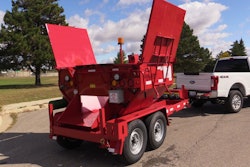
Hot box reclaimers are available in sizes ranging from 2 tons to 10 tons and in trailer, skid, and truck-mounted models.
Allen says KASI's most popular unit is the 4-ton propane-heated hot box reclaimer. "The reason for that is some days you need less than two tons and on the days you need more the trip back to the asphalt plant to get more is a killer," Allen says. "You only have to do that a few times to realize that the difference in price between a 2 and 4-ton unit is not that significant."
VanVelsor says Ray-Tech sells 15 reclaimers for every hot box, partly because the difference in price is not substantial. "A lot of the people we sell reclaimers to are contractors who work on parking lots and they can't get mix on the weekend so they use the reclaimer to make sure they have what they need," VanVelsor says.
Schwartz says KM International's biggest sellers are its 2-ton skid-mounted unit and its 4-ton trailer-mounted unit.
"We sell a lot of 2-ton trailers but usually if they move into trailer-mounted they go with the 4-ton," Schwartz says. "If they have an extra truck they often buy the skid-mounted."
But manufacturers are united in their support for both hot boxes and hot box reclaimers. "If a contractor is always going to have hot asphalt available to him he only needs a hot box," Allen says. "But if he operates in cold climates where asphalt plants close he's going to need a reclaimer. I'd recommend it to any contractor involved in asphalt repair."