
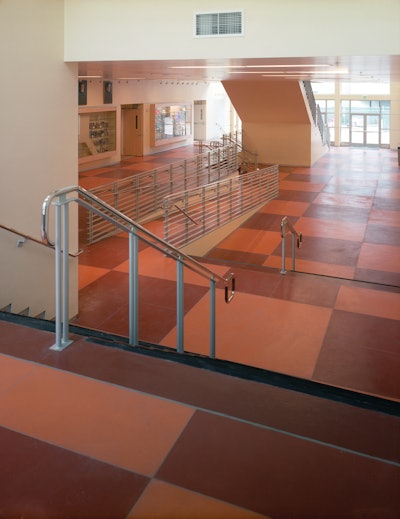
When the residential market is down, some contractors turn to the commercial market. But if a contractor is looking to do interior commercial decorative floors, it's important to know what he or she is getting into. It takes planning, education and communication to create a successful decorative commercial floor. Whether you're a contractor who has done decorative residential floors or you're brand new to the market, the requirements of commercial floors are a whole new ball game.
Preplanning
Communication is the biggest factor when working on a decorative commercial floor. A contractor needs to know what, how and when to communicate and to whom. The contractor needs to know what the owner's expectations are. These expectations need to be conveyed to the contractor's employees. A contractor must also discuss with the owner and general contractor product limitations and jobsite conditions, says Nick Sorrentino, president of Patterned Concrete of Pennsylvania. Discussing the jobsite is especially important so all parties involved know just what the flooring and decorative contractors need to provide the finished product.
Preconstruction meetings are a great place to hold these first conversations. Sorrentino also suggests holding crew meetings throughout the project to assess the job and address any problems or changes that occur. Checking in with the owner, general contractor, subcontractors and suppliers can also help ensure everyone is on the same page throughout the process.
When working on a new slab, the concrete flooring contractor and the decorative contractor need to be sure to communicate. Both contractors, especially the decorative contractor, need to convey their needs to get the most successful finished floor possible. This is especially important when staining the floor, says Chris Klemaske, project developer for T.B. Penick & Sons.
The color of the concrete will affect the reaction and coloring of the stain being applied, Klemaske says. "Darker colored concrete will react darker. Lighter colored concrete will react lighter," she explains. Both contractors should be aware of this before starting.
The concrete flooring contractor should not use magic markers or pencils to mark the slab because this may prevent stain from penetrating the concrete in these areas. They must also make sure the slab is protected from any materials such as paint, oil, etc. Klemaske also says not to leave anything sitting on the slab during the curing process because it will leave a shadow. Stains often do not hide surface imperfections and blemishes - and may even magnify them - so the concrete flooring contractor needs to be particularly careful when finishing the slab to make sure they minimize cracks and trowel marks.
These two contractors must also communicate regarding expansion joints and saw cut patterns. "Commercial projects may require more layout and joint spacing. You need to know where your joints are going before you make the first pour. Things need to be precise," Sorrentino says. To prevent joints from interfering with the decorative aspect of the floor, he suggests trying to design the layout of the joints within the pattern of the floor. If that isn't possible, Klemaske suggests doing the decorative saw cuts at the end because people's eyes will tend to go to those cuts rather than the control joints. If the decorative contractor is doing a saw cut pattern he needs to decide if he wants to do a wet cut or a dry cut, and this needs to be discussed with the flooring contractor.
Contractors must also continue to check in and communicate once the floor is complete to make sure the other trades on the job are not damaging the finished concrete floor.
During planning, contractors should identify the use of the floor and the desired maintenance. This will help determine product choices. If it is a new floor, conditions should be favorable. If it is an existing floor, however, contractors need to be aware of any cracks or failures, says Marshall Barabasch, director of architectural concrete with Peterson Brothers Construction.
Another issue to be aware of is moisture. "You would want to test to make sure you're not getting a lot of water coming through the slab," Barabasch says. If there is a lot of moisture, some sort of moisture block would need to be applied before working on the floor, he adds.
"Samples are critical and need to be done on the actual concrete that's going to be used," Klemaske adds. "We start with small controlled samples, but we always do onsite samples. Whether it's having them set a place aside for us to sample or pouring another piece of concrete when the floor is poured."
Scheduling in commercial flooring can be a challenge. Time lines can be strict as they are driven by the overall project schedule, Barabasch says. Typically, the flooring contractor is coming in near the end of the project, so there may not be much leeway in the time line. Contractors need to be aware of this and also know if any fines will be enforced for going past the deadline.
To prevent delays, contractors need to make sure they have enough product for the job and enough manpower.
Here are some tips:
- Use manufacturer supplied formulas for calculating product quantities and order anywhere from 15 to 30 percent more than needed
- Never figure half bags
- Don't underestimate the amount of material you'll need and never pour more than you can handle
- Call ahead to find a place near the job where you can get more material if needed
- Consider that if you run out of a stain or color it may result in differences in pigmentation between batches
- Always keep data in case you need to return to the job in the future
- Make sure you have at least one person for every aspect of the job and extras if possible
- Always have the right people for each job - stain should be applied by knowledgeable employees whereas general labor may be easier to staff
Equipment & materials
Most contractors agree that materials and equipment for residential decorative floors can be used on commercial floors as well. However, commercial contractors have a few extra factors determining what equipment and products are appropriate for these projects.
"The tools you're going to use are going to be reflective of the job size," Klemaske says. A floor with larger square footage may be easier to complete with larger equipment. However, large equipment may be difficult to maneuver in hallways or a narrow area so it is helpful to have smaller equipment on hand as well, Barabasch adds.
And always be knowledgeable on how the materials work and their limitations, Klemaske says. Contractors need to understand how to apply materials, any environmental factors that may affect the application or success of a product, as well as just understanding the product itself. A great way to do this is through sampling.
If specific materials aren't specified in the project and left to the contractor's discretion, always consider the intended use of the floor and how maintenance may affect the owner's daily operations in order to determine the best product for the owner and the job, Sorrentino says.
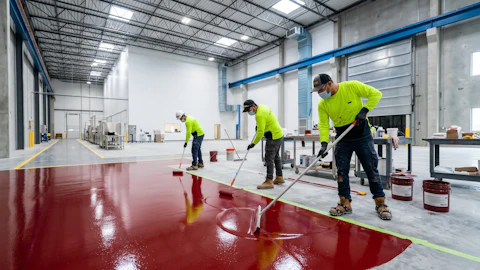
Perhaps the most important material choice is the sealer. Factors to consider when choosing sealer include intended maintenance, VOC requirements, environmental laws and condition of the slab.
Sealers need to stand up to the foot traffic of a commercial floor. A water-based sealer may not last as long as a solvent-based one, Barabasch says. So commercial flooring contractors often use a heavier sealer like a urethane or epoxy, he adds. If you chose a solvent-based sealer be aware of reapplication concerns such as ventilation and off gassing. "Once solvent based is cured out then you're fine," Sorrentino says. "But solvent based has those VOCs that will attach to things, and the smell will linger."
Contractors agree that education, planning and communication are the keys to a successful commercial decorative floor. Barabasch says having knowledgeable employees on hand will help reduce delays if problems arise. Educating the owner about product limitations and proper maintenance also helps to control expectations of the project.