The Colorado Department of Transportation (CDOT) is currently making concrete repairs on C-470 between I-25 and Santa Fe Drive (Denver southwest metro area) as part of an American Recovery and Reinvestment Act (ARRA) project.
The $32 million project will repair nine miles of C-470 with a micro surfacing application followed by a stone matrix asphalt (SMA) overlay. Concrete repairs will also be made along 26 miles of the C-470 bike path between I-25 and I-70.
The project will not only improve the riding surface of C-470 and the bike trail, but will extend the life of the pavement. The multi-modal rehabilitation project is being funded through the ARRA stimulus program and is expected to be completed by June 2010.
The C-470 corridor is the public section of the loop around Denver that is owned and maintained by CDOT. The existing eastbound/westbound road sections under repair consist of two 12-foot wide PCC (Portland cement concrete) travel lanes and 4-foot inside and outside shoulders.
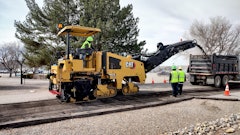
The roadway is subjected to heavy traffic in an area of expansive soil conditions. The combination of traffic and soil conditions has contributed to the deteriorating existing road conditions. Project scope called for replacing damaged concrete sections, milling asphalt patches, milling and paving bridge decks, and then placing a micro surfacing treatment as a leveling course prior to a 2-inch SMA wearing course overlay.
Originally, the micro surfacing solution was intended to fill rutting problems and act as a bond breaker for the SMA overlay.
CDOT soon recognized that the planned 2-inch SMA overlay was not going to improve the ride significantly, so an additional layer of micro surfacing is being placed to improve ride smoothness prior to the SMA placement.
A-1 Chipseal, a full-service asphalt preventive maintenance company located in Denver, is performing the micro surfacing work required on the project.
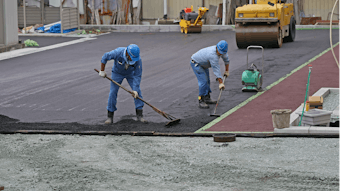
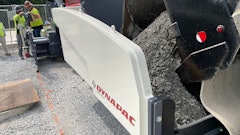
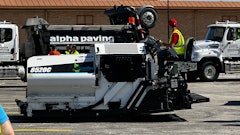
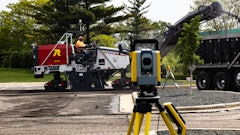
The micro surfacing material is being applied with a Bergkamp M1 continuous paver using 15-foot leveling skis.
"On the first pull (covering one of the 12-foot-wide travel lanes) we used a 12-foot-wide slurry box with a rigid (metal) strike-off (screed) to fill the ruts and improve the overall rideability of the surface," explains Ben Vagher, owner and president of A-1 Chipseal. "We were spreading 30 to 35 pounds of material per square yard to fill the ruts (which in some cases were ½-inch deep) and apply an overall ½-inch film thickness over the entire lane."
To further enhance the ride quality, Vagher's paving crew placed a second ½-inch layer of material using the continuous micro surfacing paver equipped with the skis.
Profile numbers were taken before and after, but at press time the information was not available. However, Vagher and CDOT officials say travelling over the treated sections of roadway versus untreated sections provides a noticeable difference in the ride quality they wanted to achieve with the decision to place an additional micro surfacing layer prior to the SMA overlay.
Project schedule
Crews began on the westbound lanes first this past summer and will continue work on the eastbound lanes when the westbound portion is completed. Throughout the project, work is being performed on the weekends with only one lane of westbound or eastbound C-470 open from 8 p.m. Friday to 5:30 a.m. Monday.
Lane closures are limited to work zones and not the entire project length.
"By working weekends, we can get more work accomplished each weekend than we could in five nights and we improve safety and production," explains CDOT Project Engineer Scott Smith. "We will have crews working night and days over the weekend in order to keep the project moving and get the work accomplished as quickly as possible."
Weekend lane closures will be in place, except holiday weekends, until December 2009 or inclement weather becomes an issue. In either case, the project will shut down for the winter and resume in the spring of 2010 with the same weekend hours.
Major repairs of the C-470 bike trail will likely require weekly closures, with access around the work zones.
Castle Rock Construction Co. of Centennial, CO is the primary contractor for the project, with all repair work on C-470 scheduled to be completed by June 1, 2010.
Sequence of operation
According to Ron Buck, CDOT resident engineer involved with the project, the original 25-year-old concrete roadway, was in desperate need of maintenance due to the heavy traffic load it's experienced over the years.
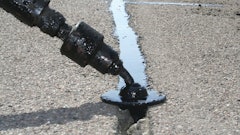
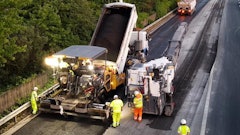
"Traffic levels have increased threefold over what the original design specifications were intended to meet," Buck notes. "The sequence we're following in repairing and improving the overall structure is to remove and patch badly deteriorated slabs of old concrete, seal and repair cracks, fill ruts with micro surfacing material, cover the entire travel lane surface with micro surfacing material, and then overlay the structure with a 2-inch SMA surface course."
When the original estimate was put together, Buck says plans allowed for ¾-inches of micro surfacing covering the old concrete road (1-inch in rutted areas).
The Type III micro surfacing design being used on the C-470 contains aggregate sized from ¼-in. to 3/8-in., with application thickness ranging from 3/8-in. to ½-in.The Type III coarse aggregate mixture is designed to correct severe surface conditions and provide improved skid resistance under heavy traffic loads.
On this particular project, however, improving skid resistance was not an objective; whereas correcting surface conditions of the existing concrete roadway and improving the final ride quality of the SMA wearing course are.
"We designed the mix to fill ruts using a rut box and then come back to place an edge layer over the entire travel lane to serve as a bond breaker for the SMA overlay," explains Dan Quire, account manager for Road Science LLC, supplier of the emulsion mix design and technical service.
Having the budget to achieve further surface enhancements proved beneficial to CDOT's desire to do everything it could to upgrade this particular section of highway.
"With that built into the plan that was approved for funded, we had some leeway to cover additional micro surfacing applications to improve the overall ride quality of the road," Buck says. "We placed a tack coat before placing the micro surfacing lift and again before placing the SMA wearing course to ensure a good bond between multiple layers being placed."
Masoud Ghaeli, CDOT Region 6 materials engineer, agrees with the solution to structure and ride improvements
"After analyzing the existing road structure conditions and the traffic volume the road needed to support, we determined asphalt to be the best approach," Ghaeli says. "Using the micro surfacing paving approach, we're able to fill the ruts and provide a leveling course as well. Applying more than one coat of micro surfacing layer is helping to achieve a smoother ride with the final SMA overlay. And, we hope the extra micro surfacing will help retard reflective cracking from the concrete joints."
A-1's portion of the project represents approximately $4 million. When the project is completed, A-1 will place approximately a half million square yards of the Type III micro surfacing slurry over the 36 lane miles and adjacent shoulders.
"We've completed about 25% of the work we need to do and we'll be back on the project in the spring to finish the work," Vagher says. "It's our first micro surfacing project and we're pleased with the way it's turning out."
In all, Colorado will receive more than $400 million for transportation projects and $103 million for transit projects under the ARRA stimulus program. For more information about how Colorado is putting the recovery act to work, visit www.colorado.gov/recovery. For a list of CDOT's Recovery Act projects, visit www.dot.state.co.us/arra.