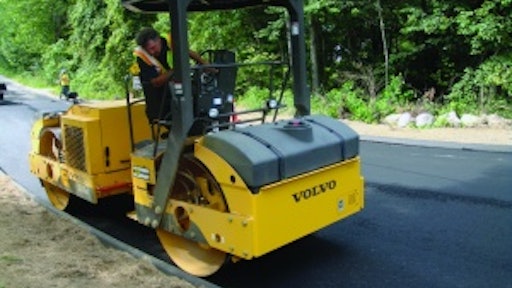
It's certainly arguable but the case can be made that the roller operator is the most important member of the paving crew. Why? Because he is the person who puts the finishing touch on all the preparation and paving work that went before him, and he is the person who makes sure the paving contractor gets paid (and in some cases how much the contractor gets paid).
One contractor I work with describes the roller operator's job in his employee manual, saying the roller operator is "?responsible to achieve a quality finished product with special attention to meeting the compaction and aesthetic requirements of the job." That about sums it up. He is responsible for achieving density requirements on jobs that have them, ride specs on jobs that have those, and he's responsible for a smooth and line-free mat as well as basic hot mix asphalt compaction requirements on every job the paving contractor does.
At the same time the paving crew has to realize the roller operator is not a miracle worker. He can't fix problems caused in laydown and he can't repair defects caused, for example, by a damaged screed. If the mat is not laid properly or if the screed has lines in it, for example, the roller operator is not going to be able to fix that. He can only provide a good finish to what he's given, and that's all a good roller operator wants: the best opportunity to provide the best finish.
Rolling over the years
The "old timer" roller operators used to say they could feel everything they needed to know about the mat and their job through the seat of the roller. And there might have been some truth to that given that the seats were steel and the rollers themselves were unsophisticated pieces of equipment with no bells or whistles to make them easier to use, more comfortable to operate, or more effective in the asphalt mat.
But it's not true anymore. Today's rollers are very comfortable, with seats and operators "isolated" from the machine, and they have become very sophisticated with joystick controls, fine-tuned steering, articulation, and any number of gauges and dials operators can use to make their job easier and help them perform better.
Today's roller operator needs to be able to roll by more than just the seat of his pants. So today's roller operator needs to have a complete understanding of the piece of equipment he's using, the gauges he can follow, as well as what the roller can and cannot be expected to do.
Gauges are a perfect example. Years ago roller operators would guess at their speed, often by eyeballing the distance between the roller and the paver and trying to maintain that distance. But today's rollers offer miles-per-hour or feet-per-minute gauges that tell the operator exactly how fast he's moving. That's important because the operator wants to move evenly over the mat, maintaining the same speed up, the same speed back, the same speed up, and the same speed back, to provide even compaction, and the gauges make it easier to do that. Keeping an eye on those gauges makes it easier to stay consistent.
What a roller operator needs to know
Just like the paver operator and the back-end operators, the roller operator needs to know all the details about the job. He obviously needs to understand basic rolling and compaction concepts, but that's just the start.
He needs to know where paving will start, how it's going to proceed, what position he's rolling in (breakdown, intermediate, finishing) and the responsibilities for that position. Mix information is also crucial. What kind of mix design is the job using? What is mix temperature (and air temperature)? What size mix is it (3/8 in. on a driveway or 3/4 in. on a highway)? Is it a more stringent mix? Is it a tender mix? What is the mat thickness? Is there a crown? What are compaction and density requirements? What is the speed and width of the paving?
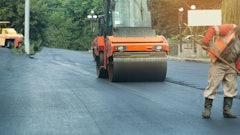
Once the roller operator has the answers to these and similar questions he can begin to plan how to get the job done. Once he knows the width of the mat, for example, he can figure out how many rolling passes he'll need based on the width of his drum. A 12-ft. paving pass, for example, is 144 in. across. If the operator is using a roller 66-in. wide he's going to need to go across three times to make sure to cover that mat. If he has an 86-in. roller he can do it in two passes, so the width of the mat and the width of the roller are essential in determining the number of passes and the rolling pattern for the job.
Two of the most important factors for the roller operator are time to the paver (and back) and the temperature of the mix and air. We used to refer to this as the "rolling zone" but now we call it the "temperature zone" of the mat. By knowing the mix temperature and the air temperature the operator can determine how much time he has to roll the mat before it gets too cold and he can't achieve proper compaction.
This is where a temperature gun comes in, and every crew, every roller operator, should have and should use his own gun. Even though these temperature guns only show the surface temperature (and even though it's only a ballpark figure) the gun gives the operator an idea of where he's at on compaction. As he becomes more experienced as an operator he will learn what that gun is telling him about the mat and what he needs to be doing to complete the rolling process effectively.
It's also important to know how much water (in gallons) the roller holds. This might not seem significant but here's why it is: How many gallons the roller holds determines who long before the operator has to go fill it up. It's a time issue. The operator wants to make sure he fills it at the right time, that he has the water truck right there when he's ready to fill so he doesn't delay the paver and so the paver doesn't have to stop. If the roller runs out of water the paver has to stop or it will get too far ahead and then the roller operator won't be able to achieve the necessary compaction and density once he starts back up.
The same goes for fuel. The roller operator would hate to run out of fuel on a pavement because if he does it could take 15-20 minutes to get the roller filled and restarted. Time is money on a paving job, so check the fuel tank and know how long the roller can run on a full tank.
Who can be a roller operator?
But the roller operator is not just going to roll, either; he's also going to have to be able to pitch in and pick up a shovel, rake, lute, use a plate compactor, and handle a maul or tamp shoes when the need arises because he's not always going to be sitting up above everyone, looking over the field. In fact, a successful roller operator is more than just a professional roller operator; he's a jack of all trades.
And that shouldn't be a problem for him because the roller operator will usually come from the crew of laborers. It's the first step up for people who want to be promoted in a paving crew, so it is open to any worker who has done well on the shoveling, luting, and raking part of the job and who is developing an understanding of how a finished pavement is supposed to look.
He is someone who is getting a good understanding of the overall paving process because the type of mix, thickness of mat, temperature of the air, speed of the paver and roller, and pattern of rolling all affect how he does his job. The roller operator needs to be more than aware of all these factors, he has to understand them and understand how they influence what he does.
And he needs to be paying constant close attention to what's going on with the mat. An applicant for roller operator needs to be quick to spot defects or potential problems, quick to know how to fix them, and quick to act to fix them. Why? Because when operating the roller he's not just out there rolling along, relaxing in the sun. He's looking at the mat to make sure there's no shoving, no checking, and that the mat's not cracking. He's inspecting the mat on each and every pass because only by keeping a close eye on the mat can the operator tell that the mat depth hasn't changed, that the temperature is where it should be, and that the mat's staying consistent. The roller operator is always inspecting and looking for imperfections.
The roller operator also has to be vigilant. Even with flashing strobes and backup alarms crew members (or worse, the public) can easily get in the path of the roller so the operator needs to constantly be aware of what's going on around him.
Laborers learning the roller operator skill set should never learn in the breakdown phase of rolling. This first phase, when the roller is on the mat at its hottest, is crucial to effective compaction and attaining proper density so the breakdown phase should be the responsibility of an experienced roller operator.
Many contractors train their roller operators on compacting aggregate, giving them a feel for the roller and an opportunity to learn how it handles before moving over to asphalt. This is a good idea if you have that type of work available to you because the new operator can train without affecting the quality of the mat. (Rollers, however, should never be used on both aggregate and asphalt. Rollers used on stone end up with drums that are scratched and pitted and if the same roller is used on an asphalt mat the drum will leave those imperfections in the asphalt mat.)
If a gravel base is not available for training then roller operators should train on the finishing phase of rolling or possibly the intermediate phase. It takes as much as 18 months before a roller operator will learn what he needs to know and spends a lot of time on a variety of different jobs, to get to know how to handle the roller in all sorts of different jobs and mixes and conditions.
And if the roller operator wants to move on in the paving crew, the back-end operator or paver operator are the next logical steps.
The finishing touch
Compaction is the final accomplishment at the end of the day. Once the rest of the crew has done their jobs the roller operator takes all the lines out, makes sure the water drains properly, and rolls the joints as seamlessly as possible.
Then he needs to pull his roller off to the side, climb down and take a good look, making sure there are no stop marks, no lines, no joint marks, and that the finished asphalt mat looks like a black carpet.
If at the end of the day the roller operator walks around and knows that parking lot represents the best that he can do, that's what the contractor is going to get paid for.
John Ball is president of Top Quality Paving, P.O. Box 4398, Manchester, NH 03108. Reach him at [email protected] or attend his paving seminars and workshop at National Pavement Expo West, Dec. 3-5 in Las Vegas, or National Pavement Expo, Jan. 20-23, 2010 in Nashville, TN. For more information visit www.nationalpavementexpo.com.