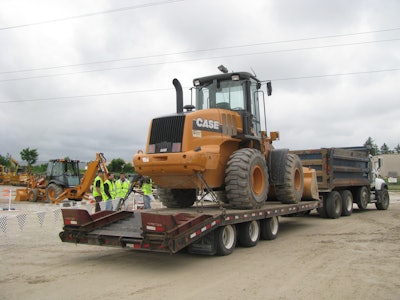
As an owner, manager or driver, you are responsible for the load on your trailer. It's as simple as that.
"It's your responsibility to tie down your load properly, securely and legally," says Jim Ladner, national sales manager, Landoll Trailers. "When you transport equipment, you accept the responsibility for any accident that may occur on your site, at a customer's site or on a public highway."
Yet, there can be many factors that distract you from properly securing a load. Maybe it's raining, it's cold or you're only moving that excavator a few miles down the road. But while you may be anxious to get done in a hurry, you are responsible for the lives and safety of the people in the immediate area, says John DeGeorge, national sales manager, Eager Beaver Trailers. "So slow down and take the time to load equipment safely," he says.
Know the limits
Securement specifics will be different for each piece of equipment you haul. But in general, there are certain factors to consider to safely and legally tie down equipment.
For starters, you need to know the load rating of the trailer and the weight of the equipment you're moving. The load rating can be found on the trailer identification plate or in the operator's manual. Equipment weight can be obtained by running it over a certified scale or referencing the owner's manual.
This information is needed to ensure you fall under the legal load limit, which is 80,000 lbs. in most states. Heavier loads, as well as those that are physically oversized (over-dimensional loads), will require specialized trailers and permits.
It's also needed to ensure you don't overload the trailer or any of its individual axles, which can cause a number of problems. Overloading the trailer can cause tire damage, as well as premature axle and bearing failure. Plus, it can seriously affect acceleration, braking and handling. Overloading the axles can result in heavy fines for carrying too much weight. State and local regulations can be more restrictive than those at the federal level, so make sure you know the rules and regulations for all the areas into which you're traveling.
"The best way to avoid overloading a trailer is to use a trailer with a capacity that is more than the weight of your equipment plus the weight of the trailer," says Shane Zeppelin, marketing manager at Towmaster Trailers. "If you're close to the maximum trailer capacity with your equipment, get the next heavier capacity trailer to make sure you stay under the rated GVWR."
The Federal Motor Carrier Regulations' Aggregate Working Load Limit also uses equipment weight to identify the number of tie downs needed, as well as their capacity. The basic requirement is that tie downs must have a combined strength equal to at least 50% of the load being secured.
For example, if you're hauling a 20,000-lb. backhoe-loader, you need chains that can support a minimum of 10,000 lbs. A 3/8-in. grade 70 chain has a rated capacity of 6,600 lbs. Because this would be divided by two according to the load limit calculation, you would need four 3/8-in. chains to properly secure the machine. If you're hauling a 40,000-lb. excavator, you would need to either add more chains or upgrade to 1/2-in. chain for greater capacity.
Inspect chains before each use and remove from service any with cracked, stretched or fatigued links. Also make sure any tie-down points, binders, hooks and clevis pins meet capacity regulations. "A chain that can handle 6,600 lbs. means nothing if the binder can only accommodate 3,300 lbs.," says DeGeorge.
To keep the system strong during the entire transport process, you should periodically pull over to check the load. Chains and straps have a tendency to shift and stretch, so it's a good practice to stop a short distance down the road, pull over and reinspect all of the straps and chains. Retighten them if necessary, then reinspect them every time you stop for a break.
Understand weight distribution
Once you determine capacities, you need to consider how and where to place the load.
"There are road rules and regulations that tell you what the trailer axles can weigh loaded and what the truck can weigh," says Ladner. "If you're overloaded on the trailer, but not on the truck, you will need to move the load forward and equalize the load between them, then secure the load."
Also consider weight distribution over the axles. "It is important to keep loads placed so weight is distributed evenly between the semi-tractor drive axles and the trailer axles," says Brent Hohman, Western sales manager, Trail-Eze Trailers.
Too much weight on the front affects steering and can make it unresponsive, DeGeorge explains. Too much on the back affects braking and decreases traction, in addition to affecting steering.
Also keep in mind that construction equipment has varying counter balances and centers of gravity. For example, a dozer, which has its heaviest part to the rear, is typically driven onto a trailer, while an excavator is usually backed on.
"Properly distributing the weight of your equipment on a trailer assures that it pulls correctly," says Zeppelin. "The trailer could 'fishtail' if the weight is not distributed properly; and the vehicle will not be able to control it very well.
"The best way to determine if the load is properly distributed is to look at the suspension and make sure it is equal all around," he continues. "You can also check to see if the tow vehicle suspension is overly compressed and move the load accordingly."
Avoid damage during tie down
To minimize damage to the equipment you're loading, pay attention to securement points located on the machine.
"It's more than simply running a chain through a D-link on the trailer and hooking it to a backhoe," says Ladner. "On trailers, it might be easy to identify where to tie equipment. On equipment, it can be more difficult. If you're not careful, you could end up damaging your equipment."
For example, if you improperly tie the front axle of a backhoe, you can accidently encompass the tie rod. "If you bend it, steering could be affected," says Ladner. "Or if equipment is secured from underneath, and you didn't notice a chain rubbing against a hydraulic hose, you could rub a hole in it and that loss of oil would be a problem."
Also consider tie-down angles. The best angle is 45°, because it gives the chain the opportunity to perform to its maximum designed working load. "Chain that is flat doesn't offer as much strength," says Ladner. "It may prevent the load from moving sideways. But when you're at 45°, you're also pulling the load down to the trailer and getting a clamping action, rather than just preventing it from sliding."