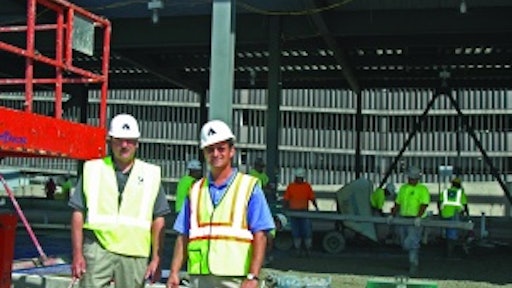
Albanelli Cement Contractors is a family business. President Paul Albanelli runs the company with his first cousin, Vice President Wayne Albanelli. Their fathers and grandfather started the company in 1950 as residential concrete contractors. The company changed over the years, with the Albanellis getting into light commercial work in the 1960s, working on grocery stores, gas stations and the like.
Paul and Wayne got their first taste of the family business in the field around the age of 13. After college in the 1980s, both men became more heavily involved with the operations of the business and eventually took over the company in 1993. They maintained the overall feel of the family-owned business, but made a few subtle changes that made it a more professional organization. "One thing about our fathers' business was they had only a few customers, and when those customers were slow, they were slow," Paul explains. "When we came in we increased our customer base so through our growth period never more than 18 percent of business was with one customer. And we try to keep it that way today."
Paul explains that in his father and uncle's day, safety was "unheard of." He and Wayne have made a major commitment to safety in their organization, one of the characteristics of their company they believe sets them apart from their competition. "Even though we're small, I like to think we're big on safety, training, customer service, and material and equipment technology. We can't afford to buy all the equipment technology out there, but we know about it and who has it in case we need it," Paul says.
Paul and Wayne led the company through roughly 20 years of expansion from the early 1980s to the early 2000s. In the late 1990s, the auto companies were booming and fueling a need for hospitals, schools and other commercial and public building projects. But the economy in the Detroit area has been on a slow decline over the last six years, Paul explains. "We didn't see a sharp drop off like the people in New York or Arizona saw," he says. "We've been riding the toboggan downhill for a while."
Despite the slow decline in the Detroit market, Albanelli Cement Contractors was able to stay strong in the commercial realm with its peak year occurring in 2007. But the economy has changed things drastically for the company since then. Albanelli Cement Contractors typically delivered 50 building projects a year; as of the end of July 2009, they've completed only five. Ten years ago they saw one or two bids per job, and now they're competing against 15 to 20 other contractors for some projects. The company's annual sales for 2009 will be 50 percent off from its peak in 2007, and they've gone from a full-time field staff of nearly 50 workers down to 30 people working on an as-needed basis.
Moving outside the zone
Contractors all over the country are seeing their markets change, with jobs harder to come by and bidding more competitive. In order to keep the lights on and their workers in the field, Albanelli Cement Contractors has made a push outside its normal areas of work to seek out jobs it wouldn't typically take. "A lot of the jobs we're doing right now we wouldn't have looked at in 2007, but now they're like jewels," Paul explains.
Paul says about 70 percent of the company's current job lineup is of a non-typical type to the company. Jobs like renovation, municipal projects like parks and river walks, and lots of work in decorative concrete.
"Since no one is building buildings, people are trying to get into other areas," he explains. "We started looking at jobs in the road builders' realm. We don't like to go there, but we will."
While new building isn't a booming market, renovation is more prominent. "There is a lot of vacant space that needs to be absorbed before building comes back," Paul says. "We've done some refurbishment jobs, where they take a store, rip out the floor and put in a Whole Foods or something similar. We'll see a lot of that, especially in Michigan."
Albanelli has also found its prior experience in decorative concrete - something its crews were doing more regularly 10 years ago - has helped the company land a number of jobs in recent months. "Decorative concrete was typically 5 percent of our sales, even less of a percentage of our profits and about 90 percent of our headaches, specifically in the residential realm, so we sort of dropped out of that market for a while," Paul explains. "But now we're back, doing projects we wouldn't normally do."
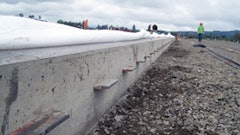
A good example of a non-typical job Albanelli has taken on is a 1 mile extension of the M-5 highway in northern Detroit. Albanelli is on the job as a third-tier subcontractor, installing sidewalks, handicap ramps, truck aprons on roundabouts and stamped concrete. The project will keep an Albanelli crew busy for about two months.
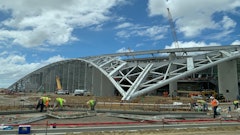
Another project the company is working on is a cruise ship dock for the Detroit River Port Authority. Along the Detroit River in downtown Detroit, in the shadows of GM headquarters and across the river from Windsor, Ontario, Canada, Albanelli's crews are installing the site concrete, slabs on grade, second-story slab on deck and colored concrete paving on the riverwalk. The city is working to beautify many areas of the riverwalk. Albanelli was involved with several beautification projects in the area and has secured the contract for the first section of the Dequindre Trail which will connect the city's neighborhoods with the riverwalk.
An upcoming job the company is excited about is its first project funded by the American Recovery & Reinvestment Act. Albanelli will be working as a subcontractor installing stamped concrete work on 38,600 square feet of median along the 1.4 mile project.
Another step the company is taking that it never imagined it would two years ago is it's looking beyond state borders. "When the market was good we were a little spoiled and didn't need to travel," Wayne says. "Now we keep looking for out-of-state opportunities; we're being forced to travel. But we're a proactive company, and we're going to travel before we sit here and wait for the phone to ring."
For Albanelli Cement Contractors, concrete work is concrete work. The company has talented crews to handle any concrete project thrown their way. But Wayne says when it comes to landing a job and following through with it, municipal projects can be far more challenging on the paperwork side. "There is a lot more paperwork for government projects," he says. "You'll hear people talk about the 'transparency' of the work - the certified payrolls, labor rates and the fact that they tell you what percentage you can make on a project." And the additional managerial demands don't equate to higher profits.
For all projects the company is currently going after, Paul and Wayne say they see competitive bidding with very little room for negotiating. And owner expectation has been increasing over the years. "The pressure on owner's reps is intense," Paul says. "They're constantly raising the bar to get projects cheaper, faster and better. And you have to try to keep up, or you won't be around anymore."
Gearing up for the future
The Albanellis know this market will turn around, and they strive to remain ready for that shift when it happens. Paul predicts the next building boom will drive a wave of technology throughout the construction industry. Growth will create a need for new efficiencies such as an increase in GPS paving and grading and more work with laser screeds.
"This isn't the shovel and rake industry it was when our fathers were around," he says. "The technology is there and the youth coming into the industry are drawn to that. I have a feeling the 2D blueprints that I grew up with will become obsolete in the next building boom. We'll still have shovels and rakes, but BIM (Building Information Modeling) is coming. I know we will have to embrace it for us to compete in the future."
Albanelli has already brought some of these technologies into the company, especially in regards to the work that is done before construction starts. The company's estimating department uses digitizers and BidScreen on-screen take off system for electronic take-off, and the entire bidding process is going paperless.
"Everything is going online," says Nick Silveri, estimator for Albanelli Cement Contractors. "We don't see blueprints anymore, nor do we see a lot of full-sized drawings. All our general contractors and construction managers have Web sites we pull drawings from. That keeps me in the office more, and allows us to bid more projects than we used to."
Aside from the technology Paul expects will expand when the market swings back, he sees opportunities for contractors in the current pool of workers. "There is a huge glut of talented people looking for work. If your company is the first out of the gate to pick them up when the market comes back, you'll be in a much better position than your competitors," he says.
Despite the changes the economy has forced upon Albanelli Cement Contractors, the company is adapting to the market and is always prepared for the future. "Even with all our economic problems, the Detroit metro area is still the 11th largest city in the United States," Wayne says. "There's a lot going on here, so when the economy comes back we want to be ready to hit the ground running."