
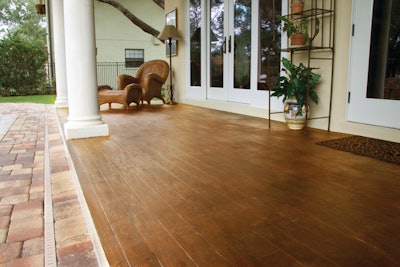
Contractors have two options to choose from when it comes to sealers: penetrating and non penetrating (or topical). A topical sealer resides on the top of the concrete, often producing a shiny look. A penetrating sealer penetrates into the concrete to help protect it. Unlike topical sealers which enhance colors, a penetrating sealer darkens the color of the concrete. This is an important fact to share with a customer so he or she is not surprised if the color of the stain changes.
McKinnon Materials' Product Specialist Glen O'Steen, or Buster as he is known throughout the industry, says he uses penetrating sealers exclusively for outdoor projects. "Anything that penetrates is going to have a lot less likelihood of having a bond failure," O'Steen says. "Moisture is being sucked down into the concrete. And if that moisture is a sealer, once it's sucked into the surface then it polymerizes and turns hard, creating a good adhesion to the surface."
Topical sealers may have the tendency to be slipperier, so many manufacturers suggest a penetrating sealer for all outdoor decorative concrete, especially areas that may get wet.
O'Steen points out sealers have different hardness factors, which also needs to be considered. "The harder a sealer is, the slipperier it will be," O'Steen says.
With VOC requirements becoming stricter, some contractors are moving toward water-based sealers only. Water-based sealers allow the concrete to breath rather than trapping in all the moisture, says Jerry Bodie of Surebond. Another sealer option that works well in the outdoors is an epoxy-modified sealer, Bodie adds.
Not only do contractors have a choice of penetrating and topical sealers, but they also have to choose between types of sealers including acrylic, urethane or epoxy sealers. Before choosing, manufacturers suggest asking questions to determine which sealer will hold up best for the job.
For example, O'Steen suggests a urethane sealer for countertops because of its FDA approval for food contact. Plus it's easy to clean and doesn't trap contaminants. The amount and type of traffic (foot or vehicular) the concrete will be subjected to will require a certain degree of sealer durability. And whether the concrete will be near a pool should be considered since water affects decorative concrete in multiple ways.
First, water can make decorative concrete slippery. To combat this, many contractors add a non-skid additive to the sealer. A non-skid additive offers a slight variation in the surface breaking the surface tension so when it becomes wet a person's foot is not completely flat against the concrete. It also creates a rough surface to allow for more grip. Non-skid additives can be incorporated into the sealer or broadcast over it.
Hard water, or untreated water, can also damage colored concrete. "Hard water deposits probably are just as bad as the worst of UV rays because the water will sit on the surface and the sun bakes it in," Bodie says. "The concrete is going to turn white in these spots."
Application
Techniques for outdoor sealer application differ from indoor applications. Things to consider include size of the job, whether it's a solvent- or a water-based sealer, and environmental factors such as temperature and wind.
Sprayers are the best tool for application. For solvents, Bodie suggests an airless sprayer. For large jobs, O'Steen says high pressure spray equipment works great. If you're using a pressured sprayer make sure to always keep the pressure up to ensure even coverage. And if it's windy, be careful to watch where your overspray is going so property does not get damaged. Or better, don't spray sealer on a windy day if you don't have to.
Sealer can be applied on smaller areas using a roller. "If you are going to use a roller go at a different angle with the second coat to guarantee coverage and hide roller lines," Bodie says.
Bodie suggests applying sealer in thin coats, and says to never over apply. Over application wastes product and increases the chance of failure. Plus, the more sealer applied the more build-up results creating a smoother surface that prevents water penetration increasing the chance for a slippery surface.
Temperature affects sealer application as well. Hot temperatures result in even hotter concrete which will dry a sealer too quickly. Bodie warns against sealing in temperatures above 95 degrees Fahrenheit.
Even with proper application sealers will not last forever. If using a topical sealer, it will be easier to see where the sealer has worn. Typically, heavily trafficked spots of the concrete wear faster. But just because a sealer is no longer shiny doesn't mean it has completely worn off. And a penetrating sealer won't have any shine at all. A simple water test can also be done, Bodie says. If you drop water onto the concrete and it darkens the concrete then the sealer has worn and needs reapplying, he says.
Be cautious when resealing. Reapplying too many times again causes build-up. After a few reapplications it may be best to strip the existing sealer before resealing.
One final consideration Bodie suggests is educating homeowners and encouraging them to share that information with future homeowners. Homeowners should know proper maintenance and contractors should be available to answer any questions for current and future homeowners.