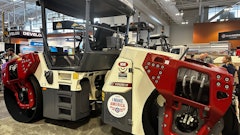
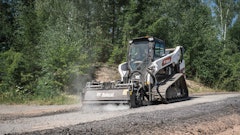
Pavement milling machines, often referred to as cold planers, initially made their mark in pavement rehab and overlay jobs that involved milling up relatively straight miles of street and highway pavement.
But following the market's acceptance of that process, and combined with the rising costs of labor and paving materials, manufacturers of milling machines have developed milling machines that are accessible to contractors of virtually any size. These machines are smaller than their main line milling big brothers but equally adept at providing the pavement milling work that is now much in demand by contractors involved in a variety of pavement repair, pavement rehabilitation, and paving projects.
"These types of mills can be used on parking lots, shoulder repairs, cut outs, utility trenches, bridge deck repairs, and a lot of other jobs where a large mill just won't work," says John Hood, product development and sales manager for paving and milling at BOMAG Americas Inc. "They can be very valuable pieces of equipment, and we are seeing them used increasingly for work traditionally done by several laborers and small equipment."
Here's a sampling of what's available for contractors.
"In-between" machine: Wirtgen America's W150
Marketed as "the largest small milling machine," Wirtgen's W150 fits neatly in the gap between its W100F and W1900, according to Jeff Wiley, Wirtgen senior vice president of sales and marketing.
"This mill is ideal for jobs ranging from trench cuts and parking lot profiling to full-blown milling of pavement where production rates are key," Wiley says. "It's aimed at contractors who are just getting into milling, and it's a great machine for contractors who already run milling machines and are looking for a mill to complement that fleet. The flexibility and economics of this machine do that. It's an in-between machine that fits in a number of different spots and a number of different uses."
Introduced to the market 18 months ago, the W150 is a 370-hp mill with a 5-ft., center-mounted drum that can cut to 13 in. deep. It features Wirtgen's Flexible Cutting System, enabling it to use drums of 2-, 3-, and 4-ft. widths, and its transport weight of 41,226 lbs. means it's easy to transport from job to job without permits.
Other features include:
- Level Pro grade control system provides simultaneous display for both sides of the machine and provides for automatic adjustment of grade and slope
- Control panel with digital readout can be operated with one hand, and targeted and actual values for the milling operation are displayed continuously
- Automatic track tensioning performed hydraulically
Wiley says the W150 offers high production on jobs that need it, but he adds that several systems and design aspects make it a versatile machine that can be used in restricted areas as well. He says the W150 has large steering angles and an automatic all-track steering system that coordinates the front and rear axle steering angles for accurate milling, even in narrow turns and on curves. A "crab steering" system enables the operator to move the machine into an area to be milled without complex and time-consuming maneuvering
In addition, front and rear tracks are hydraulically adjustable for height, what Wirtgen terms its "4 Fold Height Adjustment System." With this system the W150 can rise above obstacles, and also enables the machine to adjust to changing ground levels without manual adjustment.
In addition, a "wasp waist" design, which is the unit's narrow central chassis, enables the operator to have an unobstructed and easy view of the milling edge, even while seated, which Wiley says makes work easier for the operator and results in a better quality job.
Wiley says its design enables safe and efficient operation by a single person.
"Larger half-lane machines should have a ground man because the operator can't see all around the machine so you need a person on the ground for support and safety," Wiley says. "Because of the way the W150 is designed you can actually run it without a ground man."
"Swiss Army Knife" of mills: BOMAG Americas' 1300
BOMAG America's John Hood says contractors always want to know how often they have to keep the mill working to make owning it worthwhile.
"That's a tough question to answer because every market's different. But as a general rule we talk about rental rates on milling machines and it's tough to get a guy to come out and mill all day long for less than about $4,500 a day," Hood says. "If you do that three times a month, that's $13,500 a month. That way more than covers the payment, operating costs, and labor involved with owning a mill. That's working just three days a month."
So Hood, who says the biggest barrier to milling equipment sales today is "future utilization," says contractors concerned about that haven't fully thought through the benefits of milling.
Take BOMAG's 1300 mill, for example, part of BOMAG's 30 Class frame size of mills which includes the 1000 and 1200 models (the only difference is the width of the milling drum, which is 1, 1.2 or 1.3 meters). Often referred to as a utility mill, the 1300 is a 280-hp, 40,000-lb. machine with a 1.3-meter drum that cuts from 0 to 12 in. deep, and four tracks. A folding conveyor is standard, which makes it easy to move the equipment from site to site - an important consideration for a mill that can perform on a variety of jobs from shoulder repairs to parking lot milling, bridge deck repair, and pavement profiling.
"That's why we refer to it as a little Swiss Army Knife of mills," Hood says. "You can take your crew out there and you can saw cut and excavate the traditional way - or you can use a mill instead. We're seeing a pretty strong uptick in that kind of work because of the labor involved. It doesn't take long to override the cost of utilizing this piece of equipment, and by the time you saw cut and excavate the milling machine can be 10 times faster.
Other features include:
- Simple operator control station enabling the operator to sit right above the drum and look out over the drum and over the entire jobsite
- Standard grade and slope controls to control depth and slope of milling automatically. Hood says Bomag integrates its controls into all its mills, making it easy to program and teach someone to use in an hour or less
Hood says one of the most important features of the 1300 is its operator-selected coordinated steering system that enables the operator to steer using the front two tracks, the rear two tracks, or all four tracks simultaneously
"Any time you're milling a straight line it's pretty simple, but when you are milling on a radius, such as in a cul-de-sac where you need to maintain a curve, that can prove difficult if your machine only steers with two tracks. It can be hard to maintain that curve without getting off track," Hood says. "With the 1300 the operator can decide which steering approach he wants to take for each job and can use all four for coordinated steering to help keep the machine in line."
The 1300 also features a center-mounted drop, just like BOMAG's main line mills, and Hood says there's a specific reason for that.
"We apply the same operating principles and technology throughout our entire line, so if you use a small BOMAG mill you can get on a half-lane mill and be running it within 15 minutes," Hood says. "If you are using any one of our milling machines you can easily use another one."
Size, versatility, and power: Roadtec's X500
Another versatile mill is Roadtec's X500, a 600-hp machine that is the company's most-popular model according to John Irvine, Roadtec's vice president of sales and marketing.
"This smaller mill with its high horsepower makes it a versatile piece of equipment," Irvine says.
Available in four-track or three-track models (Irvine says Roadtec is the only manufacturer to offer both designs), the X500 allows cutting up to 13 in. deep with drums of 6-ft., 3-in.; 6-ft. 7-in; or 7-ft. 2-in. widths. Transport weight for the four-track model with the 6-ft., 3-in. drum is 49,850 lbs; transport weight for the three-track machine with the same drum is 48,720 lbs. Both units offer a tight turning radius, 5 ft., 8 in. for the more maneuverable three-track machine and 6 ft., 8 in. for the four-track machine, and both offer a right-hand flush cut.
Other X500 features include:
- A Variable Cutting System (VCS) on its four-track models so contractors can change out the drum to make 2-, 3-, or 4-ft. cuts. Roadtec also rents the VCS system.
- Forward and reverse milling so contractors can pulverize pavement
- Grade and slope controls, which are increasingly important as milling for smoothness and profile is in demand
- Two conveyors: A primary conveyor that takes the material out of the drum to the secondary conveyor; a secondary conveyor, which offers a 60-degree swing on either side, loads the material into the truck.
Irvine says that 80% of the 500 class units Roadtec sells are four-track machines, but interestingly about 90% of the largest milling machines the company sells are three-track models.
"The three-track is very popular on the large machine," Irvine says. "A lot of asphalt paving contractors who own the 500 and who aren't as familiar with milling are sold on the fact that you have to have four tracks to have more stability."
Irvine says many contractors just getting involved in milling prefer the four-track machine because they've been conditioned to think the four tracks are more stable than three.
"They don't want it to tip, and they think the four tracks will prevent that," he says. "But often a four-track machine will tip because one of the tracks is up in the air and the operator doesn't realize it. You can't do that with a three-track machine because all three tracks are always on the ground."
But he adds that contractors who use the mill on parking lots are often working on thinner asphalt pavements. "In those cases the fourth track, which provides greater flotation, is an advantage so the contractor doesn't crack the pavement.
"It's our best seller because it's a well-rounded piece of equipment," Irvine says, adding that the high horsepower enables a contractor to use it on larger jobs such as county roads and suburban streets, as well as smaller jobs such as trench milling and parking lots.
Plus, the reduced weight enables the contractor to move it more easily and without extensive permitting required by heavier pieces of equipment.
"Large contractors employ people to handle the permitting for them, but the smaller guys have to do it all themselves so any equipment that doesn't require extensive permitting is a real help to a contractor, especially to the smaller guys," Irvine says.
And Irvine says that's especially important with the X500 which, because of its weight, high horsepower, and versatility, can be used on several jobs in a day.
"So it's easy to move from job to job, and with the high horsepower you can do a variety of different jobs where the job or depth of the asphalt is big or small," he says. "It's a nice light machine that you can get a blanket permit to go wherever they want to go."
Utility mill: Volvo's MW500
Launched in the spring of this year, Volvo's MW500 utility mill has been well received by contractors, according to Patrick Wakefield, Volvo Construction Equipment's road segment manager for milling. The MW500 is a rubber-tired machine with four tires as opposed to a track unit. Its 20,062-lb. operating weight includes the optional conveyor which adjusts up, down, and up to 25 degrees to each side and features a quick disconnect. A 20-in. drum mounted in the rear of the unit mills to 8.3 in. deep, and a 158.5-gal. water tank feeds the spray bar in the drum housing, cooling, and cleaning the teeth and reducing dust.
"What the contractor is looking for in this class is maneuverability and versatility," Wakefield says. "Contractors use the MW500 a lot for patching, work on city streets, in alleys, and cutting joints in larger roadways; a lot of jobs where you need maneuverability. You can get a good tight radius with this machine."
Wakefield says the MW500's turning radius of just under 8 in. enables the mill to cut around manhole covers and other obstacles, so it's often used behind half-lane milling machines to reduce the amount of handwork, such as jack hammering, that might otherwise be required. When flush cutting is required the unit's right rear support leg and wheel can be swiveled inboard, allowing the MW500 to get closer to curbs and walls.
Wakefield says that mills in this class are either 3-wheel or 4-wheel units, and Volvo opted for the four-wheel design.
"Volvo is very safety conscious so we wanted to give the contractor the stability of four wheels on the ground. And we are able to do that while still providing a similar turning radius with our four-wheel machine as the three-wheel machines on the market," Wakefield says.
The MW500 also features Volvo's patented Line Manager System which helps the operator steer in a straight line. This system, in conjunction with the unit's anti-slip control and all-wheel drive, compensates for machine drift caused by the rotation of the cutting drum.
"The drum turns opposite the direction of machine travel and is offset to the right hand side of the machine. The line manager system adjusts the power to the wheel motors to compensate for the drum's effect on steering," Wakefield says. "Not only does this help keep a straight line but it also helps reduce operator fatigue because he's not fighting the steering wheel all day long."
In addition to the line manager system the MW500 features an operator control system that includes a large color display screen mounted in the operator control panel to provide timely information. The screen, with a trans-reflective cover for improved visibility during the day and a backlit membrane for better visibility in low-light situations, features a summary display screen with gauges and milling depth indication. Multiple diagnostic screens are available and error messages are sent in words rather than codes to ease troubleshooting.
"Once you have the drum, conveyor, and water on, the operator is really only looking at the control panel to check the depth," Wakefield says. "It's very intuitive."
He says Volvo made a point to make the machine easy to operate.
"The propel lever is unique because we've incorporated control buttons on the lever. The operator might be lowering and raising the machine hundreds of times during a busy day so we incorporated a joy stick with thumb controls to raise and lower left side, right side, or both sides simultaneously. A conveyor joystick is located right below the steering wheel so it's easy to work the two simultaneously."