It's hard for any contractor to avoid the current economic realities. Yet, there are a few emerging markets that are being driven by a trend toward recycling and the infusion of funds from the American Recovery and Reinvestment Act (ARRA).
"Of the $787 billion ARRA, there was only $26.6 billion appropriated to highways," says John Irvine, vice president of sales and marketing, Roadtec Inc. "In 120 days [by June], the states were supposed to appropriate $9.3 billion. They were well on their way to doing that. They were at 59%, or $5.5 billion, by April 7."
This speed favors mill and fill work, which can be designed quickly. "We are seeing some impact," says Irvine. "The question is whether it is a temporary blip or whether it is sustainable."
Terry Sharp, worldwide marketing manager of global paving, Caterpillar Inc., also expects the ARRA to mainly impact mill and fill applications. "Mill and fill work is hot right now. If the contractor has the equipment and the experience, he can jump on it right away," he states. "The key is good equipment and support to get jobs done quickly and with quality results. It has always been a specialized business."
Big mills are in demand
Some contractors who previously subbed out milling work are now doing it themselves. "While it is specialized, the paving contractor who has experience subbing this work out understands the business and can make money in this area. Trucking is important and margins are down to the penny," Sharp explains. The learning curve would be rather steep for a general contractor. "Only the paving contractor has a chance to enter this marketplace."
The nature of ARRA projects favors the use of half-lane mills for working on state and federal highways. "It's not about horsepower alone," says Sharp. "It's about matching horsepower to productivity and quality end product."
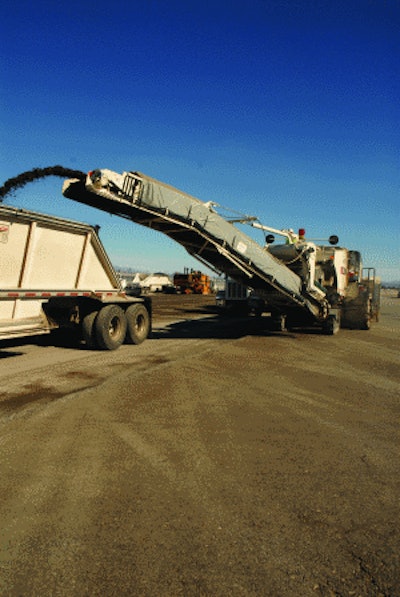
"The trends that we are seeing are more toward the big equipment. The size of the projects being let are very big, so people are trying to figure out how to get a lot of work done quickly," notes Irvine. "We have had a good run on RX900s with 12-ft. 6-in. drums [for] full-lane milling. The half- and full-lane, 900-hp-type machines are definitely in demand."
Jim Holland, Terex Roadbuilding, acknowledges, "There seems to be an increase going toward the full-lane mill. It will never overtake the half-lane, mid-range by any means." However, the full-lane mills can be used at night, an overlay can be applied and the road can be opened up to traffic the next day.
The ARRA is only one driver in the popularity of large milling machines. Another is the desire for states to stretch their budgets. "They are doing this through fractionating RAP and increasing recycle percentages," says Irvine. For instance, North Carolina is experimenting at 40% RAP; South Carolina varies from 30% to 50%; Wisconsin is increasing to 25%; Florida is going to 45%; and Kansas is going to 30% to 40%. "These were typically 10% to 15% RAP states."
According to Irvine, at 10% to 15% RAP, you typically have one large RAP pile. When you load a bucket out of this pile, you really don't know what you might get. It could be just a bucket of fines; fines contain only 7% to 9% asphalt.
To increase the percentage of RAP used and keep the asphalt in the mix within tolerance, you really need to screen it into different sizes, like you would with virgin aggregate. "You know the asphalt content and you know what aggregate sizing you are going to have at any given time," Irvine explains. You can then increase RAP content while maintaining mix quality. "If you do increase the RAP, the costs go down."
This makes control of the RAP more critical. "Some asphalt contractors are saying, 'Maybe we ought to buy a mill so we can control ownership of this RAP'," Irvine notes. "Then you can control the scheduling - you can use your milling machine to supplement schedules for peak capacity."
Of course, outsourcing is still a viable alternative. "A lot of times, you can subcontract a large mainline specialty milling contractor," says Irvine. "You can also double haul or haul mix to the jobsite and use your same trucks to collect RAP and bring it back."
Either way, proper operation of the mill becomes more critical as asphalt plants refuse to accept RAP that isn't properly sized. Screening RAP is an energy intensive process that can be minimized but not avoided.
"You can size the material properly with the mills that are out there," says Holland. "But what happens is you will see an operator who will outrun his mill. If he backs off to 90 fpm instead of 110 to 120 fpm, he can get the right sizing out of it. The quality of the millings is becoming more and more of an issue."
FDR keeps growing
Like mill and fill projects, full-depth reclamation (FDR) is well positioned to take advantage of ARRA dollars. "We have seen some FDR work that was part of that 'shovel ready' type of work," Holland reports.
FDR is also benefitting from the "green" movement. "That means looking at all processes and deciding not only how we can save money, but save resources, as well," says Tim Kowalski, manager of recycling products, Wirtgen America. "We are turning to an age where recycling is going to be the new virgin material for everything we do. After all, some of the best materials are already in the road."
FDR has been around for several years, but has remained a niche in the industry. "FDR should be mainstream," says Holland. "I really think it will grow. It will take some effort and some education."
He is not the only one who shares this vision. Mt. Carmel Stabilization Group, Mt. Carmel, IL, ranks among the largest soil stabilization contractors in North America, and it is placing an emphasis on FDR. The company averages about a million square yards of FDR work a year, approximately 5% of its current business. And it recently opened an office in Pittsburgh completely dedicated to FDR in Pennsylvania and the Northeast New England area.
Despite the current downturn, Mt. Carmel Stabilization Group hasn't missed a beat. "As a company, we are tremendously busy. Most of our work right now is soil stabilization work," says Neil Ryan, marketing manager.
The company foresees FDR continuing to grow in future. "We are in a situation now where it is time to get creative with our pavement preservation and maintenance solutions," Ryan states.
Resources such as virgin aggregate and oil will become increasingly expensive. "There are a few things that can hurt the milling process but help the stabilization equipment," Kowalski states. "One is the cost per ton of oil. Last year, we saw oil prices go into the $800+/ton range, and people were not doing the typical mill and fill. They wanted to know if there was something else out there that... would give good results at a cheaper cost. This is where pulverization and stabilization comes in."
Mt. Carmel Stabilization Group uses Portland cement to reclaim and stabilize a new base. "All of the existing asphalt is staying in place," says Ryan. "So you are reclaiming that with any aggregate sub-base and soil, building a new cement-stabilized base. Over the top of that, you need a very thin layer of either chip seal or a very thin layer of asphalt."
Because FDR doesn't take much more to design than a mill and fill project, it has also benefitted from ARRA funds. "Certainly, the states that we work in - specifically, Ohio and Indiana - have really increased the work they are actually letting and also the frequency of their lettings," says Ryan. "There is a lot of work out there that I don't think we would have seen otherwise."
States are looking for solutions to stretch their investment, as well. "Right now, everybody is looking to get creative. A lot of the things the industry has been promoting for years and years are being recognized as creative ways to save money, and they are [more] permanent solutions," Ryan asserts.
A place for both
Some contractors are seeing the need to own both milling machines and recycler/stabilizers.
"We have a lot of repeat business for both the mills and the recyclers," Kowalski comments. "What we are seeing is those that have just mills are starting to look at reclaiming/stabilization equipment, and those that have reclaiming/stabilization equipment are looking at mills. They are looking to expand their knowledge and business, so as not to be left out of possible work available in their area.
"Also, asphalt-producing contractors that sub out the work are starting to buy machines to help manage their own work when the sub is not available," he continues. "With a lot of contracts having some extreme penalties for not getting work done, the contractors want to have the flexibility to do it themselves if they need to."
This diversity can help ensure success. "If you specialize in only one area, you are at the mercy of having up and down times," Kowalski comments. "Several contractors are looking to expand their fleet of equipment and the knowledge of processes, so they can be more competitive in the market and have a chance to get more work."
Milling Machine ROI
As the price of virgin materials continues to escalate, it becomes easier to justify the purchase of a milling machine. According to Roadtec, RAP is worth the virgin material it replaces. In other words, 30,000 tons of RAP is equivalent to 28,200 tons of aggregate.
"We did a study on an RX900," says John Irvine at Roadtec. "If you can find five or six days of work at only 334 tph, where you can collect the millings off that job and reuse them in a mix, just getting the RAP and putting it on your yard to be used later will pay for the annual ownership costs of that machine."
Roadtec reports that the total virgin cost per ton of aggregate plus asphalt ranges from $40 to $50/ton. The cost of processing and screening RAP ranges from $4.02 to $4.45/ton. That equates to a per-ton savings of $35.98 to $50.55.