
Award winning kitchen
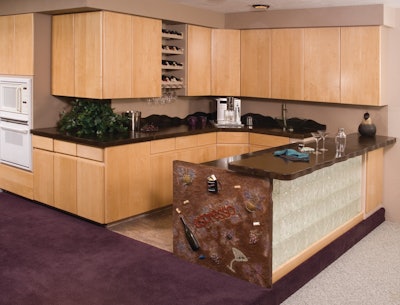
Creating kitchens that are classic and simple while incorporating tangible objects from the owners' lives is not an easy task. But Steve Silberman and Tommy Cook of Absolute ConcreteWorks, Poulsbo, Wash., were up to the task. Not only did they create the desired concrete countertops the homeowners wanted, but they also created an award winning concrete art piece for the kitchen's bar area.
The homeowner wanted the countertops to have a worn, leathered look without the rugged feel. The countertops also included stainless, removable trivets and a cook top that was flush with the countertop, Cook says. Aside from the countertops in the kitchen and bar area, Absolute ConcreteWorks also created a concrete backsplash and a removable concrete art piece that incorporated items from the homeowners' previous endeavors.
Absolute ConcreteWorks used its trademarked SoundCrete GFRC concrete mix for all the concrete elements in the kitchen. "The main reason for using GFRC is higher strength and lighter weight. It's a much easier product to deal with," Cook says.
To create the precast countertops, Cook first used templates to fabricate the molds. Once the molds were created, the inlays set for the knockouts and the inserts for the trivets in place, Cook sprayed on the GFRC mist coat. He then back brushed the mist coat to remove any pin holes and "compact" the concrete.
Next he sprayed the GFRC backer mix, which contains the glass fibers, to a 3/8-inch thickness. Styrofoam was then added on top of the backer mix. "The foam is in there to take up volume. It's a weight reduction method," Cook says. "Another benefit is the Styrofoam holds temperature, so it makes it a little warmer than your standard concrete countertops would be." Another 1/4-inch of backer mix was sprayed over the foam, and then the countertop was troweled and left to cure.
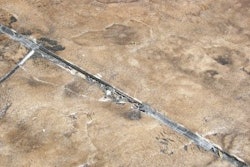
To achieve the desired color, Cook sprayed on brown acid stain and let it sit to create its own pattern. He also used pads to buff the concrete and give it a "worn" look, Cook says. The countertops were neutralized, rinsed and covered with a food friendly sealer.
While the kitchen countertops were kept simple, the wine bar area was a bit more whimsical. Here, Cook created countertops with wavy edges and the award winning art piece.
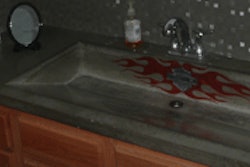
The art piece, which won Best "Funk"-tional feature in the 2009 Cheng Concrete Exchange Circle of Distinction Design Challenge, utilized some of the homeowners' personal items to create a 3-D look. The panel was done in a positive cast, which was a bit of a challenge, Cook says. After spraying, the concrete items were troweled into the piece. Dry color was tamped into the surface, and the final details were created using acid stains and dyes.
Office suspension
Shawn Wardall, Specialized Construction Services Inc., Waterloo, Wis., recently completed a concrete desktop for the University of Wisconsin Medical Foundation. The desktop posed some challenges for Wardall including reinforcement and incorporating non-concrete elements.
The project was the main reception desk in the medical center. The desktop itself was a 17-foot-long, seamless, poured-in-place piece that took 800 pounds of concrete to create. The desk also consists of precast panels that make up the lower half of the desk, Wardall says. The poured-in-place concrete desktop took eight weeks to complete.
After creating several samples to get the desired look, Wardall prefabricated a 2 x 4 framing for the underside of the desktop. This desktop also required space for recessed lighting underneath and inset limestone on top. To create the space for lighting, Wardall used 1-inch rigid, semi-tapered foam. The limestone inset was formed out with the rest of the forming.
Wardall mixed the concrete on-site, 100 pounds at a time. He added white and chamois Colormaker pigments for integral color. He then poured the mix into the form and placed #3 and #5 rebar where needed.
Wardall's biggest challenge was the lack of support underneath the desktop. Other than the rebar in the concrete, the only support the desktop had was from two, 6-foot-long, 3/4-inch-wide steel plates, Wardall points out.
Once the concrete was poured it had to be vibrated. "I used a Makita pencil vibrator to vibrate everything into place so we could minimize any air voids in the concrete at the surface and around the perimeter as well as get good consolidation around the reinforcing steel," Wardall says. After vibrating, the surface got a hard trowel and was left to cure over a weekend. Wardall came back the next week and used a cup grinder to expose the aggregate. He polished the desktop surface to an 800-grit level.
Three weeks later, Wardall came in to remove all the forming and grind the 3-inch edges that were now exposed. The whole desktop was then polished to a 1,500 grit, he says.
"I used Prosoco Consolideck LS - a lithium-based silicate sealer, hardener and densifier - as well as the Prosoco Consolideck LSGuard hardener to finish off the look of the concrete surface," he adds.
The final result was another one-of-a-kind specialty project that Specialty Construction Services Inc. likes to create.