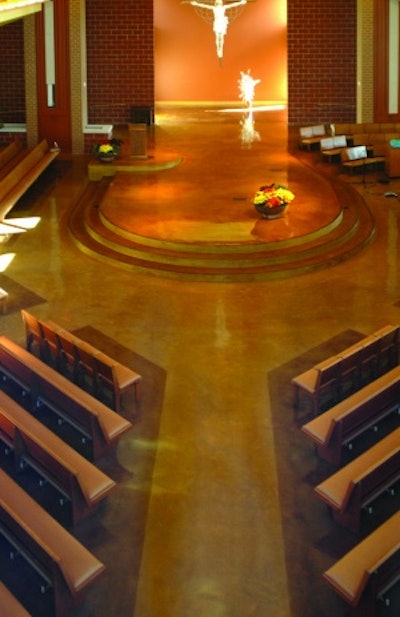
When Shawn Wardall of Specialized Construction Services, Inc. took on an 11,000-square-foot polished concrete floor at St. Francis of Assisi Catholic Church in Belleville, Wis., he wanted to bring the congregation a beautiful, natural-looking floor to match the unique architecture of the building. He also wanted to introduce a flooring technique to the area that would offer a low maintenance finish, longevity, the ability to customize a floor to the building around it and open doors for concrete polishing. The end result is a floor in a mixture of rich tan and chestnut brown that exceeded the client's expectations thanks to preplanning and contractor expertise.
Planning the floor
Wardall says the key to a great finished project is thinking ahead. He was lucky to be involved with the church floor project in its early planning stages, giving him the chance to work with the client and architect to determine what they really wanted in a floor and the chance to work with the concrete contractor to optimize the performance of the floor for a quality finished project.
When Wardall met with the building's architect and the church's planning commission, he educated them on the benefits of polished concrete flooring over other options such as carpet. He also accompanied them to another church in the area where he had performed the polished concrete floor work, giving them a firsthand look at what a finished concrete floor system looks like, how it performs and its lower maintenance benefits.
An important feature of the floor that Wardall was able to accomplish through preplanning has to do with what it's missing - control joints. "I think there's a real visual benefit to be able to look down an aisle and not see control joints," Wardall says. "I think a random crack lends itself to a natural floor - like aged leather - and the randomness adds beauty. Natural fissures are much less of a distraction than control joints."
Wardall points to color performance as another reason to avoid control joints on a decorative floor. "Because the concrete cures differently around those control joints, dyes and stains look different about an inch around those joints," he explains.
After discussions with the architect and the church's planning commission, the architect removed the spec for the concrete contractor to saw control joints in the floor.
In order to achieve the kind of floor that lends itself best to polishing and to minimize random cracks, Wardall and the concrete contractor devised a plan for a wet cure for the floor. After placing the floor, the concrete contractor covered it with visqueen and everyone stayed off the floor for one week. After a week's time, the visqueen was removed and the floor was covered with Tyvek and plywood for three months; during this three-month period traffic was allowed on the floor. "The floor retained moisture for three months over the course of the summer, creating an optimal curing and hydration process for the concrete," Wardall explains.
By the time Wardall had finished the floor in late October, only minimal random cracking had begun to occur on the floor. Random cracks occurred on the raised altar portion and steps, however, as that area was poured differently, and therefore cured in a different manner.
"Eventually the floor will see some random cracking, but the longer it takes, the smaller those cracks will be," Wardall explains.
Polished to perfection
To achieve the natural look Wardall wanted for the floor, he used four dye colors to tint and highlight the integrally colored concrete. Wardall likes the effect he gets by using dye on a polished floor. "Dye is a fine particle, and I prefer an acetone-based dye. They seem to be better at penetrating a floor and getting a color to stay vibrant and successful throughout the life of the floor," he says.
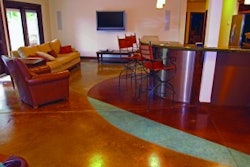
Aisles and the main portion of the altar are a mottled rich tan, while the areas of the congregation floor under the pews and the edges of the altar steps are a mottled chestnut brown. Wardall separated the color changes with a shallow score line he cut with a 4-inch angle grinder and a steady hand.
Wardall and his team used a 24-inch planetary grinder with four heads to polish the bulk of the floor. Around walls and columns he used a number of smaller grinders to achieve polishing in these tight areas. The polishing work on the floor took 10 days.
Wardall polished the main floor to an 800 grit and the altar and steps to a 1,500 grit using iShine flexible polishing pads. "These pads ride on top of the floor - on top of the crème - so you can polish the surface more evenly and still retain the topography of the floor," Wardall says. His first time using the pads didn't come without a hitch, however. Wardall says he typically polishes a floor to a 400 grit, applies his dye and densifier, then finishes out his polishing. When he tried his usual technique with the iShine pads he got heavy scratching on the floor after applying the dye and densifier. With help from his distributor, Wardall learned from the polishing pad manufacturer to apply the densifier after the 100 grit step and dye at the end of the project before polishing the last grit step.
Wardall used a lithium silicate densifier to harden and protect the floor. Lithium silicates are the newest of the densifying technologies and are made up of smaller molecules that allow for greater depth of penetration than sodium- or potassium-based densifiers. Wardall says clean-up with lithium silicate densifiers is often easier than the alternatives. "If you're using a sodium silicate densifier you have to thoroughly rinse the surface or you run the risk of your surface turning white, which can be a bear to remove," he explains. "As long as you don't over-apply the lithium silicate densifier, any whitening that occurs can be wiped, brushed or burnished off with little trouble."
Wardall left the congregation with a floor that will outlive carpeting many times over. The maintenance program he established for the church is relatively low key - they will maintain the floor with a floor scrubber and Wardall expects it will need to be burnished every few years to bring back the vibrant colors. Upon turning over the project, Wardall says the planning committee made special note of the fact that the floor isn't slippery although it looks like it is. Both the congregation and the contractor are pleased with the end results.
"Every year there is a project for me that really sets the standard, that stands apart from the other work we have completed. I am proud of the work we have done for St. Francis of Assisi and hope they will enjoy this work for many years to come," Wardall says. "The benefits of this system are numerous, and I expect the success of this floor will help fuel continued growth in the polishing market for an indefinite period of time."