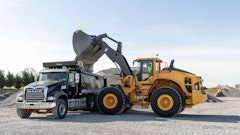
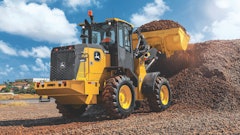
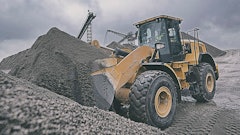
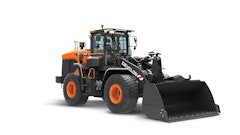
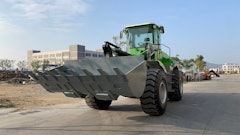
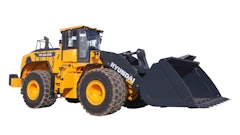
Many factors affect the fuel efficiency of a wheel loader, including poor maintenance, worn ground-engaging tools and operator inexperience. Yet, the largest variables are ones you can typically control.
"The biggest factors in fuel efficiency are properly trained operators and machine maintenance," says Chad Ellis, product and governmental sales manager, Doosan Infracore.
Machine design is another key component. "Both the machine design and operator play important roles in fuel economy," says Jahmy Hindman, product marketing manager for wheel loaders, Deere & Company. "Poorly trained operators will cause even a good machine design to suffer poor fuel economy, and poor machine design will limit the fuel efficiency well-trained operators can attain. Operators who ride the brakes on wheel loaders cause excessive fuel burn and maintenance to the machine, for example."
Nick X. Tullo, articulated haulers and wheel loaders, Volvo Construction Equipment, adds, "The design of the loader is great, but all the design efforts are wasted if the operator does not utilize the features. I feel the operator will play the most important role."
Adjust operating practices
"Regardless of skill, any operator will benefit by a well-designed machine," asserts Tom Grill, senior application specialist for quarry and aggregate, Caterpillar. "A well-trained operator can also save a substantial amount of fuel based on his or her operating efficiency and awareness of work conditions."
In some cases, an operator can adjust his or her operating style to decrease fuel consumption. "For example, when travelling with a wheel loader, use lower engine speed and possibly a higher gear," he advises. "If you are loading a truck in two minutes and you have to wait one minute for the next truck, then you can adjust your operating style and take more time to load. Lowering engine speed during the travel loaded, dump and travel empty cycle will save fuel."
But sometimes this isn't feasible. "If production is limited by the loader's capabilities, a reduction in fuel consumption is not going to happen. In this case, you want to look at how many tons are moved for each gallon of fuel consumed," says Grill.
Plan the traffic pattern and assign machines to the appropriate jobsites. "Layout of the jobsite to maximize production is key, [along with] making sure the machine is properly sized for the job at hand," says Ellis.
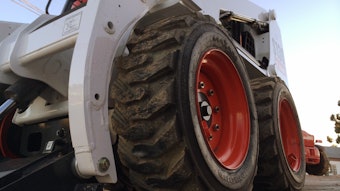
Other simple steps you can take to cut fuel cost while maximizing productivity include maintaining proper tire inflation (under-inflated tires increase rolling resistance) and linkage lubrication (dry pin joints increase the hydraulic pressure required to lift the load), as well as proper matching of loader size to the application.
"The single most important factor to reducing fuel costs for wheel loaders is ensuring the right machine is specified for the application," Hindman states. "This includes factoring in the size of the machine required and equipping the machine properly. For example, for a stockpiling and transport operation, a machine equipped with a lock-up torque converter should be specified to improve fuel economy."
Influence of machine design
There are several different ways machine design can influence fuel consumption.
"Features of a wheel loader that can give the best potential savings in terms of fuel economy include any type of fuel management system or positive flow control/load-sensing hydraulics," says Grill. "In load and carry applications, the lock-up torque converter is a feature that can assist in potential fuel savings."
Some companies offer different working modes. For instance, Doosan has two working modes: power and economy. "Economy mode will save fuel on less demanding jobs," says Ellis.
Deere & Company believes fuel economy begins with the engine design. "Additional design features - like lock-up torque converter transmissions, auto-idle and auto-shutdown, load-sensing hydraulics and variable-speed cooling fans - enhance machine fuel economy regardless of operator capability," says Hindman.
He adds, "Our experience tells us that the lock-up torque converter and auto-idle/auto-shutdown have the potential to make the largest impact on fuel economy."
Volvo has increased the fuel efficiency of its wheel loaders by designing them to run at lower engine speeds. "The operation... is much more efficient at 1,100 to 1,500 rpm, where the torque curve is best. The loader is designed with plenty of hydraulic flow at low rpm to save fuel," says Tullo. "New re-handling buckets that enter the pile more easily also help. Couple these with TP link, which keeps 70% of breakout force through the lifting cycle, and we do not have to run the engine at high rpm to load our buckets."
This technology does necessitate operator training. "If they have run competitive machines, they must be completely retrained to realize the fuel savings by low rpm loading cycles," Tullo notes. He advises working at between 1,200 and 1,700 rpm when digging or loading material.
Save with on-demand hydraulics
"The design of the hydraulic system is critical to machine fuel economy," says Hindman. "The load-sensing hydraulic system utilized in today's John Deere wheel loaders provides only the necessary flow required by the operator for the task at hand. Special attention was paid to minimizing hydraulic losses (pressure drop) in the hydraulic system design for our new K-Series wheel loaders."
Of course, the role of the hydraulic system in potential fuel savings requires some perspective. "The hydraulic system plays a smaller role in fuel efficiency on a wheel loader than, say, an excavator," says Ellis. "But you try to maximize fuel efficiency in every aspect of machine design. Doosan has implemented on-demand pumps in its larger wheel loaders to maximize fuel efficiency."
It is all about eliminating unnecessary waste of energy. "Volvo has a load-sensing hydraulic system that improves fuel efficiency - the parasitic load on the engine activates the hydraulic pumps only when the machine is working," says Tullo. The engine and hydraulic system are also optimized for maximum efficiency. "Volvo designs the pumps around the engine curve so they can achieve full flow at low rpm. There is no need to run the engine up to the red line."
Get a grip
Wheel slippage is another energy waster. "Both wheel spin and slippage reduce fuel efficiency and increase operating costs," says Tullo.
Spin or slip control can be beneficial, depending on the operator skill level. "If a new operator is frequently spinning the tires while loading, this feature can have a significant impact on operating costs by improving fuel economy and minimizing tire wear," Hindman explains.
It is also beneficial in less than ideal ground conditions. "In poor underfoot conditions, spin/slip control features can impact fuel economy and production significantly by keeping the loader more mobile and producing," says Sameer Marathe, performance controls engineer for large wheel loaders, Caterpillar. "Without a spin/slip control feature, the operator can waste a lot of fuel maneuvering the machine... because he must deliver power to all the wheels and try positioning the machine to gain traction.
"Smart spin/slip control features can automatically divert power to wheels with good traction and get the machine mobile faster," he adds.
Of the spin/slip control features typically used on wheel loaders, those using brakes are the least efficient, Marathe asserts, because they waste energy across the brakes. "Features using lock-up differentials are more efficient," he states, "and features using independent wheel power control are most efficient - such as four-wheel hystat or electric drive."
Don't work up a sweat
Cooling systems have been designed to further reduce parasitic losses. "Auto-reversing cooling fans only run when cooling is required," notes Tullo, "and the speed is variable based on the temperature of the component."
The fuel savings from a hydraulically driven fan will vary. "The fuel savings is in direct relation to the environment and temperature the machine is working in," says Tullo. "The fan helps reduce burn up to 30% over conventional belt-driven systems. This is due to the automatic adjustability of fan speed, instead of running at high rpm constantly like belt-driven fans."
The benefits of the hydraulically driven fan depend heavily on the ambient temperature where the machine operates. "The cooler the ambient temperature, the more benefit the hydraulically driven fan provides," says Hindman.
Sean McCurdy, cooling system engineer for large wheel loaders, Caterpillar, explains, "Technically, a hydraulic fan is less efficient at the same fan speed than a mechanically driven one. The fuel savings come because a hydraulic fan can be controlled to a lower speed when full fan speed is not required for cooling. Although cooling performance is directly proportional to fan speed, the fan power draw is cubic. Thus, being able to slow the fan down quickly saves a significant amount of fuel."
"The variable fan can reduce fan power consumption more than 90%, depending on the fan speed and fluid temperatures," adds Lucas Knapp, performance controls engineer for large wheel loaders, Caterpillar. "This translates to an overall machine power reduction of 7.7% at rated speed. At max fan speed, the fan uses slightly more power than the belt-driven fan. So over the life of the machine, a typical customer might see a 1% to 6% fuel savings with a hydraulic fan."
A hydraulic fan also reduces noise levels, prevents over cooling in cold weather and provides adequate cooling at high altitudes.
The cooler layout can play a role in cooling system efficiency, as well. For instance, John Deere designed its Quad-Cool system so that minimal recirculated air (warm air previously exhausted by the fan) finds its way back through the cooling package. "Continuously pulling in fresh, cool air through the cooling package keeps the fan speed lower and reduces fuel burn," says Hindman.
Self-cleaning capability also enhances operation. "Doosan has maximized efficiency of our cooler package by its design, with more efficient material and a self-cleaning feature (reversible fan)," says Ellis. "A well-maintained cooler group is key to efficiency."
But fuel economy is only one consideration when designing the cooling system. "In general, cooling design is a balance between three desires: cost, fan sound/power and system size. One can trade off any factor to improve another," says McCurdy.
"As for size/fan speed, we have strived for a balance that provides the operator the best visibility as compared to cooling package size," he continues. "Cat utilizes advanced software to study the air flow paths through the cooling package to minimize inefficient recirculation effects that would necessitate higher fan speed."
Beyond fuel costs
Of course, fuel efficiency is only a part of the equation. You also need to compare overall operating costs of the machine.
"Design of the wheel loader is key, but there must be a balance between fuel efficiency and performance," Ellis emphasizes. "A less fuel-efficient machine... may have higher production, so lower operating costs."