The May issue of Pavement Maintenance & Reconstruction looks at some diversification options for pavement marking contractors, including raised marker installation specialists, M.A.S. Markers, Lebanon, IN, owned by Michele Johnson; husband Steve is operations manager and runs the crews.
Steve Johnson started working at James Drew in 1985, the first year the company entered the marker business, and he started as a foreman of a crew installing markers. By 1990 James Drew had three crews installing pavement markers and several crews replacing reflectors in existing markers.
In 1997 James Drew Corp. decided it wanted out of the marker installation business and offered Steve Johnson a chance to buy that part of the company. He wasn't interested but Michele took a closer look at the operation and she thought it was a business she'd like to take a crack at running. So she acquired that part of the company, and with Steve as operations manager they were installing and replacing markers right from the start.
When Michele acquired the marker installation business from James Drew Corp. in 1997, she decided not to make cuts in equipment or staff to inflate the bottom line. Instead, she took a long-term view, investing in the operation, improving existing equipment and buying new equipment.
"When she bought Drew Corp. out she had enough capacity equipment-wise for two marker installation crews and two reflector replacement crews," Steve Johnson says. "Today we have the capacity for four marker installation crews and four reflector crews."
Steve says M.A.S. Markers, which uses markers from Ennis Paint, currently has the capacity to install "every single raised marker in all of Indiana and Kentucky. And we have the capacity to change all of reflectors in all of Indiana, western Kentucky, and the southern two-thirds of Illinois."
Since 1997 M.A.S. Markers has tackled jobs in Indiana, Illinois, Kentucky, Missouri, and Arkansas. And business in 2008 was good, with 25 jobs carried over from 2007. Michele Johnson says M.A.S. completed more than 120 jobs in 2008 and carried another 40 accepted bids into 2009.
Johnson says 75% of M.A.S. Markers' work is done on state highways, 20% is done on interstates, and the remaining 5% is done for cities and counties. M.A.S. customer base is virtually entirely public agencies at the local and state levels. In the peak summer season M.A.S. historically has run three crews of five people each, but last summer the contractor added a fourth crew to help finish out the season.
To learn more how M.A.S. Markers improved its efficiency, productivity, and bottom line, look for the "Reflecting on Raised Markers" article in the May issue of Pavement. To learn how Michele and Steve emphasize safety and how they run their traffic control operations, read on.
Safety and traffic control
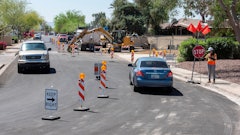
Because virtually all their work is done amidst live traffic, a significant aspect of their operation is traffic control. "We move along at 2 mph," says Steve Johnson. "There's nothing standing still and you have to have experience when it comes to that kind of work."
He says that the company's emphasis on safety and its focus on traffic control have resulted in only one worker hurt on the job since 1985, and it was a minor accident. "We've had people hit our TMAs but everyone walked away unharmed."
Every year all M.A.S. employees work through Flagger Certification via the American Traffic Safety Services Association (ATSSA). The foremen and other key people on the job receive training in ATSSA safety supervisor courses, as well as on-the-job training.
All interstate work in Indiana is night work, while most interstate work in Illinois is daytime work. M.A.S. crews do not use any special lighting other than the halogen headlights on the equipment.
"We try to request policing on the site. That's the safest traffic control item there is, a squad car with lights on it," Johnson says. She says the procedure for having a police officer on site differs from state to state. Illinois, for example, provides that policing service and has a fund set up so the contractor doesn't have to pay the fee for the police officer's presence. Indiana is moving toward Illinois' policy, but if M.A.S. wants that police presence in Kentucky the contractor has to foot the bill itself.
"Anytime we're on an interstate or highway we try to put a cop out there, even if we have to pay for it," Johnson says. "A squad car with lights is the best traffic control item there is."
But whether or not M.A.S. has a cop on the site, it sets up its marker installation or replacement train this way:
- Dune buggy to replace damaged reflectors
- Saw truck to cut/install and replace new castings
- Truck with TMA
- A second truck with TMA
- Arrow Board with TMA
"All of this is staggered to push traffic away from the working vehicle in the front," Johnson says.
Behind all this are message boards, which they include on every job. "The first is situated one-half mile behind the first moving TMA providing directions to drivers and basically just giving John Q. Public a warning of what's going to happen up ahead," Johnson says. "Big printable message boards are the second safest operation that money can buy on a moving operation."
The M.A.S. emphasis on safety creates some difficulties when bidding jobs because not all bid specs require traffic control or safety operations at the level M.A.S. insists on for its workers. He says in Indiana (and other states where police presence is not required in the bid specs) M.A.S. bids the job initially per the specs, then makes a point of submitting a change order asking for the state to pick up the cost of a police officer and car at the jobsite. The same is true for use of TMAs, which many bids don't call for. Regardless of whether the state accepts the change order or not, M.A.S. uses TMA trucks on all four-lane jobs. Police presence varies but M.A.S. will pay for the officer itself if Johnson thinks his crews will be safer.
Johnson says the company also plans its work with safety in mind. Work schedules are set up around traffic flow, trying to avoid peak travel times if possible. "My experience shows that 75% of wrecks are in the right lane because when you're tired you tend to move to the right lane and that's where they happen. So when we go out we change all reflectors from the left lane. That way traffic doesn't have to cross over us to exit. Accidents go to the right, exits are to the right, we just try to work out of their way."
He adds that when installing markers on ramps his crews do have to work in the right lane, "but we try to keep out of the right lane as much as possible."