Auxiliary high-flow hydraulic systems can dramatically increase skid-steer loader productivity in the right applications. The higher the horsepower, the more work you can accomplish in a given period of time.
To calculate hydraulic horsepower, you multiply the flow rate in gal./minute (gpm) times the pressure in pounds/sq. in. (psi), then divide by 1,714. So let's assume a skid-steer loader has an operating pressure of 3,100 psi and comes in a 22-gpm standard-flow or a 34-gpm high-flow configuration. Using the above equation, the standard-flow model would provide: (22 gpm x 3,100 psi)/1,714 = 39.8 hp. The high-flow model would offer: (34 gpm x 3,100 psi)/1,714 = 61.5 hp. As you can see, the high-flow unit has quite a bit more capacity to get more work done in a specified time frame.
"With higher hydraulic flow, the loader can provide more performance to power high-flow, high-performance attachments," says Kelly Moore, product manager, skid loaders, Gehl Co. "The increase in productivity is the greatest benefit - being able to perform more work more efficiently and more quickly. For instance, a high-flow trencher or auger attachment coupled to a high flow-equipped loader will run at a faster speed with plenty of torque to avoid stalling in highly compacted materials."
Chris Giorgianni, general manager for product marketing, JCB, states, "The major advantage of a high-flow skid steer is that you have the option to run attachments that require the high hydraulic horsepower and flow, allowing them to run in their optimum performance range. Generally, attachments that require high flow are ones that have a component that needs to be run at a high rate of motion. Examples would be certain varieties of stump grinders, cold planers and slot cutters. A high-flow machine would be of greatest benefit for these, because without the high flow, these types of attachments lose their effectiveness."
"Relatively speaking, the larger a hydraulic attachment, the more flow it will require to engage the ground or spin a drum faster," adds Gregg Zupancic, product marketing manager for skid steers and compact track loaders, John Deere Construction.
A compatible option
Standard-flow auxiliary hydraulics do have limitations. "The limitations are the types of attachments that you can run," says Jim Hughes, product manager, Case Construction. "If your attachment requires 30 gpm and you only have standard auxiliary hydraulics, you will not be able to run the attachment at peak efficiency, which runs the risk of damaging the attachment and/or the machine."
"A standard-flow machine will only be able to run attachments designed for standard flow," agrees Giorgianni. "The high-flow machine, however, can run both standard- and high-flow attachments. With a standard-flow machine you limit the machine's versatility, as it reduces the range of attachments you can run."
Because skid-steer loaders equipped with auxiliary high-flow hydraulic systems are compatible with standard-flow attachments, purchasing a high-flow model doesn't necessarily mean you have to upgrade to high-flow attachments.
Giorgianni explains, "On a high-flow machine, you have both a high-flow connection and a separate standard-flow connection. In other words, the high-flow system is standalone and can be used only when needed. The machine can be operated as a standard-flow machine the rest of the time."
Couplers for both are usually included. "A separate set of standard-flow couplers are provided distinct from the high-flow couplers," notes Moore, "which allows proper operation with the standard-flow attachments."
So you essentially get two systems for the price of one. "It's not simply a matter of having a machine that has either standard-flow or high-flow hydraulics," says Hughes. "When you order the high-flow option, you get additional high-flow connectors to hook the hoses from the attachment to the machine. Therefore, if you are using an attachment that requires standard flow, you attach it to the standard-flow connectors. If you are using a high-flow attachment, you attach it to the high-flow connectors.
"Now, if you are using an attachment that requires both standard flow and high flow at the same time, you need to order a second auxiliary hydraulics kit from your dealer," he notes. "Attachments that would use both standard and high flow would be those that have a positioning cylinder, like some rock saws or cold planers."
Attachments dictate flow choice
The biggest downside of high flow is the added cost. "There is a slightly higher price for the high-flow models due to the additional high-capacity components included with the option," says Moore. "The price increase varies from approximately 3% to 5%."
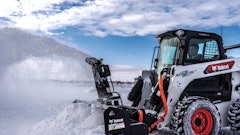
Depending upon the manufacturer, the high-flow hydraulic option can add $1,850 to $2,600 to the cost of the machine. However, Zupancic asserts, "This is a small price to pay for significant increases in a machine's potential hydraulic output. The increased hydraulic flow and power mean better performance for the attachments... This is especially useful for improving production of attachments that demand a lot of hydraulic power, such as a 5-ft. trencher, snow blower, tree shredder, cold planer or large mowers."
Yet, high flow is not the right choice for every application. "A standard-flow machine would be a better solution in applications where an attachment is used that does not have the hydraulic horsepower requirements of a high-flow system," says Giorgianni. "An example would be a scrap grapple, in which the auxiliary hydraulics do not require the high horsepower and flow to drive the grapple open and closed."
"A standard-flow machine is better when all the customer needs to do is dig or lift material the majority of the time," Zupancic states. "Maybe occasionally they would use a hydraulic auger or smaller trencher. In this case, the added cost and complexity of a machine equipped with high flow would be a waste."
Attachment usage ultimately drives the decision. "The choice of whether or not to order a machine with standard-flow or high-flow auxiliary hydraulics really depends on the hydraulic flow requirements of the attachments," says Hughes. "If the optimal flow for the attachment (as recommended by the attachment manufacturer) falls within the range of the machine's standard flow, high flow is not needed."
For example, the standard auxiliary hydraulics on Case skid-steer loaders and compact track loaders range in flow from 19.5 to 23.8 gpm at rated engine RPM, depending upon the model. "So if you are running an auger that has an operating range between 6 and 15 gpm, standard auxiliary hydraulics will work fine and there is no need for high-flow hydraulics," Hughes points out. "However, if you are running a cold planer, your hydraulic flow requirements are going to be much higher."
Most of the cold planers the company offers have a flow range of 22 to 40 gpm, meaning that standard-flow hydraulics would not allow the attachment to operate at optimum efficiency. The optional high-flow auxiliary hydraulics provide a flow of up to 41.8 gpm at rated engine RPM, depending upon the model. "So in order to maximize productivity and most efficiently run the cold planer, you would need to order the high-flow hydraulics option," says Hughes.
Yet, the majority of attachments on the market today operate within the standard flow range. "Most attachments can run with standard auxiliary hydraulics," Hughes acknowledges. "However, our customers who need high-flow hydraulics [because of the attachments they run] understand the benefits and order their machines with the high-flow hydraulic option."
Zupancic agrees, adding, "Customers usually understand that if a specific attachment requires a minimum flow to run efficiently, they will need to match their machine minimum flow output to run those attachments. Depending on the model size, John Deere sells 10% to 20% of their machines with the optional high-flow system."
Gehl reports it continues to sell more standard-flow skid steers than high-flow units. "The majority of attachments available today are standard-flow attachments, and the majority of applications can be completed with a standard-flow system," Moore points out. "Standard-flow attachments are efficient and perform satisfactorily in these applications."