Engine oil tends to get all the attention when it comes to fluid analysis discussions. Legitimately, it should get a lot of press because of the expense associated with engine repairs and failures. Yet, there are additional fluids that can, and should, be analyzed to ensure your equipment will continue to run productively without untimely breakdowns.
"When you look at construction equipment, the most expensive component is likely the engine, so contractors have a tendency to test the engine [oil] more often. And that's a good thing," says Mark Minges, chief operating officer, POLARIS Laboratories. "But when you consider, for example, that it's the hydraulic system that makes the machine work, it's important to keep its fluid clean, as well as know how much wear is going on in the pumps and gear boxes.
"If any one of those components breaks down, it doesn't matter what shape the engine is in," he continues. "If the hydraulic pump locks up, you can't do any work. If the planetary drive goes out, you won't be able to drive the machine."
While any fluid can be tested, the main ones to focus on include coolants, transmission fluids, gear oils (planetary drives, differentials, final drives, wheel motors, etc.) and hydraulic oils.
Catch potential problems early
As with engine oil analysis, the goal of analyzing other fluid types is to identify potential problems early. "If you can identify a problem such as contamination or wear, you have a reason to take a closer look," says Richard Gapinski, BP Lubricants. "For example, if fluid analysis identifies a lot of wear, it could be an indication of inadequate lubrication which may be causing a part to be experiencing excessive wear. And it's less costly to make a repair or change the fluid before the part fails and causes additional damage."
Hydraulic oils, transmission fluids, etc., don't encounter the combustion byproducts you find in engine oils, so they tend to have longer drain intervals. "But it's important to test them," Gapinski emphasizes. "They can lose their ability to lubricate because of degradation or contamination. Degradation can occur when the lubricant gets unusually hot, which could be caused by unusually high ambient temperatures or a mechanical problem. This will result in decomposition of the fluid through thermal breakdown or oxidation." Contamination is usually in the form of dirt or water that has gotten into the fluid.
On some equipment, transmissions and axles have warranties for 750,000 miles. "And some fluids used in that equipment may have drain intervals of 500,000 miles," notes Dan Arcy, technical manager, Shell Global Solutions. "That may mean you're not draining the fluid for five years or more. If it did become contaminated, you may not know it right away."
Fluid analysis also provides documentation that you used the correct fluid during the warranty period should any problems occur. Plus, it minimizes the risks of misapplied fluids, which can cause chemical reactions that attack components.
"If someone puts hydraulic oil in a transmission, or tops off a coolant with engine oil, you will be able to identify that and correct it before it becomes a major issue," says Arcy.
Test at regular intervals
It's important to establish and maintain set testing intervals. "By testing the fluids on a regular basis, you get an insight into what's going on inside the system," says Minges. "You can see how that fluid is performing and how much wear is being produced. By monitoring it regularly, you can determine if you need to change the fluid, clean it out or change a component.
"The whole idea is to prevent a catastrophic failure," he continues. "When you look at the construction business, the main cost is downtime. While some repairs can be costly, if you have a haul truck or an excavator that is down and isn't working, it isn't making money. By monitoring fluids regularly, it will positively affect your return on investment, because it gives you enough information to make better maintenance decisions."
Work with your local equipment dealer and/or lubricants provider to determine the appropriate test intervals for each fluid type based on the application. For example, coolants should generally be tested about every six months, but you may want to test hydraulic oils on a quarterly basis. In some situations, you may need to shorten the typical interval times.
"Some construction environments can be particularly harsh," Arcy comments. "Recently, in Galveston, TX, I watched them rebuild the beaches after the hurricanes. The tires and axles on the trucks used to move the sand were working under water. That water can seep into the axles. If that happens, the water can displace the oil and you could end up with wear issues."
Fluid analysis made easy
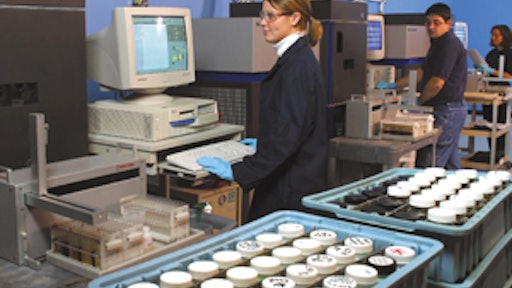
Although you're testing more fluid types, the process of collecting samples and monitoring results isn't necessarily more complex. Sampling of hydraulic fluid, transmission fluid, etc. is similar to taking an engine oil sample, and lab processing costs are comparative. Just make sure to fill out the paperwork correctly so the lab knows what type of fluid it's testing.
You would also be monitoring many of the same properties as engine oil, including wear, contamination, additive elements and viscosity. Of course, each fluid will have unique properties that should be tested, as well.
To make it easier to track test results, many lubricant marketers offer computerized reporting systems. "In the last 10 years, oil marketers have introduced computerized systems to coordinate the analysis of the samples, and also report the results back to customers," says Gapinski. "The system will flag the customer when something looks suspicious. In the past, that was all done manually."
The systems also enable you to perform trend analysis once a sampling history is established.
"One test can tell you something, but it's better if you have several tests done on the same machine and the same oil so you can see how it's trending - how fast it's degrading, how fast TBN (total base number) is going down or TAN (total acid number) is going up. It can identify how fast you are seeing wear metals accumulating or additive elements depleting," Gapinski points out. "There are sophisticated computer programs that greatly aid the process of record keeping and interpreting the results."