Hot pour cracksealing can be an add-on service or an essential piece of business. But no matter what capacity it's done in, if a contractor is going to offer hot pour cracksealing he or she needs to first learn about the available application equipment.
Before purchasing, contractors should consider the type and size of cracksealing jobs they will be doing."Divide the work you'll be doing into 1,000 pounds per day," says Mark Manning, vice president of marketing for Crafco Inc. "If you want to place 1,000 pounds - or about a half pallet of sealant a day or less - then you would go with the smaller machines. If your primary application is roads then you'll be placing 1,000 pounds or more a day. You'll be looking at a 200- to 400-gallon machine for that."
Pour pot
The smallest option for hot pour cracksealing application is a pour pot. Pour pots generally hold only a few gallons of sealant which needs to be melted prior to being added to the pour pot, Manning says.
A pour pot is more a conveyance for material than an application system, says Brad Dunn, Cimline's vice president of sales and marketing. Usually a small, direct-fire kettle melts the sealant which is then added to the pour pot for application. Other contractors use the pour pots with larger melter units. "Some contractors buy 200-gallon melter/applicators without pumps and hoses and only use pour pots with several crew members," Dunn says.
Pour pots can be a good option for contractors doing very minimal cracksealing - such as sealcoating contractors who need to seal cracks on a driveway before sealing. The small size of pour pots also makes them a good option for cracksealing in small spaces.
Pour pots can come in different configurations depending on what a contractor prefers, says Kurt Schwartz, sales and marketing, KM International. Some may have a squeegee built on while some don't. Some pour pots come in straight configurations while others have a tilted elbow.
"Some people would rather stand up straight and have the material flow straight out the bottom," Schwartz says. "Other people want a tilted elbow because they find it easier to see the rubber flowing through."
Banders
The next option up is a bander, which is often found in 10-gallon capacities but can come in larger sizes, too. Some banders come with their own heat source and can act as a melter/applicator system while some need separate melting kettles like a pour pot.
Banders are usually gravity flow applicators with squeegees attached to help smooth the sealant over the crack, Schwartz says. Like pour pots, banders can also be used with smaller direct-fire kettles or larger melter/applicator units. Schwartz says banders can be good for smaller cracksealing jobs, but contractors may choose to use them on larger jobs as well.
Melter/Applicators
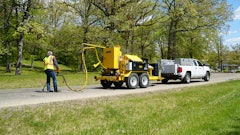
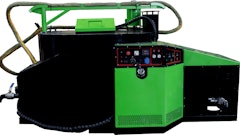
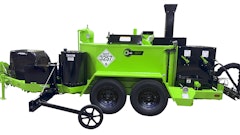
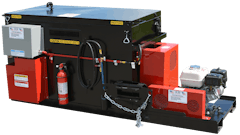
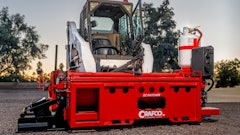
The final step up are the larger melter/applicator units that are usually trailer mounted. The most popular sizes for these units are 100-, 200-, and 400-gallon capacities, Dunn says.
"The 100-gallon range is popular with the municipalities and small contractors doing parking lots," he adds. "The majority of contractors tend to be in the 200-gallon oil-jacketed unit range. The big ones are in the 400-gallon range; and that's typically for state work and contractors who need lots of capacity."
One important consideration when purchasing these larger application units is the type of trucks you have for towing. The GVW of a pickup truck will determine how large an application unit you can tow. So contractors need to decide whether they want to purchase what they can tow or if they want to purchase a new truck to tow a larger melter/applicator, Manning says.
Another consideration is the pumping unit on the melter/applicator. Pumping units can be static or recirculating, Dunn says. A static pump will run only when the contractor is asking for the sealant whereas a recirculating unit is constantly running whether sealant is being applied or not. "Typically, the recirculation is more important in high-production jobs," Dunn adds.
Larger melter/applicator units have the ability to offer contractors more options than the smaller push units. One option is the choice between a heated or a non-heated applicator hose. Heated hoses are self-regulating and can sometimes be easier to use because they are all automatic, Manning says.
A heated hose might also benefit contractors who work in colder seasons because it helps prevent the sealant in the hose from freezing up, Dunn adds. "Heated hoses are especially helpful whenever temperatures reach degrees in the 30s and 40s."
Manning says the best way for a contractor to decide whether to go with a heated or a non-heated hose is to try them both out.
Most larger units also have the option of one or two applicator hoses. Several melter/applicator units come standard with dual hoses that can be both heated, both non-heated, or one of each, Dunn says.
Dual hoses are most helpful in larger production jobs such as major highway work or larger parking lots, Manning says. Dual hoses can also help contractors finish a job faster with the use of only one cracksealing application unit and tow vehicle.
Another option manufacturers are seeing more contractors buy is a material transfer conveyor. These conveyors, also known as auto loaders, extend from the applicator's loading hatch allowing contractors to load sealant onto the conveyor from a distance or even from the truck. Like the option of two hoses, Dunn says that a material transfer conveyor is another option suited more for contractors doing high production work.
Even if contractors are purchasing a larger unit they may also want to consider having a pour pot and/or 10-gallon bander as well.
"There are a lot of times where you might want to team up the larger equipment with the smaller equipment to double the production," Schwartz says. For example, some contractors will use an applicator hose near the machine and use pour pots further away or beyond the reach of the hose, Dunn says.
A final thought
"Don't talk to a manufacturer until you decide the use for and what type of equipment you want," Manning says. "And don't buy a machine without trying it." It is important to "test drive" your larger application units before making your final purchase.
Cleaning before crack filling
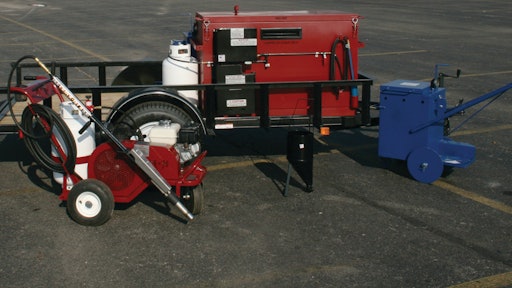
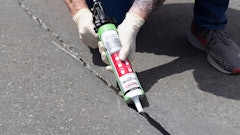
Manufacturers agree that the key to successful crack sealing is a properly cleaned crack. Handheld or backpack blowers can be used to clean debris from cracks, but they may not always dry the crack. Another tool for crack cleaning is an air compressor. Many manufacturers are now offering integrated air compressors on larger hot pour crack sealing melter/applicators. Kurt Schwartz of KM International suggests contractors invest in a portable heat lance because it cleans and dries the crack at the same time.
"It's a system," adds Brad Dunn of Cimline. A properly cleaned and dried crack can be the best starting point for a successful crack sealing job.











![Screen Shot 2023 01 04 At 5 23 30 Pm[35]](https://img.forconstructionpros.com/files/base/acbm/fcp/image/2023/01/Screen_Shot_2023_01_04_at_5.23.30_PM_35_.63bc42696de27.png?auto=format%2Ccompress&fit=crop&h=135&q=70&w=240)
![Patcher4 4edited[66]](https://img.forconstructionpros.com/files/base/acbm/fcp/image/2022/10/patcher4_4edited_66_.63602ddb9e727.png?auto=format%2Ccompress&fit=crop&h=135&q=70&rect=0%2C123%2C1920%2C1080&w=240)