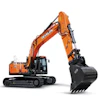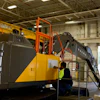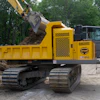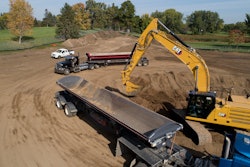
In more ways than one, there's a lot riding on an excavator's undercarriage, so diligent maintenance is key.
"Good routine maintenance keeps the overall cost of ownership down," says Chris Giorgianni, general manager of product marketing for JCB. "It extends the life of the wearing parts of the machine, such as sprocket, idler, chain and pads. It also stops vibration in the machine and damaging movement if these wear items are looked after well."
Scott Emmans, district service manager at New Holland Construction and Kobelco Construction Machinery America, explains, "The moving components of the undercarriage are wear-items, meaning they are expected to wear over time in the process of doing their job. The bottom rollers carry the weight of the machine while it is traveling and digging. The front idler holds the track chain in proper alignment while the machine is traveling and acts as a shock absorber and chain tensioner."
He adds, "The upper rollers carry the chain in alignment and are high enough to allow debris to fall from the chain, so it is kept relatively clean. The drive sprocket engages the track chain and propels the machine by pulling the chain over the sprocket.
"These components wear out over time," he continues. "With proper maintenance and normal use, their life should be reasonably long. With poor maintenance and rough operation, their life expectancy will be less. This becomes a significant issue because these
components are expensive to replace and time-consuming to install. Taking the time to do proper maintenance can go a long way to reducing operating costs."
Amy Van Hook, product manager, customer support, for John Deere, points out, "The undercarriage can represent a significant portion of the operating costs for an excavator. Proper maintenance will help extend undercarriage life and lower operating costs by keeping the excavator on the jobsite moving material and generating rental fees, not in the shop for repairs."
Are you doing enough?
There are signs that a rental center has forgotten or neglected undercarriage maintenance. They include loose tracks (which adds wear to pins, bushings and sprockets), chipped or broken sprockets, and loose or missing sprocket bolts - plus an increase in repairs.
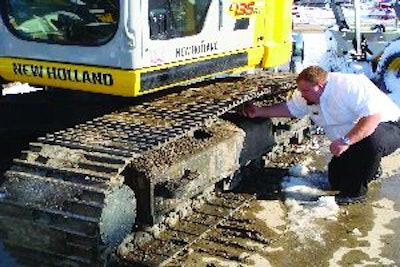
"If you notice tracks are packed with dry dirt or clay, or in winter, snow and ice, you have situations that block the rollers from turning and cause accelerated wear," says Dave Pooley of Hyundai's service department. "Clean the tracks when they return to the rental yard and urge your customers to keep them clean, too."
Training your customers in other operational techniques can also help decrease undercarriage wear. For example, Giorgianni notes, "tracking backwards all the time can wear the tracks and undercarriage. Remind your customers that excavators should always be tracked in the correct direction over long distances. Also they should know to dig over the idler, not the sprocket, to reduce wear."
John Deere recommends the narrowest shoe possible to achieve required flotation. "If a machine is equipped with wider shoes than necessary for the application, you can expect to see shortened undercarriage life," Van Hook explains. "Wide shoes are necessary in soft underfoot conditions, but take that wide shoe into harder ground conditions, stumps or rocks, and you can expect to see reduced life. Wide shoes have an impact on track chain wear in general and can increase the load on the complete undercarriage system and components."
Hyundai's Pooley and Tom Novak point out that track tension must be checked daily for jobsite conditions. "You want to slacken tension for soft and muddy conditions and tighten for rock and general hard ground conditions. Slack measurement depends on size of machine, and manufacturers specify that in their operators manual," they say.
Undercarriage maintenance
Manufacturers agree that undercarriage maintenance doesn't vary much according to machine size, and it's neither time-consuming nor expensive. Emmans explains: "Much of it is only taking the time to check and inspect components to confirm their condition," he says. "Machines built over the past 10 years generally do not require oil changes within components as their oil capacities and seals usually last the life of the component. This lifetime is defined as wearing from the new external dimension to a published end-of-life dimension and can be measured physically on the component."
By knowing the new and end-of-life dimension you can quickly determine the percentage of wear that you have left. "All components are designed to wear at roughly the same rate," Emmans explains. "If you have one component that is damaged or worn more than others, it will increase overall wear and shorten the life of all related components. The most often noted example is a failed bottom roller that will not turn. As the machine travels, the chain is dragged across this seized roller, wearing flat areas on the bottom. This wear is reflected on the chain surface and increases friction, which increases wear on the chain pins, bushings, sprockets and idlers. For one seized roller, all components suffer and have a shorter life."
Proper maintenance starts with a daily inspection or as soon as the machine returns. "Use a track spade to clean the dirt from the top rollers and around the sprockets and idlers," he suggests. "The cleaning serves two purposes: to remove material that might freeze or dry overnight and cause components to be stuck in the first movement the next day, and to allow a visual inspection for loose, worn or missing components."
A walk-around inspection is also in order. Track tension should be noted. There should be some slack in the chain, but not too much. "Consult the operators manual for proper specification," Emmans says. "If the chain is too tight it will wear all components at an excessive rate. If the track is too loose, it may come off while turning or on uneven ground."
In this walk-around inspection look for loose, damaged, or missing components including bottom rollers, track guides, top rollers and loose track pads. While in the front of the machine look down along the tracks to see if there is a section that is out of line. This could indicate a loose track pad or possibly a broken track pin. Stand to the side and confirm all rollers are in place and appear to be in proper alignment.
Check rollers, idlers and final drives for oil leakage. "Often when a roller or idler leaks, the oil drops into the track chain where it is difficult to see, but it is more noticeable where it would run down the side of the component," Emmans notes. "Rollers and idlers can be re-sealed if the outer shell has significant life left, but usually if the leak has gone on too long, there will be internal damage. It's more cost-effective to replace the component."
Check for track wear. "Tracks wear in three areas; link height, external bushing wear and internal pin/bushing wear," Emmans explains. "Link height is measured from the pad to the top of the link that contacts the roller. The roller surface of the link is heat-treated to improve durability, but a seized roller can quickly grind off this hardened surface and weaken the chain. Measuring the link height gives an indication of this wear."
Emmans points out that external bushing wear is noticeable by view and feel, as it reflects the contact with the sprocket. Wear on the sprocket is generally similar by percentage to external wear on the bushings. "This wear can be accelerated by too-loose track or excessive high-speed travel," he says. "You might notice this by looking at the sprocket tips and seeing they look like wave caps, worn and swept back in one direction."
Internal bushing wear can only be measured externally, by measuring the distance between the centers of track pins. It is recommended to measure in three different places and average the measured dimension. Compare this figure to the manufacturer's specification. "It is always a good idea to replace track chains and drive sprockets at the same time, as matching worn components to new will only accelerate the wear to the new component and reduce its life," he notes.
Van Hook suggests having a complete undercarriage inspection performed every 1,000 to 2,000 hours. "In abrasive or high-impact applications, you'll want to do more frequent inspections," she says.
"Final drives and motors require regular oil changes," Pooley adds. "On a regular, timed schedule, all undercarriage bolt torques should be checked. Track wear should be monitored and recorded during routine maintenance. There are specific recommendations in each manufacturer's operators manual - follow them."
Rubber Track Tips
According to Scott Emmans, district service manager at New Holland Construction and Kobelco Construction Machinery America, an increasing trend in smaller excavators is to have rubber tracks installed.
"Rubber tracks allow increased versatility for the machines but are somewhat less durable than steel tracks," he says. "Rubber tracks are to be used on flat surfaces and not in rocky or debris-strewn jobsites, so this becomes something of an issue with rental machines. Rental customers desire rubber tracks, feeling they will minimize jobsite damage, but they do not realize that more care must be taken in how and where the machine is operated."
Rubber tracks have internal steel belts/cables that are bonded inside the rubber exterior. During normal operation these belts may stretch, but the significant wear comes in the area of sprocket engagement. "Abrasive soil/sand and higher travel speeds increase the wear in this area where the sprockets connect with the track," Emmans explains. "Because the track runs on the sprocket, increased engagement wears into the rubber track assembly and makes it appear longer on the machine. As this engagement wear increases, the track adjusters must move the idlers out to compensate and keep the tracks adjusted."
Externally, rubber tracks are subject to wear from abrasion and are prone to cuts in the rubber from jobsite debris. "Small cuts have little effect, but larger cuts may reflect damage to the inner cords," he says. "Deep cuts that extend into the cords allow moisture to enter and corrosion to begin, which reduces track strength and shortens its life."