The quality of electricity generated varies between generators. Clean power is electricity that maintains a consistent voltage while producing a steady 60-Hz frequency with no harmonics.
To achieve clean power, one of the most important considerations is the generator’s continuous power rating, which is the maximum amount of power that a generator can run at for an indefinite period of time without degradation or damage. The standby rating represents the maximum amount of power the generator can produce for short periods of time without overheating or causing damage. It’s important to note that extended use at the standby rating output can cause damage and reduce the useful life of the generator.
Generator rating terminology differs between small portable models and towable units. “Typically, in smaller generator models (less than 10,000 watts), the model number reflects a maximum power rating,” says Rick Bernier, national product specialist, sales application engineering, Wacker Neuson. “This is the temporary amount of power a generator can deliver for about 30 minutes in a six-hour period.”
Beyond that time frame, the generator must be run at a lighter load or be turned off for six hours to allow it to cool down before it can carry this load size again. “It is recommended you choose a generator that is at least 10 percent larger than your continuous power needs, so you have extra capacity for unexpected load requirements,” Bernier advises.
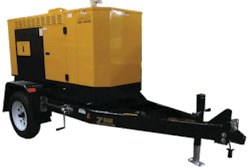
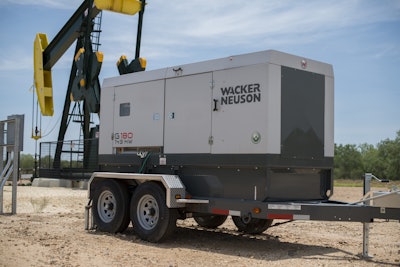
Towables have a slightly different nomenclature. “Typically, a towable unit is rated in prime power, then it has a 10-percent overload rating that will get it to what is called the standby rating,” notes Todd Howe with Doosan Portable Power. “This is the maximum amount of power you can pull out of the generator. If you operate it there, you would have a reduced lifespan.”
Units used in emergency applications are typically sized according to the standby rating, because they are not going to run very much and therefore will have a useful service life. “A mobile application for rental and construction, keeping it at the prime power rating, will ensure the unit will live to maybe a 10,000-hour lifespan,” says Howe.
Do the math
The math to determine the required size for a single-phase generator is rather straightforward.
As an example, Bernier cites a generator that must supply combined 120- and 240-volt loads. Assume that three 120-volt loads have amp draws of 2, 3 and 5 amps, or a total of 10 amps. Multiply the voltage times the total amps to determine the wattage. In this case, it would be 120 volts x 10 amps = 1,200 watts. Let’s assume there is also one 240-volt load that draws 10 amps, or 240 volts x 10 amps = 2,400 watts. Combined, the total power demand on the generator is 3,600 watts (1,200 + 2,400). Consequently, you would need a generator that can supply both 120/240 volts and has a continuous rating of 3,600 watts or greater.
Now let’s look at the surge rating. “The surge rating refers to the instantaneous amperage draw of a motor on first starting.
“This is the amount of power a generator can supply for about two seconds to start motors,” Bernier adds. “If all motors will start at the same time, add starting amps together and multiply by voltage to get total motor starting (surge) power. When in doubt about the sequence of motor starting, size for all motors starting at the same time.
“If motors will always start sequentially from largest to smallest, determine the worst case power surge,” he continues. “Is the largest motor the largest power surge, or does the power surge of the last motor starting plus the running power of other motors total up to be the largest power surge? Choose a generator that is surge rated to or greater than your calculation. It must also be rated for the continuous run power you determined.”
According to Bernier, certain rules of thumb can be used to determine surge power in single-phase systems. For example, if the motor label does not show starting amps, then calculate that brushed motors 1 to 5 hp in size typically require two times the running power to start. So a 1-hp motor that draws 1,200 watts would require surge power of 2,400 watts.
Clean power protects equipment
To provide clean power, a generator must provide consistent power output with low voltage fluctuation. Consistent voltage is necessary to ensure the operating loads do not draw more current than they are rated for.
“The better the voltage regulation, or the lower the percentage of variance, the better,” Howe says. “The application and type of equipment to be powered really determine how sensitive the voltage and frequency regulation needs to be.”
Some equipment is more sensitive to voltage fluctuations. Well-regulated voltage is the key to power tool durability and life. Wide variations in voltage can lead to over-speed, and high current conditions can lead to tool damage.
“The correct voltage extends the life of tools and appliances by allowing them to operate at designed temperature levels,” says Bernier. “Many of today’s tools contain protective power modules that will not allow the tool to operate if the voltage or frequency from a power source is outside of its design limits.”
On quality generators, voltage output is controlled through an electronic regulator. “The electronic voltage regulator monitors the voltage output to loads, much like a thermostat monitors the temperature in your house,” says Bernier. “The difference is the voltage regulator is lightning fast and responds to load changes in 1/100ths of a second. The faster the generator responds to load changes, the more stable, clean and equipment friendly the sinusoidal voltage output.”
Some low-cost portable generators don’t use voltage regulators. “Voltage control is more relaxed and comes from a rectifier or capacitor,” says Bernier. “Motor starting surge is 1.5 to 1.7 times the run rating (vs. 2 to 2.5 for a premium model) and voltage output is not clean.
“The design of generator components contributes to clean voltage output by reducing harmonics,” he points out. “Harmonics are additional unnecessary voltage sine waves sometimes referred to as ‘noise.’ Harmonics can distort the primary sinusoidal voltage output.” To combat this, Wacker Neuson includes winding slots in its generator design that are skewed with a 2/3 pitch to reduce harmonics.
Consistent engine speed is critical
Generators are designed to run at a certain speed. Maintaining this speed is critical to produce power at a consistent voltage and 60-Hz frequency.
“In mobile generator applications, where you have bigger units and more sophisticated control technology, we try to hold it to a half percent of voltage variation,” says Howe. “A quarter-percent frequency regulation is about the best you can do nowadays. The little portable gas- and diesel-powered machines still have mechanical governors and carburetor technology. Typically, you are looking at +3% to -5% nominal speed on those.”
Larger generators with more extensive electronic controls will provide better power quality. “If you need precision power that closely approximates what we are used to getting from the utility grid, step up to a towable machine,” says Howe. “The portable machines are going to have way too much voltage and frequency variation.”
Single phase vs. three phase
Both single-phase and three-phase generators are commonly found on jobsites. Single-phase generators contain the standard voltage that is delivered to most homes, either 120 or 240 volt. They are adequate for running resistive loads, low power draw applications and machines with simple electric motors. Three-phase generators are more efficient than single phase because the resulting line currents are lower. Three-phase generators are used for higher power applications where losses due to inefficiencies are significant. Three-phase generators may be found running pumps, industrial motors, batch plants and other large scale electrically powered equipment.
Three-phase power delivers greater energy density. “A typical three-phase generator is like having three single-phase generators combined into one,” says Bernier. “Almost three full-voltage sine waves are produced in the same time period it takes for one sine wave to come from a single-phase generator. These sine waves overlap each other slightly and follow one another 120° apart. This allows three-phase motor manufacturers to install three windings in electric motors (5 hp and larger) to provide more power in a smaller package.”
The differences between single-phase and three-phase generators are not visually apparent. “The difference basically has to do with the construction of the alternator,” says Howe. “A single-phase alternator has one set of windings that produce one sinusoidal AC sine wave of voltage. A three-phase alternator has three independent windings that each produce an independent sine wave.”
Larger generators, such as towables, typically offer three-phase power. “Usually, when you are getting into three-phase power, you are looking at applications that have higher amperage requirements,” says Howe. “For example, you can get single-phase motors up to about 5 hp. Once you get 7 to 10 hp, you get single or three phase. Everything 15 hp and up is three phase.”