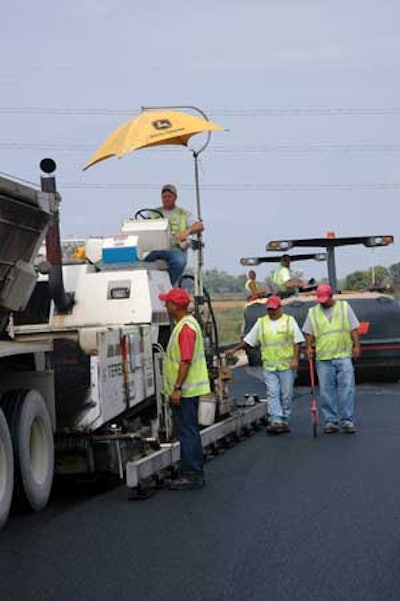
The Illinois Tollway is currently investing $180.2 million to reconstruct and widen a 16-mile section of the Jane Addams Memorial Tollway (I-90) near Rockford, IL between the Newburg Road Intersection north to Rockton Road just south of the Wisconsin border. Work to reconstruct and widen the interstate roadway to three lanes in each direction began last year as part of the Tollway's multi-billion dollar Congestion-Relief Program designed to rebuild and restore most of the 286-mile system.
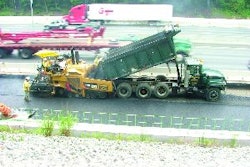
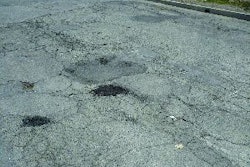
With eastbound traffic now shifted to the westbound lanes of the divided roadway, general contractor Rockford Blacktop Construction Co. of Loves Park, IL, and subcontractor Rock Road Companies of Janesville, WI, have been working around the clock to reconstruct and widen the eastbound portion of the project. Advance work on the project was completed in 2007 and included shoulder resurfacing to accommodate the traffic load of two open lanes in each direction, construction of median crossovers, adjustments in existing guardrail and intermittent pavement repairs.
The section of interstate being reconstructed and widened carries the highest percentage of trucks in the entire Tollway System. On the east end of the project near Newburg Road, Average Daily Traffic numbers in 2007 were recorded at 29,000 vehicles in each direction.
On the west end of the project near Rockton Road, ADT numbers of 24,000 vehicles were recorded in 2007. To relieve the congestion of this section and provide a safer corridor, the Tollway's widening design from two to three travel lanes is being accomplished by changing the median from an open drainage ditch system to a closed drainage system with concrete median barrier wall.
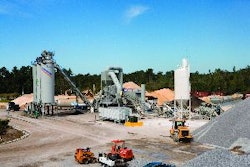
The existing roadway is being recycled into either new asphalt pavement or new aggregate base. All aggregate base material recycling is being done on-site to save in trucking costs and reduce vehicle emissions.
While portions of the original concrete roadway (approximately 60 percent of the roadway is being totally reconstructed) are being removed and crushed to maintain clearance under bridge structures, some of the concrete roadway is being rubblized and left in place.
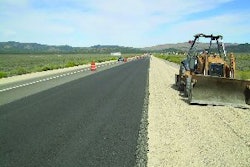
When the project is completed by the end of 2009, it's projected that 650,000 toms of asphalt will be used to construct a 12-inch overlay of the rubblized concrete, as well as build a full-depth 15-inch perpetual pavement of the areas that were completely reconstructed, along with and the additional new travel lanes and shoulders.
Addressing rising costs
Like many other road agencies across the country, the Illinois Tollway is utilizing construction designs and implementation practices to maximize its budget constraints. With ever-increasing costs of construction and materials like liquid asphalt, which hit $800-plus per ton this past summer, the Tollway designed the project to use a high percentage of fractionated reclaimed asphalt pavement (FRAP) in its HMA and SMA (stone matrix asphalt) mixes. Research and application of the high-FRAP mixes took place in 2007 with advance work to construct shoulders to carry heavy traffic during the reconstruction and widening project. Applied Research Associates developed the pavement type, and the Tollway and its consultant developed the mix design to be used for the project, with higher levels of FRAP content being used in the bottom lifts and decreasing FRAP content in subsequent lifts. But the design also allowed for sand-sized RAP to be used in the top two SMA lifts, which also included ground tire rubber (GTR) instead of a fiber filler to help maintain an open graded friction course (OGFC) design.
The Tollway uses the Illinois Department of Transportation (IDOT) Superpave mix design specifications, which allows for up to 25 percent RAP content on dense-graded base courses and up to 15 percent on intermediate binder dense-graded courses. The Tollway's research, however, allowed for up to 40 percent of FRAP in the intermediate dense-graded binder courses developed and placed by the two paving contractors working on the project.
The only concern the road agency had regarding the use of FRAP in its SMA design has been the quality of aggregate. An SMA design requires aggregate with an angular design to create a stone-on-stone matrix to ensure a rigid structural composition when compacted. That's what provides its anti-rutting characteristic on heavily traveled roadways.
Fortunately for the Tollway, the existing pavement milled off the roadway contained 100-percent crushed aggregate. The SMA design for the project allows for up to 15-percent fine aggregate RAP. Following test strips and construction of temporary travel lanes, it was determined that a Trap Rock aggregate would provide the best results for SMA mix containing 15-percent FRAP material. Mix designs being used on the main travel lanes of the project include:
On the 12-inch asphalt being placed over the rubblized concrete:
? 3 1/2-inch N50, IL-19, base course containing 40- to 50-percent FRAP with PG 58-28 AC
? 3 1/2-inch N90, IL-19, binder course containing 40-percent FRAP with PG 58-22 AC
? 3-inch N80 SMA/GTR binder course containing 15-percent fine-aggregate FRAP with PG 76-22 AC
? 2-inch N80 SMA/GTR surface course containing 15-percent fine-aggregate FRAP with PG 76-22 AC
On the 15-inch full-depth portions:
? 3-inch N50, IL-19, base course containing 40- to 50-percent FRAP with PG 58-28 AC
? 3 1/2-inch N70, IL-19, binder course containing 40-percent FRAP with PG 58-22 AC
? 3 1/2-inch N90, IL-19, binder course containing 25-percent FRAP with PG 58-22 AC
? 3-inch N80 SMA/GTR binder course containing 15-percent fine-aggregate FRAP with PG 76-22 AC
? 2-inch N80 SMA/GTR surface course containing 15-percent fine-aggregate FRAP with PG 76-22 AC
"We're projecting a $10-million savings by using a high RAP content in the mix designs for the project when it's completed," notes Paul Kovacs, Illinois Tollway's chief engineer.
When asked why the Tollway chose asphalt over concrete, Kovacs says the agency identified asphalt as the appropriate design for the project considering the volume of traffic, truck traffic in particular.
"All the work we do has a standard we need to address and through the research we do on a project, asphalt proved to be the best solution," Kovacs says.
And the Tollway's research in using a high FRAP content in design played a critical role in choosing a cost-effective solution to designing, constructing and maintaining a quality road structure.
"Based on the assumption we developed through the research work we developed in producing and constructing high-RAP roadways, and the extensive investigations we conducted to determine if this was the way to go, we concluded that it was the best approach and one that could save millions of dollars," adds Steve Gillen, materials manager for Illinois Tollway.
As for the use of ground tire rubber (GTR) in the SMA mixtures, Gillen says the purpose is to hold the SMA mix together without the use of a fiber additive. Designing a safe and durable friction wearing course was an important consideration, and the Tollway's research efforts concluded that could be accomplished with GTR modified asphalt. Additional Tollway research shows that an open graded friction course mix with a GTR modifier provides quieter noise levels with excellent friction values and no flushing.
Project challenges
With the paving contractors on board with the Tollway's high-RAP design, both Rockford Blacktop and Rock Road invested substantially in the equipment to fractionate RAP and incorporate that material along with the GTR into the mixes they produce for project, the only significant challenge the road agency has faced is maintaining safe traffic flow through the project. It's the Tollway's policy not to reduce travel during construction while still providing contractors with 24-hour access to the project.
This has been accomplished by shifting all traffic to one side of the median, allowing contractors to work safely around-the-clock to complete the project as quickly as possible. Kovacs says the project would have cost considerably more and taken a lot longer if the Tollway tried to maintain traffic on both sides of the median.
Both Rockford Blacktop and Rock Road utilized high-speed mobile screeners to process HMA grindings into small piles of sized or fractionated RAP. During the 2007 advance work, the contractors and the Illinois Tollway used the temporary pavement work to test the FRAP processing procedure in the production and placement of mixes with much higher RAP quantity as compared to current Illinois DOT mixes. The high-speed FRAP processors used by both Rockford Blacktop and Rock Road were loaned to the contractors through the Astec Corporation during the test production phase.
For the contractors, initial work with production and placement of the SMA mixes did require some adjustments, according to George Malek and Joe Lindemier, resident engineer and assistant resident engineer respectively for V3, the project's engineering firm. During initial production, the crumb rubber additive was clogging screens in the tanks where it was being mixed with the AC. That was solved by removing the screens.
Out on the project, roller operators were experiencing some shoving of the mat when trying to compact the SMA mix with heavy tandem rollers. That problem was solved by using lighter vibratory rollers, operating in static mode, to perform the initial compaction before the heavier tandem rollers began their roller patterns.
The Tollway and paving contractors are on scheduled to complete the eastbound portion of the project this month and all indications point to a smooth, less congested and safe ride for the motorists.
With the success of this project, the Illinois Tollway has established new production and construction standards for higher RAP mixes and GTR in SMA mixes for all future projects. Adopting the new standards not only supports a sustainability approach to constructing quality pavements, but it also saves the road agency and its users millions of dollars in the construction and maintenance of the system.