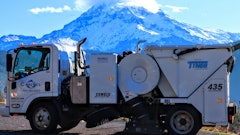
Job costing in its simplest terms is knowing how much it costs to perform a particular job. But the intricacies of that ?job cost? and how to get to it is where most contractors get bogged down. And once you have collected and organized your job costing information, how do you know it?s right? In other words, how do you know that the 25% of revenues you spend on labor for sweeping a parking lot is what you should be spending on the job?
That?s just one of the questions two veteran contract sweepers - who run two vastly different types of sweeping businesses in different markets of different size - were asking themselves about five years ago. Since then, they have been working jointly, comparing notes and numbers so that each can improve his own job costing - and his company?s bottom line.
Gerry Kesselring, Contract Sweepers & Equipment, runs an employee-owned company based in Columbus, OH, with operations in Cincinnati and Dayton. Contract Sweepers employs 100 people providing parking lot, municipal, and construction sweeping within a 75-mile radius of each location. Contract Sweepers also generates a portion of its revenue from scrubbing, indoor sweeping, distribution, and other pavement maintenance services. ?We are a sweeping contractor first and foremost,? Kesselring says. ?Sweeping is primary to what we do.?
Gabe Vitale, president of C&L Sweeper Service, Jackson, NJ, is a second-generation owner of a 50-person company that generates 85% of its revenue from sweeping (60% shopping centers, 15% construction, and 10% municipal). Like Contract Sweepers, C&L Sweeper also offers full pavement maintenance services.
Their efforts at comparing and contrasting job costing information has its roots in the North American Power Sweeping Association (NAPSA), where both are long-time members. What they?ve determined is fuel costs should be roughly 9.3% of revenues, direct labor (wages only) should be 25% of revenues for parking lot sweeping, and direct labor for broom sweeping should be roughly 25.5%. Neither of the labor figures includes benefits, insurance, etc. (They caution that these job costing figures are benchmarks for the two operations and might or might not be applicable to other contract sweepers.)
Seeking common ground
Vitale and Kesselring acknowledge that virtually all companies who track costs track costs differently - sometimes because of personal preference, sometimes because of company size, sometimes because of the approach to the business, and sometimes because they don?t really know what to allocate where.
So the first step the two took, and Vitale says it was possibly the toughest step to take, was to put together charts of accounts that were similar to one another so when they were making comparisons the accounts contained the same types of information.
?It took a while for us to be able to get some information we could use because we were each measuring differently,? Kesselring says. ?I put all my oil and preventive maintenance in one group, for example, and his is somewhere else. So we started to massage our numbers to come up with a common baseline.
?Once we had some understanding of what each of our numbers was, what each of our operating costs were, we were able to start comparing our organizations. We started understanding what?s going on in each business, and we could start to ask some questions: Why are his costs higher in some areas than mine? Why are some of mine lower than some of his??
And that?s when they really began to see the impact of job costing.
?Once we started looking we noticed there were a lot of similarities,? Vitale says. ?But it was the differences that were the most interesting and the most important.?
Start with information
?We?ve always run our company by the numbers. We wouldn?t have been around for 38 years if we didn?t,? Vitale says. ?But job costing has been an evolutionary process, and today we?re getting to hard, hard numbers.?
Vitale and Kesselring stress that there are many ways to collect the information you need to job cost. Kesselring relies on a custom computerized system he terms ?pretty robust.? Vitale relies on standard QuickBooks and Excel software that generates profit-and-loss statements, income statements, and cash flow reports. Vitale says all C&L Sweeper Service labor is broken down, from porters to mechanics to truck operators. And it?s broken down even further so the company knows the labor cost for the driver of an air sweeper or a construction site sweeper.
?As a percentage of labor to sales, a broom operator on a construction site at night gets paid more than an air operator working on a shopping center during the day,? Vitale says.
And here?s one of the values of knowing that: ?Your broom operator might be making you a nice profit on his job while the parking lot sweeper might be losing money on his job. If you keep all those figures lumped together you might never realize that and might continue to lose money or not be as profitable as you could be on the two jobs combined.?
Kesselring says Contract Sweepers has always done a pretty good job of understanding where its costs go. ?Maybe we even go overboard on it, but we always understand how much it costs to run each piece of equipment. Everything is computerized in our system, but that?s just the way we do it. You don?t have to do it that way,? he says.
All Contract Sweeper labor is assigned to specific class codes, fuel is assigned to each specific piece of equipment, and when an operator goes out to a job, construction sweeping for example, that labor is charged to construction sweeping. In addition, every Contract Sweepers purchase order is allocated to a specific place. ?If something is bought for a piece of equipment it?s allocated to that piece of equipment. If we?re buying inventory it gets allocated to inventory, but once that inventory gets put on a piece of equipment it?s allocated to that specific truck. And all equipment is allocated to whatever specific job it works on.?
Kesselring says Contract Sweepers tracks equipment allocation on each job and applies labor costs to each piece of equipment on each job. Contract Sweepers? approach to job costing also generates an hourly rate (that includes depreciation, fixed costs, maintenance etc.) for each sweeper. On large, longer-term projects all costs are allocated to that specific project, generating what essentially is a mini profit-and-loss statement.
To help track costs even better Contract Sweepers assigns operators to a specific piece of equipment. ?That way if the costs on that particular vehicle are higher we can look at the operator and talk with him to try to determine why that might be,? Kesselring says. ?If we know his costs are higher than someone else operating the same piece of equipment, what?s the reason for that? If he?s wearing out brooms faster than someone else, why? Is he not adjusting them properly? Is he leaving them down driving from one job to another? And if it?s a production issue we can look at that, too. If we know a job should take an hour and it takes him 90 minutes, why? Is he doing things you shouldn?t be doing??
Raising red flags
Both contractors always felt they had a handle on job costs and that costs were where they should be.
?But when you start looking at the numbers things start to jump out at you,? Kesselring says. ?I don?t think there?s ever been an ?a-ha? moment. It was more like, ?Look at this?? People have to understand that it?s the incremental piece that?s important. It?s not the low-hanging fruit that?s now going to make an impact. I?d like to think that as an industry we?ve already picked that. It?s the small, incremental steps of pulling out savings, of asking one question, such as ?Why is it taking one driver 30 minutes to get out of the shop each night when it takes everyone else 20 minutes?? Those 10 minutes add up.?
?There are some situations you can?t change,? Vitale says, ?But if you see a red flag you at least know there?s a red flag and you can decide what, if anything, you want to do about it.?
Among the red flags the two contractors raised are:
#1. Fuel costs. C&L Sweeper Service had noticeably higher fuel costs than Contract Sweepers. So they talked about why that might be. As it turns out, C&L Sweeper Service operates in a much more rural market than Contract Sweepers.
?We have a little more time between stops because of the type of market we?re in,? Vitale says. ?Plus, if we?re working on expanding into an area where we don?t have many accounts our fuel cost will be higher because we?re spending some money to try to expand into that area. But we know that, and that explains why our fuel cost is higher.
#2. Route density. Kesselring says knowing the cost of a particular job also helps Contract Sweepers focus its marketing efforts. ?If our operators are passing some properties that we aren?t sweeping, let?s go after those and see if we can cluster our business,? he says. ?Windshield time costs money.?
And C&L Sweeper has worked to improve its route density. ?Contract Sweepers has much more dense routing than I have and Gerry really challenged me to increase my route density,? Vitale says. ?I work in a rural area so there?s quite a bit of distance from one job to the next so that was a challenge for me, but it?s an effort we?ve made based on comparing job costing information.?
#3. Labor costs relative to the revenue generated from a specific job. ?I thought my company was operating pretty much as it should be, but it wasn?t. What I thought was efficient, wasn?t,? Vitale says. ?By looking at Contract Sweepers? numbers and comparing them with my numbers we realized there was a substantial difference there that we needed to take a look at and at least be able to explain.?
Part of the explanation is that C&L Sweeper pays prevailing wage on some jobs, but the labor costs also caused Vitale to reexamine his GPS system ? a passive system that was providing information but not necessarily the type of information he needed to make some important decisions. So he switched to an active GPS system, which he says has been a ?big, big tool in helping us get better control of our costs.?
In the end, using information generated through the new GPS, Vitale was able to reduce labor expenses by as much as 15%, which brought him much more in line with Contract Sweepers? job costing numbers.
#4. Getting better information. C&L Sweeper?s use and switch to an active GPS system, and the impact the switch had on its operation, caused Kesselring to take a more aggressive look at GPS for his company. Kesselring says Contract Sweepers had been considering GPS for some time but had always been looking for ?the perfect, perfect system,? he says. ?But there isn?t one.?
But Vitale?s insights encouraged Kesselring to install a GPS system last January, and Kesselring says the system will pay for itself in less than 12 months. ?When you start reducing inefficiencies that impacts fuel savings, and that can be significant,? he says. ?When operators start to realize there?s someone there looking at them, their behavior changes. Let?s face it ? if you?re saving a half-hour per night for one operator that?s 180 hours of operating hours. And if you?re operator costs you $20 an hour that?s $3,600 in savings on one truck.?
#5. Target times for jobs and routes. ?If you?re running a number of trucks you can?t look at each job or each truck each day,? Kesselring says. ?But we can look at exception reports every day. We can say ?I want to see all the jobs where the operator was +/- 15% of time on those jobs.? If he?s spending less time we might have quality issues; if he?s spending too long, why??
He says establishing a route time and being able to track individual sweepers via GPS has already resulted in some nightly savings. ?We had an instance where an operator was arriving back at the shop at the end of his route 30 minutes later than we thought he should have,? Kesselring says. ?We took a look at the GPS information and discovered that instead of driving the highway back to the shop he took surface roads. Why? Because he wanted to, but there?s your half hour right there, and we might never have been able to figure out where that half hour was without the GPS.?
#6. Too many employees. C&L Sweeper had two operators who were on the payroll just in case they were needed. ?Now we?ve cross-trained our mechanics as operators and told them if we need them to drive they?re going out there. It helps them keep their jobs and helps us not have to employ two extra people,? Vitale says.
#7. Waste disposal costs. ?Gabe has done a much better job of pushing that back on the customer than we have, and that came to our attention when we saw that our dumping costs were so much higher than his,? Kesselring says. ?We have always accepted that cost but we?re trying to get property managers to provide dumpsters for us to dump into on their site. Our dumping costs have gone down, and we expect them to continue to decline.?
#8. Job profitability. Job costing has also helped the contractors get a better handle on the accounts it has, enabling each to decide how it wants to handle each account. ?We?ve raised prices on some accounts when renewal time comes as opposed to just keeping them because they?re nice folks, because we?ve had them a long time, or because they pay on time. We?ve raised them or let them go,? Vitale says. ?We know we?re going to allow about 20% of our customers to be marginal or incremental business for us but we need to make a good profit on the other 80%. We know how much marginal business we want to have and why, but we can?t know that if we don?t know our numbers.?
#9. Can we afford raises? ?If we?re going to give raises we know that money has to come from somewhere, and through job costing we can get a better idea of where we want it to come from,? Kesselring says. ?Do we want to become more efficient in some way ? with routing, for example? Do we want to raise our prices? Do we want to take a closer look at lot times outside the norm to see if we can make it up there??
Why job costing = success
Vitale says understanding job costs is essential to success in the market ? and in winning profitable bids. He says once a contractor knows the cost of goods sold (which in his case includes brooms, fuel, tires ? anything that?s required to run a sweeper), the contractor can combine that with the labor rate, overhead, and the profit margin he wants to make to form the basis of a solid bid.
?You put it all together and establish a price,? he says. ?If your price is too high all the time and you?re losing bids you need to take a look and see why you are too high and what you can do about it. If you?re too high in profit you can shave that, but if you?re too high in costs how can you fix that? If you don?t have numbers to look at you can?t make an intelligent decision.
?The exciting part is that, with a business plan in place, you really know if you hit your numbers throughout the year, and you don?t have to wait until the end of the year to find out if you made any money. And if along the way you are missing your targets you can try to figure out why and make adjustments so you can fix it and still make money the rest of the year.?
Vitale says the ability to share this information with someone in the industry who understands it has been a key to their job costing efforts. ?You can hire a CPA - and companies do need to do that - but CPAs aren?t looking forward, they look back at what?s happened,? Vitale says. ?Running a business based on what your CPA tells you your numbers show is like driving a car forward while looking in the rearview mirror. Working with Gerry helps keep both of us looking ahead.?