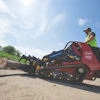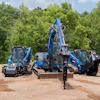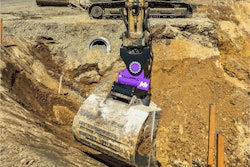
Although most contractors realize they can increase utilization of compact equipment by using attachments, there are those who have turned it into almost an art. Such contractors have managed to take a small fleet of carriers and convert them into multipurpose workhorses capable of taking on most any task a project owner or general contractor can dish out.
This strategy is proving especially effective as the construction economy slows in certain market areas. Consider Egnoski Excavating & Construction, Whitewater, WI. Tom Egnoski and his son perform a variety of trenching, digging, landscaping, demolition and other work for both residential and commercial clients. The fleet includes two Caterpillar 247 multi terrain loaders and two IHI compact excavators (Models 20JX and 40JX).
?Back a couple years ago, when we saw the recession coming, we were wondering what would happen,? Egnoski says. ?So we keyed in on every job no big contractor would want to take. We went out and talked to general contractors, electricians, plumbers.?
Thanks to a sizable collection of attachments, Egnoski Excavating & Construction has been able to take on numerous smaller jobs for these contractors on a subcontract basis. The result has been the company?s busiest year ever. ?I?ve never seen anything like it in 30+ years in the trades,? Egnoski asserts.
?I think [the attachments] doubled my business, because it?s basically just that much more versatile,? he says. ?I can offer something that most people don?t have.?
Adaptability brings in more work
Perhaps no one has done a more thorough job of using attachments to their advantage than Dee Willingham, owner/president of AAA Grinding and Trenching, Ventura, CA. He estimates he has as many as 35 different attachments for his two Caterpillar 287 multi terrain loaders, and he?s not afraid to add more, if needed, to get the job. ?A call could come in tomorrow and I would go out and buy one,? he says.
This mind set has enabled Willingham to rapidly expand his business. Although it specializes in road repair and asphalt prep for parking lots using Coneqtec/Universal cold planer attachments, AAA Grinding and Trenching is able to take on most any task that can be done with a compact machine. Willingham has equipped the loaders with asphalt rock saws to perform sawing for pipeline companies; trenchers for installing conduit between landing lights at airports; augers for a variety of drilling work, including 36,000 fence holes along the Coachella Canal in Southern California; and brush buckets for clearing debris in confined areas, such as freeway medians.
The attachment arsenal also includes dozer blades, 4-in-1 buckets, barrel grabs, breakers, brooms and even a berm grinder that Willingham invented. The berm grinder came about when a guard rail company hired him to come up with a solution for removing old berm. ?They said, ?We?ve got about 85 miles of berm right now that we need to take off, and here?s $10,000 to make it,?? Willingham recalls. Now, in addition to using it in his own operation, the berm grinder is being marketed and sold to other contractors through Coneqtec/Universal.
Bill Broach, owner of Bill Broach Co., Blythewood, SC, is also ready to add attachments as needed. ?Usually, when I get a big job that will actually pay for the attachment, I?ll go ahead and buy it,? he says.
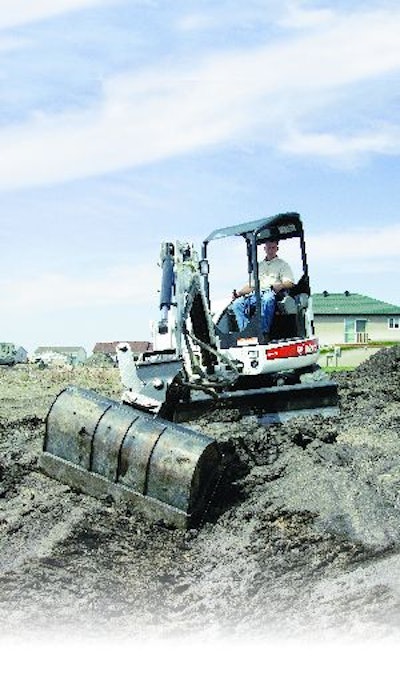
Bill Broach Co. focuses on smaller trenching projects and concrete slab removal inside buildings. In addition to various types and sizes of buckets, breakers and augers are commonly mounted on the company?s two Bobcat skid steers and two Bobcat compact excavators.
Size limits/requirements on a project often play a role when purchasing new attachments. ?On our Bobcats, we?ll use the biggest bucket we can because it carries the best payload out the door. But if it can?t fit through the door, you have to buy a bucket that will fit,? Broach points out. ?Six months ago, we did [a job] where we had to have a 30-in. trench... so I went ahead and bought a 30-in. bucket. When it requires it, we?ll get it.?
According to Egnoski, electricians, plumbers and other specialty contractors often have specific requirements for the size of attachment that can be used. ?When I trench for electricians, they all want 1-ft. buckets. Plumbers want 18 in.,? he says. He was currently digging out 6-ft. sidewalks for a concrete contractor. ?I have a 3-ft. bucket on the excavator, so it?s two wide and I?m done. And I have 2-ft. buckets, too.?
Egnoski also maintains a large selection of auger bits. ?I started out with two bits... I ended up with 12, 18, 24, 32 and 36 in., because there?s always some demand that comes up,? he says. ?So you end up buying another $5,000 worth of bits.?
Although the costs can add up, the time savings alone can often pay for the investment. ?Every job is going to require different specifications,? says Ron Peters, product manager, CEAttachments. ?If you need a 12-in. trench, it doesn?t make any sense to dig a 24-in. trench and waste all that added time and money to remove the dirt... And generally, when you fill the trench back up, you?re going to have to compact the soil. There?s more work involved to go dig a larger trench than you really need.?
Lower cost of transportation
Egnoski often travels with a couple different attachments loaded on the trailer with the loader or excavator. For example, he?ll have a bucket to prep sidewalks for a concrete contractor. ?Then I sometimes take my roller [attachment] and roll it for them because it?s faster than using a plate compactor,? he says. ?You take a 5-ft. vibratory roller, go over it a couple times and you?re done.?
A recently purchased 5-ft. rototiller frequently works in combination with a Harley rake. This summer, the combination was used to restore yards damaged by flooding. ?That ground is so hard. So I would go in and rototill it first, then I would go in with the Harley rake to do the final on it to get it set for seed,? Egnoski explains.
The ability to transport a smaller carrier and attachments rather than multiple dedicated machines reduces overhead costs. ?With a skid steer and some attachments, you generally don?t need a CDL, because it doesn?t weigh as much as dedicated equipment,? says Peters. ?You don?t need a big dump truck and trailer to haul the smaller equipment around.?
Fewer loads also mean less cost. ?I use [a roller and grader] quite a bit for doing gravel driveways, because I can haul all the equipment in one load. I can put the roller, the grader and one machine on there and go do the job,? Egnoski points out. ?If I had a roller and a grader and a skid loader, that?s three trips to the job. If I can go with one trip, my overhead starts coming down. I don?t have to have a bigger trailer, a [different] license, a bigger truck, more insurance. I stay low so my cost stays down.?
Getting more for less
Clearly, the ability to do more with compact machines can be an advantage in the right circumstances.
?Getting into tighter areas with compact excavators, skid steers or compact track loaders has opened opportunities for some [contractors],? says Doug Laufenberg, John Deere product marketing manager - attachments. ?And with this smaller equipment, many times, they can get added versatility by adding attachments.?
?You can have less money invested in your products and be more productive, doing more jobs,? Peters comments. ?You can do the whole job from start to finish with one skid steer or track loader, but you utilize different attachments to do it.?
An obvious benefit is a lower capital investment. ?Typically, the attachment is lower in initial purchase price than a dedicated machine,? says Laufenberg. ?Adding a vibratory roller attachment might cost around $7,800 vs. a dedicated walk-behind, double-drum roller at approximately $27,000 or a ride-on roller for over $50,000. Granted, the dedicated rollers may do the job in one pass vs. doing two with an attachment, but you have much less invested in the attachment and you are getting better utilization out of the skid steer vs. having a dedicated machine sitting idle for most of a job.?
Willingham asserts, ?If I were buying dedicated machines, I would have millions tied up in [equipment].? He cites the cost of a dedicated drill rig for augering holes as an example. ?I can buy a whole new skid steer, an auger and some other stuff for the same price. It?s economics.
?You can?t buy a small machine and expect to do the large work with it,? he admits. Yet, he feels there are times when a small machine will ?run circles? around a larger, dedicated machine, particularly on confined jobsites. ?A big machine has to maneuver. While it?s turning around, you may have made another two or three passes.?
There is also the added maintenance associated with a dedicated machine. For his operation, Broach says it?s more practical to invest in an attachment that he can take on and off his existing equipment. ?That way, you don?t have the maintenance on another engine and the drivetrain,? he states.
?It?s very expensive when you?re talking oil and filters,? Egnoski says. ?Filters can cost $50 to $60 on some equipment, just for one filter.?
Ultimately, the decision to invest in an attachment rather than a dedicated unit comes down to utilization. ?If you?re doing trenching every day and that?s all that you do, you wouldn?t want to do the job with a skid steer and a trencher [attachment], because you?re going to sacrifice production,? says Peters. ?But if you?re doing 100 ft. here and there and utilizing it once a week, you wouldn?t want to invest in a dedicated trencher, because they cost so much. It would just make sense to have an attachment.?
Egnoski agrees, adding, ?Buying a machine specifically made to do one thing, you invest maybe $100,000 in that machine and you use it only to do that one thing. I have my track loader, but I can use that one machine for 12 different things. That?s cost effective.?