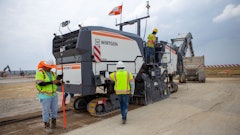
Pennsylvania-based paving contractor E.J. Breneman L.P. recently completed a NovaChip application process for Florida?s Department of Transportation as part of the road agency?s ongoing initiative to extend the service life of its road network. The 5.5-mile stretch of Interstate 10 just west of Jacksonville is a heavily traveled roadway that required substantial rehabilitation to accommodate the daily traffic volume it carries.
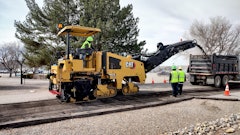
The project called for milling 22 lane miles and then replacing it with two 1.5-inch lifts of structural hot-mix asphalt, with a final ¾-inch bonded open-graded wearing course.
?We can generally get 12 to 20 years out of our structural courses, and we were looking for a way to extend the life of our wearing courses,? notes Stephen Sedwick P.E., material operations engineer for District 2. ?We (Florida DOT) completed a one-mile test project using a bonded wearing course application on I-75 in Marion County three years ago, and we were happy with the way that project has performed. So, we decided to use the process on a full-blown project.?
The only change from what typically would be considered a NovaChip or Ultrathin Bonded Wearing Course application the DOT made on the project is in the hot-mix design used in the application.
?Rather than using a gap-graded mix (which is typical of a NovaChip application), we wanted to use (Florida DOT?s) our FC5 open-graded friction course mix design,? Sedwick says. ?It?s the standard design mix that we place on a typical mill and fill project. It?s a porous mix design that allows the surface water to drain away, providing good tire/road contact and eliminating a lot of tire spray.?
According to Sedwick, the original road structure was showing signs of top-down cracking, and the road agency was looking for a way to prevent the surface course from raveling.
?We can manage to get 15 years out of our structural courses but our wearing courses never seem to last that long,? Sedwick says. ?Based on the performance of the test project we completed three years ago, we felt the bonded application process would give us the best result in making the wearing course more durable?
On a typical paving application a tack coat is put down with a distributor truck in front of the paver. Some of the tack is removed by trucks that feed the paver with hot mix. In an ultrathin bonded wearing course application, a polymer-modified bonding emulsion is applied (by the paver) directly in front of the paver screed and at a heavier application.
?We generally get 8 to 12 years out of our typical FC5 wearing course, but we think we?ll get substantially more service life by using the bonded application process,? Sedwick says. ?The process cost a little more, but the extended years of service will more than pay for the investment.?
SemMaterials provided the NovaBond polymer-modified emulsion for the project. The heavy application provides a durable membrane to seal the underlying structural pavement and also provide superior bonding of the thin overlay.
NovaChip paving treatment
The state-of-the-art NovaChip system combines the strength of hot mix asphalt with the flexibility of a thin maintenance treatment.
An effective pavement preservation program includes a number of maintenance strategies that are cost-effective and efficient in their application. NovaChip, or as it is commonly known, ultrathin bonded wearing course, is a pavement preservation technique.
The NovaChip application is an ultrathin bonded wearing course laid to a depth of ½ inch to 1 inch in thickness.
An ultrathin bonded wearing course is a high-performance surface course for preventive maintenance and new construction. It can be used either over older asphalt surfaces or over Portland cement concrete pavements.
The main application is a heavy application of polymer modified asphalt emulsion that is immediately covered by an ultrathin gap-graded hot mix asphalt material.
This technique provides a superior bond to the existing pavement. All material is placed by one single motorized machine. The surface improves skid resistance and visibility in wet weather, funneling water through the matrix of stone on stone contact and keeping surface water to a minimal. It also lowers the noise caused by tires on an asphalt surface and protects the investment below the surface.
The components of the bonded wearing course:
- Polymer modified emulsion membrane 0.13 to 0.3 gallons per square yard
- Ultrathin high performance hot mix using: high-quality aggregate; gap-graded; only ½ to 1 inch thickness; mix designed specially for process
- NovaChip spray paver, which combines a distributor and paver in one unit and applies both emulsion and hot mix in a single pass lay down
The NovaChip process was a French process that used a unique paving machine manufactured in Germany. Many countries within the European Economic Community (EEC) have been using the system since 1986.
The process was brought to the United States in 1993 and has had great success in many states. During the construction seasons of 1995 and 1996, Pennsylvania laid some 1,000,000 square yards of NovaChip on state, county and city streets.
Pennsylvania continues to place ultrathin bonded wearing surfaces today. There are many reports by respected department of transportation research centers that have documented the outstanding performance of the durable surface. E.J. Breneman L.P. constructed the largest single NovaChip project in North America in 2001. The project was located in Burke County North Carolina on Interstate 40.
Project design ? material
Ultrathin bonded wearing courses are ?gap-graded? mixes that include a high proportion of ?single-sized? crushed aggregate bound together with mastic of fine aggregate, filler and asphalt binder.
The normal course aggregate consists of 100 percent single face (85 percent two face) crushed material with a maximum Micro-Deval loss of less than 18 percent (or a maximum Los Angeles Abrasion of less than 35 percent and maximum sodium sulfate soundness loss of 12 percent).
The aggregate should be cubical with a maximum of 25 percent 3:1 flat and elongated particles. The fine material should also be angular with a minimum uncompacted void content of 40 percent. During the mix design process, the mixture should be checked for moisture sensitivity.
A membrane of a polymer modified asphalt emulsion is sprayed prior to the application of the hot mix asphalt layer to both seal the existing surface and to bond the ultrathin bonded hot mix asphalt layer to the existing old pavement.
The membrane is applied at approximately 0.2 +/- 0.07 gallons per square yard. The rate will change in accordance to the surface condition of the existing pavement. The liquid bonding emulsion should fill any small voids and provide enough emulsion so that it makes up about one-third of the thickness of the ultrathin bonded wearing course.
Binder for the ultrathin bonded wearing surface course is chosen based on the climate, traffic speed and loading conditions for an individual project.
A PG 70-28 grade is typically used on northern projects and a PG 76-22 is used on southern projects. Each project undergoes a strict design procedure and the PG grade of asphalt is then specified in accordance with that design.
Mix design and construction
The goal of the mix design is to provide sufficient asphalt binder to ensure adequate film thickness on the aggregate to provide for a durable hot mix asphalt layer.
The design is accomplished by compacting the hot mix asphalt mixture with a Superpave gyratory compactor. The specimen is compacted, after compaction the specimen is removed and the bulk specific gravity is determined. The desired air voids in the mix is about 10 percent with a film thickness of about 10 microns.
After the design binder content has been determined, the mix is re-tested for moisture susceptibility using the procedures of ASSHTO T-283. The specimens should be conditioned in accordance with the standard agency procedures.
The mix is also tested for draindown, with a desired draindown of less than .10 percent. The binder content of the mix design ranges from 5.2 percent to 5.8 percent.
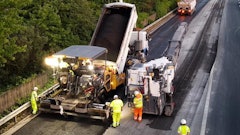
The ultrathin bonded wearing course uses a specially built paving machine. Breneman uses the Midland Machinery NovaChip paver. There are two other types of NovaChip pavers available through Vogele and Roadtec.
The NovaChip paver has a receiving hopper that the ultrathin material is placed; the ultrathin hot mix is then moved by four screw-type auger conveyors to the rear of the NovaChip paver.
Once the ultrathin bonded material is placed in the screed, it?s struck-off directly into the path of the polymer modified emulsion membrane.
The polymer modified emulsion membrane is applied by way of pressurized spray bar that is located directly behind the rear wheels of the NovaChip paver but in front of the hot mix paving screed. One of the unique parts of this NovaChip paver is the location of the spray bar, in normal pavement lay-down operations the tack coat is sprayed onto the old roadway surface.
The trucks hauling the new mix to the hot mix paver must then reverse through the tack coat to place their load into the paver. The resulting consequence is that a portion of the tack is then tracked onto adjacent highways or streets. A 3,000-gallon storage tanker in the front of the NovaChip paver provides the needed polymer modified emulsion. The application rate is calibrated into the machines computer. The polymer-modified emulsion is sprayed at around 150 degrees F.
Immediately after the polymer-modified emulsion is sprayed onto the surface of the old pavement, the ultrathin bonded wearing course is placed at 310 degrees F. The two materials immediately bond to form a thin surface on the old pavement. The paver operates at around 60 to 120 fpm depending on conditions, like depth of the lift of mix. The paver screed is hydraulically extendable, so the process can match varying widths of roadway.
The mix should be applied at a temperature of 290 to 330 degrees F. Because the mix is placed very thin, it will cool rapidly.
If the screed is not preheated, there will be difficulty at startup. Rollers should be compacting the material as close to the NovaChip paver as safely possible. To maintain a smooth mat, one should keep from stopping the NovaChip paver?s forward movement; stopping the paver will also hinder production. Logistics are, therefore very important.
Sufficient nurse trucks for the emulsion should be available, and plant production and lay down should be balanced so that the mix can be placed without stopping.
It?s very important not to vibrate the ultrathin bonded wearing course, the matrix is stone-on-stone and crushing the aggregate through vibration will cause problems.
There are normally two steel drum rollers, both rollers should be around 10 tons in weight. These rollers are operated in the static mode only. In some cases, vibrating the longitudinal joint or seam is allowed.
The process of compaction is to merely ?seat? the aggregate in the mix and not crush the aggregate. In some cases, a pneumatic-tired roller can be used to assist the compaction effort. The compaction effort should start immediately after the ultrathin bonded wearing material is laid.