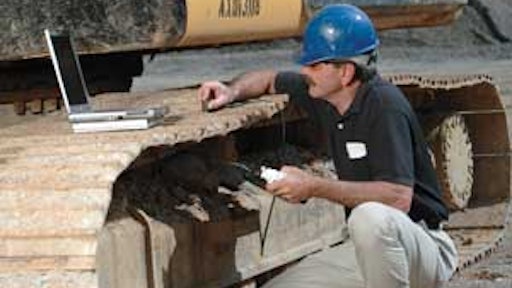
With undercarriage maintenance representing half of the owning and operating costs of a steel track machine, any extension in track life drops straight to the bottom line. And one of the largest influences on track life is the operator.
"Maximizing undercarriage life begins in the operator's seat," says Dick Schaefer, senior product manager, undercarriage, Komatsu America Corp. "The operator is the key ingredient to controlling undercarriage cost per hour. Therefore, operator training is a must."
Even with recent changes in track systems, the basics still apply. "Undercarriage technology has improved over the years with better shock absorbing systems, but the basic [excavator] track remains the same as it has for the last 20 or so years," says Dave Pooley, Hyundai Construction Equipment U.S.A. Inc. "Application and operator awareness make the difference in the longevity of the undercarriage."
Speed kills
High speed has always been detrimental to steel tracks.
"Traveling at high speed adds additional wear and stress on undercarriage components and increases the potential for serious damage," says Guido Bottin, vice president of operations, Berco of America Inc. "Wear on tracks is directly proportional to speed. So non-productive, high-speed travel should be limited, and every work action of the jobsite should be planned carefully. Track adjustment and alignment are also very important when operating at high speeds."
Of course, high-speed operation can't always be avoided. "There are times when a job requires higher speed operation, but the fact is wear accelerates as speed increases," says Thomas Neeley, world-wide undercarriage support manager, Caterpillar. "Links, rollers and idlers are particularly vulnerable. Keep them working longer by controlling your speed."
Schaefer adds, "While there is not a specific 'proper' operating speed, a well-trained operator knows how fast is too fast. "
Avoid abrupt turns
Rapid turns also place unnecessary stress on the undercarriage. "The operator must avoid pivot or hard, tight turning whenever possible," says Schaefer. "Tight turning of a machine exerts a high degree of stress on undercarriage components. Keep in mind that when we are talking about undercarriage, we are talking about a system. One component is reliant upon another component in order to function."
Actually, any time you change directions wear is occurring. "Changing directions while driving adds wear to the undercarriage, particularly on links, bushings, sprocket teeth, roller flanges and track guides," says Bottin. "Needless to say, the more abruptly and aggressively the operator turns, the more forces are produced contributing to wear on the components. In some extreme situations, these forces and loads can even lead to de-tracking. Therefore, planned ahead, gentle turning is always preferred, especially on terrains providing a lot of friction on the tracks."
In addition, avoid always turning to one side, since this can cause uneven wear. "Alternating the turning directions when possible is always recommended," says Bottin, "as well as making slow turns and periodic sprocket inspection to ensure bushing impact to sprocket is correct."
"If you're always turning in the same direction, the undercarriage components on one side of the machine will wear at a different rate than those on the other side," Neeley explains. "More specifically, turning left all the time accelerates wear on the right side and vice versa. To ensure even wear, pay attention to the way you are turning and change directions whenever possible."
Track slippage
"When moving material, an efficient operator will keep blade loads productive, yet will avoid loading the blade to the point the tracks slip," says Schaefer. "Track slippage can affect more than just the machine's undercarriage. It can adversely affect the entire drivetrain."
Track slippage and spinning can accelerate shoe grouser wear. Areas affected include sprocket teeth and bushing contact surfaces, track links and roller rails/flanges and idler tread surfaces. "All of the heavy contacts among these parts cause accelerated wear on components," Bottin comments.
The potential repercussions go beyond increased wear. "Track spinning delivers several hits to the bottom line," says Neeley. "It reduces production, so your revenue potential declines... More than a 5% slippage of the track increases undercarriage costs and fuel costs without improving productivity. And it accelerates undercarriage wear, so your costs escalate. Grouser bars are especially prone to wear problems associated with track slippage."
To minimize the potential for track slippage or spinning, Bottin advises operators to carefully consider the ground conditions and the status of grousers while operating. "Furthermore, choosing the right shoe width is important to prevent slippage in all applications," he says. "This should also prevent premature wear and other potential problems."
Working on slopes
"Operating on hills generally accelerates wear because the loads are not distributed evenly on the whole undercarriage, but are carried on by a lower number of components compared to work on flat ground," says Bottin. "Working up- or downhill stresses the rear and the front components (respectively), while working on a slope or side hill shifts the weight and loads on the downhill side of the machine."
If working on hills can't be avoided, the best approach is to alternate the direction of travel as much as possible to even out the wear on undercarriage components.
Keeping the undercarriage clean also helps. "Working on hills tends to accumulate dirt more in some areas according to the direction the machine travels," Bottin points out. "Pressure washing the undercarriage helps in keeping abrasive materials (sand, gravel) from piling up on the contact surfaces of the components, reducing wear accordingly."
Proper frame alignment is also important. "Check periodically to make sure tracks are traveling over the sprocket and idler in the center of the rollers," Bottin advises.
Reverse operation
Reverse operation has traditionally been one of the fastest ways to wear out a track. "The only time bushings rotate against the sprocket teeth under load is during reverse operation," Bottin explains. "This can accelerate the wear of sprockets and bushings up to three times compared with forward traveling."
"Operating in reverse, even at slow speeds, compounds bushing and sprocket wear," Neeley adds. "So don't run in reverse unless you have to."
In cases where reverse travel is necessary, Schaefer advises moving the machine just fast enough to maintain production without over speeding. "Some contractors have even locked out the highest reverse gear range to prevent operating the machine faster in reverse than necessary," he notes.
Some of the newer track systems on crawler dozers are more resistant to wear in reverse. "For instance, Caterpillar's SystemOne undercarriage eliminates the significant bushing and sprocket wear that occurs in reverse operation on sealed and lubricated track," Neeley asserts.
However, Schaefer cautions, "While innovations such as rotating bushings reduce the effects of reverse operation on an undercarriage by perhaps as much as 50% to 70%, there is no room in the cab for an untrained operator."
Clean and inspect with each shift
Failure to keep the undercarriage clean can compound problems related to improper track tension.
"Clean-out of tracks is a must," Pooley emphasizes. "If the tracks are too tight when working in muddy conditions, and the operator does not clean the mud out before it dries, the mud will harden and the tracks will become tighter. The sprockets will ride over the hardened mud that is packed in the rails. This will allow tracks to jump when traveling and cause idler and chain failures."
Buildup of mud and debris can also cause components to wear at a faster rate. Consequently, Neeley advises starting every shift with a clean undercarriage.
"If a cleanup didn't happen at the end of the previous shift, take a few minutes to get the job done before you go to work," he suggests. "And if you are operating in very cohesive and abrasive materials like mud or clay, you may need to clean the undercarriage more than once during a shift."
Bottin agrees, adding, "Tracks should be cleaned and adjusted at the start of each day and, in certain applications, they should be inspected every four hours."
Also periodically examine the undercarriage for unusual wear. "Inspect the undercarriage before you start working," says Neeley. "In addition to ensuring that the undercarriage is clean, spend a couple of minutes on a visual inspection. Check for loose bolts, leaky seals and abnormal wear patterns. When you spot potential problems early, you can often prevent them from turning into bigger issues that reduce component life significantly or cause unscheduled downtime."
Be aware of track position
Excavator operators also need to be aware of track positioning. Working over the side should be avoided due to the bending loads that can be transferred to the chain and shoes, says Bottin.
"When working with excavators, it's important to keep in mind the position of the idlers and sprockets in relation to the direction of work," he explains. "Operators should always work in the direction of idlers so that high vertical loads can be transmitted to the frame in a safe way through the links and idler. Working in the direction of sprockets can cause premature bushing cracks or breakage due to the loads being transferred directly to the bushings/sprocket system."
"The effects of impact on the sprocket and final drive can be high-dollar damage," Schaefer adds.
Don't travel with the drive sprockets in the front. "To maximize undercarriage life, always travel in forward when traveling a long distance, [with the idler] in the front of the machine," says Neeley. "There is significantly more external and internal bushing wear when you travel in reverse."
Also pay attention to your speed. "Because an excavator uses end thrust track rollers, when traveling on other than a horizontal plane, side loading of the track rollers is occurring," says Schaefer. "Therefore, travel at a speed that is productive, yet not at a speed that could cause track rollers to overheat and cause damage to the surface of the roller's internal seals." Overheating can cause loss of oil, with roller failure soon to follow.
If the ground is soft, use counter rotation of the tracks, Pooley advises, which allows for easier turns. "If the ground is too soft, then the turn will have to be gradual so that material does not build up against the side rail."
Don't make assumptions
When assigning an operator to a steel track machine, it's important to avoid making assumptions about their previous training or experience.
"Operators are often called upon to operate several different types of machines on a jobsite," says Schaefer. "Assuming an operator has been trained on the proper and most productive operation of a crawler-type machine can be a costly mistake."
Before the operator is allowed to run the equipment, review the importance of speed, direction of travel and proper turning practices, as well as the need to avoid impact and high packing conditions when possible.
"Make sure there is an avenue for the operator to communicate undercarriage abnormalities," Schaefer adds. "For example, unusual noises, loose or missing hardware or adjustment of the track's tension has to be effectively communicated to maintenance personnel."


![Jd Anti Vibration Undercarriage System 1[2][2]](https://img.forconstructionpros.com/files/base/acbm/fcp/image/2021/08/JD_Anti_Vibration_Undercarriage_System_1_2__2_.6116b9ff490e9.png?auto=format%2Ccompress&fit=crop&h=135&q=70&rect=9%2C2%2C701%2C395&w=240)


