It's inevitable. A seasoned superintendent, an impatient foreman and a "know-it-all" project manager begin a heated discussion on the best approach that will give their project a jump ahead of the schedule while incurring the least amount of unbudgeted costs. Words are thrown out seemingly to first drive home a point of experience, but then the words quickly get heated and are soon misinterpreted as "incoming."
Within just a few minutes these three construction leaders are almost moved to a physical altercation. The superintendent storms out of the trailer, after kicking over the water cooler, the project manager heads back to his room to e-mail his latest complaint about the situation and the foreman finishes his cold cup of coffee and eases on back to his crew convinced he is the only right thinking leader on the job.
This scenario is repeated hundreds of times a day on construction sites across the country. Whether your construction company builds mammoth hospitals or you operate a small specialty trade flatwork company, the same potential for conflict exist. But how do we resolve such conflict that can damage relationships, sabotage performance and leave fewer profits in the end?
Conflict must first be understood before it can be resolved. Conflict is inherent in any work environment where there is more than one individual at work. It's just human nature to consider personal preference over the opinion of others. In the construction industry, there is no shortage of workers and leaders who feel their way of performing, making decisions or addressing other individuals is superior. It takes a willingness to listen to the "other side" to prevent conflict or to resolve
differences.
So, what is the source of most conflict within a construction crew or project? Generally speaking, most conflict begins when there is a difference
between two opposing points of views or between the two individuals who hold those views. The opposing views might be based on different opinions or they may be based on different interpretations of some single source such as the interpretation of a drawing, a budget, a procedure or a regulation. No matter the source, a conflict develops when there are differences.
Before we review some solid conflict resolution techniques, let's be fair to the topic of conflict. Not all conflict is bad. In fact, if the two parties engaged in the conflict are mature, much improvement can come out of diverse opinions and experience. It would be fair to say that many of the best solutions on most construction sites, among even the most emotional of crews, probably came as a result of some momentary conflict.
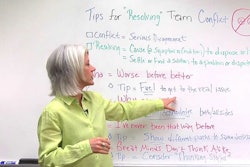
Now, let's briefly address each of the steps to resolving conflict.
- Recognize that conflict is normal.
Conflict is as natural to construction employees as breathing. Remember, not all conflict is bad! - Seek to understand the 'root' of the difference.
Conflict often arises due to misunderstandings. Always get clarity on the issue at hand. Seek to get to the real root of the conflict; allow the different parties the time to fully explain their perspectives. Work to have the conflicting parties agree on what the root issue is that is causing the conflict. - Strive to keep cool heads from heating up.
Cool heads typically come to resolution sooner, and that means less time is wasted on disagreeing. If temperatures are rising, call a time-out and separate for a short time before reconvening. Bring a little humor into the situation without making fun of those who are in conflict. - Consider personal baggage that some individuals may be carrying.
Some conflicting parties simply can't let go of past wrongs done to them or some past negative experience they have always carried with them. Considering a person's baggage doesn't mean not holding individuals accountable but it often explains why some folks take a particular negative approach or position that can contribute to conflict. - Remind those involved with the conflict of the desired business result.
When conflict happens many individuals become selfish or self-serving. It is very critical to remind those involved, if necessary, that "it's not about them." The ultimate result must achieve the desired business result even if it means that one or more parties must give up something. This step isn't as much "cold" as it is realistic that construction is a business and as a result not everyone gets their way all the time. - Brainstorm for possible solutions that support reaching the desired result.
Eventually the conflicting parties must brainstorm for possible solutions. The effort here must stay focused again on the desired business result ? "What is the best decision for this situation?" - When necessary be very clear about the 'non-negotiables.'
There is little reason to get all chaffed about what cannot be changed. Maintaining conflict over federal, state or town requirements for building makes little sense. The "non-negotiables" for any situation experiencing conflict should be clearly communicated and recognized. - Come to an agreement without pulling rank.
If the conflict is between a boss and an employee, it's tempting for a boss to pull rank and force the conflict resolution. While there may be a need to do that in some cases, it is always better to have the conflicting parties, no matter their rank and relationship to each other, come to a mutual resolution. Rank pulling often leaves one party the "loser" and looking to get revenge. - If agreement is reached, follow-up with conflicting parties to test adjustment.
Whenever conflict is reached it is wise to follow up with those parties involved to see how they are adjusting to the resolution and what issues may still exist. Follow-up also reinforces to both parties that the conflict, although uncomfortable, produced a better than expected result. - If agreement is not amicably reached, senior leader makes decision and communicates needed action to involved individuals.
While this step is not desired it may represent reality. If the conflict must go to a higher power for resolution, then the senior leader had better be very clear about what is expected and what the consequences will be if a resolution is not supported or maintained. This is the least desired step to take but at times it may be the only final step that can be taken.
I've tried to present some additional ways to resolve conflict that may not always be formally taught. While conflict is quite normal for construction crews it does not mean leaders should not address the conflict and look for positive and proactive means to resolve conflict. Certainly conflict within a construction crew, like within any relationship between people, leads to communication breakdowns and lower productivity.