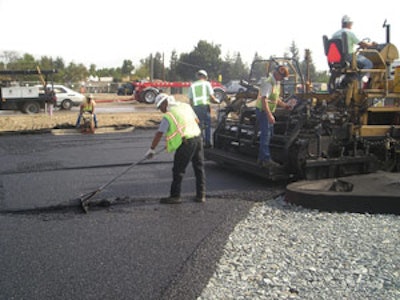
Typically used for off-road pavements that handle a low volume of traffic flow - parking lots, industrial parks, and driveways - porous asphalt pavement has been around for more than 30 years. But only recently, as land values have climbed and stormwater regulations have evolved, have so many developers begun to embrace this paving technology.
"Ten years ago it was almost unheard of, and five years ago people had become much more aware of it but it still wasn't being used very much," says Andrew Potts, water resource engineer for Cahill Associates, a consulting firm specializing in porous asphalt pavement. "But in the last three years use of porous asphalt pavement has grown exponentially. It's now on an upward swing of the curve, and we're seeing a lot more going into the ground."
Simply put, porous asphalt pavement is constructed of hot mix asphalt that has the fine material screened out. Screening out the fines creates an asphalt mix that has an air void matrix that allows water to move through it. Potts says that a traditional HMA pavement has voids ranging from about 4% to 7% but porous asphalt pavement has voids ranging from 15% to 20%. These voids enable rainwater to move from the pavement surface into the aggregate beneath it, where it can be stored until it eventually seeps into the natural soil beneath the aggregate.
"Stormwater management has come a long way in the last 30 years or so," Potts says. "Before we were only concerned with the peak rates of runoff from a project, and we handled that with detention ponds. But we've learned over the years that we were not doing a good enough job and that detention ponds were not the most effective way to manage stormwater runoff."
He says the current approach to stormwater regulation has evolved, so instead of looking only at moving the water off the pavement surface current stormwater management considers ground water recharge, water quality, and streambank protection, among other things.
"Porous asphalt pavement is another tool that can be used to meet those environmental or stormwater goals," he says. "If you can meet them by putting stormwater management underneath your parking lot you don't have to use alternative approaches, especially with land values increasing."
But Potts cautions that porous asphalt pavement shouldn't be used everywhere. "It can be used where natural site conditions, the soil and the water table, are conducive to it," he says. "And you need to use it in the proper application. You don't want to use it at gas stations, for example. But in the right setting it can be a really powerful tool."
Developers can use porous asphalt pavement without having to spend a lot of money and take up a lot of the site (areas which could be used for other construction) with other types of stormwater management, such as detention ponds. So porous asphalt pavement is now being used as a water management alternative that developers are increasingly embracing and that paving contractors are having to learn to construct.
Constructing porous pavement
Potts says the first thing to understand about porous asphalt pavement is that it's really a "system" and not just a type of hot mix asphalt.
"I can't emphasize that enough," he says. "It's important to move the water off the surface but even more important is what happens to the water after it moves beneath the surface."
Porous asphalt pavement is constructed in three basic layers: soil, an aggregate base, and a layer of hot mix asphalt. Soil must be permeable, and the contractor grading and preparing the site must be careful to not compact the soil because water needs to be able to seep into it. Some soils are not adequately permeable - in those cases porous pavement shouldn't be used or modifications have to be made to the system (e.g., the use of an underdrain).
A thicker aggregate base
The aggregate layer is an open-graded aggregate base composed of large (1 - 2 inch) angular stone. "You need angular aggregate so you have a good base to pave on and it helps support loads," Potts says.
Depending on the site and the use, the porous asphalt pavement typically uses an aggregate layer 12 to 24 inches thick, installed in lifts of 8 to 12 inches. He says the number of lifts of aggregate varies depending on how thick the lifts are.
Because the base is constructed of larger aggregate and because the fines have been removed, the angular base has air voids of around 40%. This allows water to be stored within the aggregate until it gradually seeps into the natural soils.
Potts says that in between the soil and the aggregate construction often calls for a geotextile fabric that provides separation between the open-graded stone and the soil. "By using the geotextile it makes sure the stone doesn't settle into the soil and the soil doesn't infiltrate up into the stone," Potts says.
He says placing the stone is similar to placing stone on a traditional paving job, but compacting the stone is different. Each lift is compacted just enough to set it up. "Unlike a conventional subbase it doesn't require 95% compaction," Potts says.
Hot mix asphalt surface
In most porous asphalt pavement constructions hot mix asphalt is placed in a single lift of 3 ½ inches and then compacted to 2 ½ to 3 inches. Potts says the mix can be placed by a standard paver, but track pavers are required.
"You can't use a tired paver because you're working on a base that's a little more unstable," Potts says. "The base is not compacted like standard subbase, so you need a track paver so you don't rut the stone as much."
He says planning of the paving is important for two reasons. First, the HMA itself is a different mix with a higher asphalt cement content and a stiffer binder that is sticky and difficult to work by hand. So paving should be planned in as many straight runs as possible. "Try to use the paver as much as possible so you can minimize handwork," he says.
The second reason planning is important is scheduling of mix pickup from the plant and staging of haul trucks. "Because it's a stiffer binder the mix needs to be hotter so you can work it easier," Potts says. "So you don't want trucks sitting there lined up and waiting too long. The mix will cool down, and it can be very difficult to place."
He says that while compaction of a porous asphalt mix is similar to compaction of a tranditional HMA pavement, there are some differences contractors need to be aware of. First, and probably most important, let the mat cool slightly before starting compaction.
"You don't want to overcompact it because you can cause a breakdown of the aggregate itself or a reduction in the permeability, so try to let the porous material cool off a little before you hit it with a roller," Potts says.
He says an 8 to 10 ton static roller is best because a vibratory roller might overcompact it or damage the aggregate, and he recommends only "a couple of passes" before it will be properly compacted. "Then the seams can be cleaned up with smaller rollers," he says.
Why it's the future
"Porous asphalt pavement turns a problem into a solution in terms of stormwater," Potts says. "It turns an enemy of stormwater - impervious surfaces - into a way to capture stormwater."
Potts says that once the porous asphalt pavement is constructed it's important to keep it really clean. "You need to keep it a porous system," he says. "It sounds obvious but often we see corners cut and things can get messed up if you're not careful." After construction, Cahill Associates recommends sweeping the pavement with a vacuum sweeper twice a year to maintain the permeability of the system long-term.