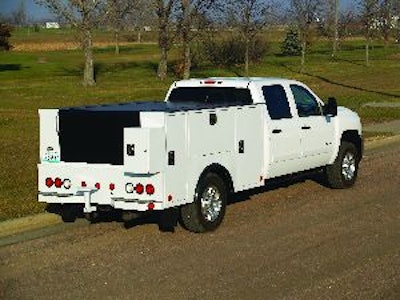
Class 5 and smaller mechanics trucks have been around for a long time, accounting for as much as five to six times the unit sales numbers of larger mechanics bodies, according to Jason Ollerich, Feterl Mfg. While the size of this market hasn't changed much, there are several companies offering new, smaller, mechanics truck products.
"Our customers are increasingly concerned about fuel economy," says Tim Worman, product manager for commercial vehicles at Iowa Mold Tooling (IMT). "With the price of diesel being what it is these days, everyone is looking for better fuel efficiency. Smaller mechanics trucks offer better fuel economy than bigger versions, and they also fill the niche need for customers who don't require a full-sized mechanics truck." This includes customers who have lighter lifting requirements.
Smaller mechanics trucks offer economies of scale. "The smaller trucks are less expensive to purchase up front, typically have better fuel economy and are better suited for preventive maintenance jobs," notes Walt Van Laren, Service Trucks International. "Class 5 trucks don't require a commercial driver's license to operate, thereby increasing the number of employees that can operate the unit. The size of the truck seems to be relative to the size of the equipment being serviced and the size of the business."
Their advantages make smaller trucks particularly attractive to the first-time buyer. "First-time buyers will get into the Class 5 truck first to understand how a service vehicle works in their business," Van Laren notes. "Construction companies that buy Class 5 trucks often shortly realize ? depending upon the equipment size they work on ? that the truck is not big enough for their needs."
"Class 5 chassis will continue to be a great option for customers who service small to mid-range equipment, including those in utilities, rental markets and equipment dealers," Worman says. "Class 3 and 4 chassis are generally best for customers who service compact equipment. We do not foresee this truck going into other industries that primarily use heavy equipment. Contractors who service heavy equipment are still going to need larger mechanics trucks. "
A careful balance
It pays to understand all of the trade-offs before selecting a Class 5 or smaller mechanics truck.
Obviously, there are limitations on the size and type of equipment a smaller vehicle can accommodate. "Depending upon the major equipment installed, such as a crane or compressor, PTO space availability and torque rating, compromises may need to be made to meet the customer's requirements," says Van Laren. "A crane and compressor can be properly sized and installed, allowing available payload for tools and materials. Oftentimes, it involves educating the buyer as to what is possible with a given GVW and what is not."
Ollerich adds, "You can certainly get smaller cranes and put them on smaller bodies, but you really give up a lot of performance. You are now talking about someone who doesn't use his crane every day ? maybe only a couple times a week. A lot of these customers are guys who are getting their first cranes. Maybe they had a Class 3 straight utility bed, which is basically just a box, and now they are getting a crane on it."
Choosing a smaller truck is a balancing act. "The most important attributes for these smaller truck chassis include the overall weight, stability and strength of the body. Finding the right combination is key," says Kyle Whiteis, director of marketing for Auto Crane Co. "Many bodies designed for these chassis are made with lightweight materials that often lack the strength and stability required of a mechanics truck (with crane). A significant weight savings may not be as attractive if you find yourself replacing the body more quickly than you had expected or find the lifting capability of the crane compromised."
"The duty cycle and longevity of the smaller class trucks is typically less," Van Laren explains, "so the bodies and accessories for them are built to match."
Fiberglass is a common material choice on smaller utility bodies. "The main advantage of fiberglass is that it weighs a lot less, but it is a little more difficult to customize," says Ollerich. "In this market, it isn't as big a deal because most people are really slamming these things out in high volumes." They simply don't do much customization.
Metal bodies on mechanics trucks allow more customizing, but come with more of a weight penalty. Manufacturers have to engineer the smaller mechanics bodies to address this weight. "You are talking thinner gauge material and leaving out some of the features that are available on the bigger trucks ? in our case, the sleeved substructure," says Ollerich. "Instead of going with structural channel, we are going with light formed channel for the underbody to keep the weight down."
But manufacturers approach design differently. "In the smaller trucks, where a lot of guys are into the 20- or 22-gauge bodies, we are more into the 14-gauge," says Ollerich. "It is significantly thicker, so the body is going to be more durable."
Compromise required
No matter what size of truck you purchase, the weight of the body is going to be an issue. "Utilization of space in a weight-conscious manner is one of the most important factors in building a service body," says Van Laren.
It becomes even more critical as you move into Class 5 and smaller vehicles. "The class of chassis will dictate the gross vehicle weight of the unit. A mechanics truck of this size that is upfitted with a crane and compressor will have payload available for tools, but the parts payload may be compromised," Worman points out. "An owner needs to be aware of available payload at the time of the purchase decision. Customers who do not fully understand this potential payload compromise during the buying phase might end up with an under-utilized mechanics truck."
Any compromises really depend on your application. "The questions you have to ask yourself are how much weight are you going to lift and how often you plan to use the crane," says Worman.
Storage capacity is a smaller vehicle's Achilles' Heel. "You are looking at weight vs. storage capacity," says Ollerich. "With a Class 3 truck, you put your tools in it and a few spare parts and you might be at weight or overloaded. The same thing with the Class 4 trucks. You really need to think about what you need to have with you. There are some trade-offs."
Power take-off (PTO) capability adds a completely new dimension to a small truck. "Once you get that PTO option available on the transmission, you can do so much more," says Ollerich. For example, you can have a hydraulic-driven air compressor vs. a heavier, more expensive engine-driven unit.
Overall, purchasing a smaller mechanics body requires a different mindset than buying a larger unit. "The chassis is probably going to be double the cost of the body," says Ollerich. "With the bigger trucks, the body may be the same price as the chassis or maybe even a little more expensive."
Think long term
When sizing a mechanics truck, carefully evaluate how much truck you need now and into the future.
"I would caution buyers against purchasing a smaller mechanics truck based solely on economy," says Worman. "Of course, economy is and should be an important consideration in any equipment purchase, but it should not be the deciding factor. The most important consideration when buying a mechanics truck is making sure the truck satisfies the needs of the job so it can be a revenue generator for your business.
"Buyers who ensure that lighter-duty mechanics trucks meet their lifting and payload needs see great benefits with Class 5 chassis and smaller," he continues. "But if the size of truck does not meet the needs of their application, the unit will probably be under utilized and will not benefit the fleet."
Don't fall into the same pitfalls as those who came before you. "Contractors that are new to service trucks typically buy less truck than what they really need, especially if they want options like compressors and cranes on them," says Van Laren. "There is little price difference between a Class 4 and Class 5 truck, so it's almost always worth it to go with the higher rated GVW. Depending upon the operation, most customers would be better served by going up a size class."
Whiteis agrees, noting, "Auto Crane works with its customers to make sure they fully evaluate both the lifting and payload requirements of the truck itself. We recommend that you have a clear picture as to what you will need to carry with you and what remaining cargo capacity you require. We find the most common pitfall is getting into a truck that is either too small to begin with or one that is quickly outgrown."
In fact, Auto Crane sales data shows a migration to larger Class 6 and 7 chassis. "While many customers do find [the Class 5 and smaller] size truck meets the bulk of their needs, we are beginning to see a percentage opting to move up to a larger class of chassis," says Whiteis. "With escalating costs of fuel, materials and labor, many businesses all across the country are stretching already tight budgets tighter. Some of them are weighing current needs with what they think they will require in the future, and are going with a larger size body to take advantage of the added flexibility. We find most of our customers who choose to go up a class are happy with their decision."