The beauty of skid-steer and compact track loader attachments is that, for the most part, they are interchangeable. Attachments such as dirt buckets, pallet forks and mowers are commonly used on both machines.
"Yet with a track loader, buckets can be easily filled to capacity, typically with less effort than a skid steer would require," says David Steger, product and training manager, Takeuchi. "Pallet forks can carry supplies through the muck, and mowers can tackle slopes due to the awesome traction that these machines offer."
However, there are certain attachments that are particularly well suited to a track loader, and will perform significantly better due to the benefits tracks provide. Some of these include dozer blades, four-in-one buckets, landscape rakes and cold planers, as well as brush cutters, sod rollers and tree spades.
Increased traction
The key strengths of a compact track loader focus largely on the tracks. "They provide a much greater amount of rubber on the ground vs. four wheels," says Rick Harris, training manager, ASV. "That equates to a tremendous increase in traction."
For example, the largest ASV machines have as much as 2,800 sq. in. of rubber on the ground. "One of the first things you will notice about a compact track loader is its ability to push and dig," Harris states. "That's a byproduct of all that track on the ground."
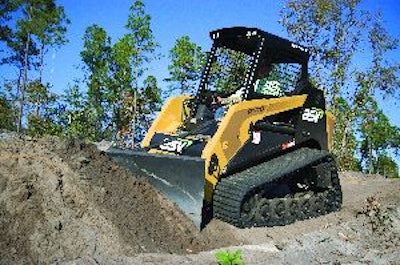
This makes it particularly well suited for ground-engaging attachments that require a lot of tractive effort, such as six-way dozer blades. In fact, you would be hard pressed to find such an attachment on a wheeled loader, Harris indicates.
Tractive ability is one reason compact track loaders are becoming increasingly popular on jobsites where contractors need to move a lot of dirt to contour the ground and/or push and backfill. "When [the] loader is on dirt most of the time, it may be in the best interest of the contractor to upgrade from a rubber-tired skid-steer loader to a compact track loader for improved productivity," says Greg Rostberg, marketing manager, Bobcat.
Some of that increased productivity can be attributed to operating weight. For example, a Bobcat T300 compact track loader weighs 9,702 lbs., while a comparable S300 skid-steer loader weighs 8,448 lbs. "The extra weight allows the machine to have higher pushing forces, so compact track loaders particularly excel at grading and excavating applications," says Rostberg. "These applications may be as simple as rough grading in a new residential area, or as complex as a final grade for a new concrete pad that requires a high degree of accuracy."
That additional operating weight also gives the compact track loader the ability to lift heavier loads. "The ability to move more material in less time improves the end user's efficiency on jobsites," says Rostberg.
Low ground pressure
Although it tends to be heavier than a skid-steer loader, a compact track loader's undercarriage distributes the weight over a larger area. As a result, the loader has more flotation with less ground pressure.
"Instead of four points of contact with the ground, the operator has the weight of the machine spread out over the entire length of the track," says Rostberg. "This provides increased flotation and minimal ground disturbance. In turn, ground pressure is greatly reduced, so you can travel across finished landscapes without having to line your path with boards or mats, thus saving time and energy."
The extra flotation also gives you the ability to work in muddy ground conditions that could sideline a wheeled machine. "That means you can get out onto jobsites sooner [after it rains], and you can get out earlier in the Spring and stay out later in the Fall," adds Ron Peters, CEAttachments, "all without leaving deep ruts like a skid loader can."
A lighter footprint gives a compact track loader the ability to more efficiently host finish grading attachments such as land planes and landscape rakes. "Compact track loaders excel at finish grading or working on subbase because of the low ground pressure," says Rostberg. "That, in turn, leaves a smoother surface when the project is finished."
"You can do more finish work with attachments mounted on a track loader," agrees Peters. "It won't leave tire prints because it can essentially float over the ground with less pressure."
For an especially light touch, some manufacturers offer smooth tread turf tracks. "You can use these on a unit as heavy as 6,300 lbs. and counter rotate on golf course turf without making a mark," says Harris. "That's because of the low ground pressure. It allows you to work on sensitive jobsites, which is important because site repair at the end of the job can be a big consideration when bidding a job."
Traversing tough terrain
Another benefit of a compact track loader is higher ground clearance, which makes attachments such as brush mowers and mulchers more productive. "Our smallest track loader has 12 in. of ground clearance. Many skid-steer loaders provide just 7 to 8 in. of clearance," says Harris. "The PT80 offers 15 in. of ground clearance, which is more than a pickup truck."
This added clearance is a benefit when you consider departure angles and the uneven terrain encountered in vegetative management and land clearing applications. "If you have low ground clearance, you usually have a small departure angle, which means you usually hit your bumper when you go up a hill or across a ditch, uneven terrain or large rut," says Harris. "A large departure angle will allow you to traverse uneven or hilly terrain without catching your bumper or hanging up your machine."
The balance and stability provided by a track loader's large footprint also makes large attachments such as mulching heads productive. "A skid-steer loader can handle a mulching head that might weigh up to 2,300 lbs.," says Harris. "But because of a wheeled machine's short wheelbase, you can be limited in the areas you can work in."
A compact track loader's stability adds to its value when working on slopes, regardless of the attachment used, indicates Steger. "Many attachments benefit from the stability gained by the solid contact between the ground, frame and undercarriage components," he says. "And this is just comparing the same soil conditions. When you factor in the ability to work in soft, muddy or sloped terrain, it's easy to see why track loaders consistently get the job done, while their counterparts are often stuck or unproductive due to the conditions."
This ability makes compact track loaders particularly attractive for landscaping tasks, such as laying sod. "Traditionally, sod is cut into 2' x 4' sheets to be laid by hand," says Harris. "But with an attachment such as a sod roller mounted on a compact track loader, you can roll sections as large as 48 in. wide and 30 ft. long. Imagine the amount of labor that saves. Now imagine it being done on slopes or on uneven terrain along highways or along off-ramps. It can eliminate the need to hydroseed.
"And with a compact track loader, you have more operating capacity, stability and accessibility compared to a skid-steer loader," he adds.
Smooth operator
Another application where compact track loaders are gaining in popularity is cold planing operations. "Many contractors have found a benefit for using compact track loaders for asphalt milling due to the solid connection the tracks give to the paved surface," says Steger. "It keeps the planer in the cut with less opportunity to wander or bounce out of the cut."
Traditionally, cold planer applications have been dominated by skid-steer loaders. "But this attachment requires a lot of hydraulic flow and high cooling capacity. It's also very fatiguing to the operator," Harris points out. "With the suspension and high-flow capability of our track loaders, you can be more productive and cost effective. You can turn on hot asphalt, because the track loader's weight distribution doesn't tear it up like a wheeled machine would."
Attachments Downsize Labor Costs
John Perkins, Orono, MN, started in the landscape business in 1968. He eventually started Perkins Contracting, first using tractors, then skid-steer loaders. In the early 1990s, he began the transition to compact track loaders and currently has an ASV RC30, RC60 and SR80 in his fleet.
Perkins focuses on a relatively niche market ? area municipalities and school districts, where jobs range from erosion control and culvert cleaning to laying sod for ballparks and rolling fairways on golf courses. Both smooth and lugged rubber tracks are used, depending on the time of year and task at hand.
Perkins figures he has 18 to 20 attachments, some that he's designed specifically for his machines and his operation. Those used most frequently include a front-mounted tiller, a Harley rake and custom-built pull blades and sod layers/rollers.
The custom-built pull blade (shown at right) consists of a cut section of oil pipe that is adapted to the loader. "We use if for mucking out silt from culverts and for pulling cattails from ponds," he says. "It has an extension so I can reach in and remove debris and vegetation. Because of the loader's flotation capability, I can go into the ponds if needed. I've been in far enough that I've had water almost to my feet. There was one instance where I had to retrieve a picnic table from a bog. A group of kids had carried it in, and with the weight disbursement of my loader, which weighs about 8,000 lbs., I was able to retrieve the table and bring it back."
The custom-built roller, which attaches to the front of the loader, measures about 8.5 ft. wide by 4 ft. high and holds roughly 500 gal. of water. "I use it to roll ball fields and fairways in the spring," says Perkins.
"There's such a variety of attachments," he adds. "Many of them virtually eliminate manual labor."
The labor savings has enabled Perkins to downsize his business from a high of about 40 employees to just himself and two other employees handling relatively the same amount of work.
In particular, the sod layer has enhanced productivity. "In the 1970s, we had 10 guys who could lay 5,000 yds. of sod a day," Perkins recalls. "Now I can get big rolls of sod that weigh up to 2,000 lbs. With this equipment, we can lay 1,200 to 1,500 yds. an hour. We recently re-did the outfield of a local ball field, where we laid almost 12,000 yds. of sod in one day."
Because of the compact track loaders' ability to access wet, mucky areas, Perkins is often called for specialty jobs. "These loaders give me the ability to bid on pond areas that aren't accessible to other machines," he says. "It's really amazing where I can go and not do any damage. A lot of the jobs we do are for developed areas around holding ponds, storm sewer outlets, etc., that aren't accessible because landowners have landscaped around everything. There's simply no access. But with a track loader and attachments, we can get in and solve the problem without hardly any damage to the turf or landscape."
From Ordinary to Extraordinary
Although Paul Daysh, California Retaining Walls, utilizes attachments commonly used on skid-steer loaders ? including buckets, forks and augers ? he says those attachments are much more productive and efficient when mounted on his compact track loaders instead. This Bay-area contractor has 12 Bobcat T300s used for grading and building retaining walls.
In fact, the track loaders have improved productivity so much that Daysh can now work year round. "They've taken me from being a nine month a year company to a 12 month a year company," he says. "The challenges of running in the winter were just too much for wheeled loaders. You just can't access many areas in the winter without a rubber-tracked machine. Since I made the transition in 1999, I am now able to work in those slippery winter conditions. With their low ground pressure, I can just be more productive. And the damage and impact to sensitive areas such as golf courses is a lot less with rubber tracks."
Daysh routinely runs in creek bottoms, and the stability of a track loader gives him the ability to also maneuver hillsides. "Our tracked Bobcats are a lot more stable and can handle heavy loads better," he says. "We custom-built some high-volume buckets that can carry about 2 yds. of material. We simply wouldn't be able to utilize that bucket on very many skid-steer loaders. The speed of operation that these tracked loaders provide makes them well worth their extra cost. Safety, stability and increased production are three factors that make these machines worth the extra money."