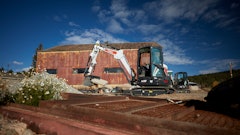
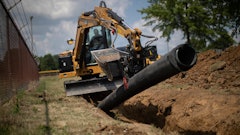
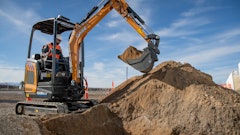
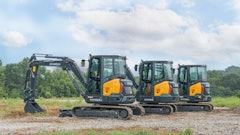
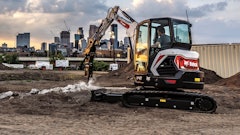
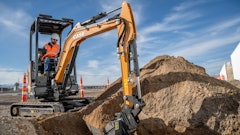
It could be said, the greatest accomplishment for compact excavators in the last 10 years has been overcoming the labels of "cute" and "toy."
"Ten years ago the North American markets may have scoffed at these compact machines," says Greg Rostberg with Bobcat. "We've seen a huge amount of the market migrate from large equipment to the compact side."
Rostberg explains that compact excavators have many other advantages over larger construction equipment, such as being highly maneuverable and compact in size. They also have a larger range of motion, attachment-carrying versatility, excellent visibility of the surroundings and attachment, and better fuel economy. And compact excavators only require a small trailer and truck to transport.
"More and more customers are realizing these advantages," he says. "The market has become more open to the idea that such a small machine can perform the same tasks as their larger equipment - and sometimes perform even better."
Compact excavators may be small, but operators still expect productivity, versatility and dependability from them. As Mark Wall, product marketing manager with John Deere, says, "Customers won't sacrifice these things simply to get into a smaller, more compact piece of equipment."
So how did compact excavators rise above the name-calling and become one of the most productive machines on the jobsite?
Productive features
Over the last decade, manufacturers have strived to get more bang for their buck out of compact excavators. To make its compact excavators more productive, John Deere has updated its entire line over the last two years.
"Several features from John Deere's larger excavators were incorporated into the D-Series compacts," says Wall. "For example, the three larger models of the series now feature auto shifting between high speed propel and low speed, high power propel."
Bobcat now offers the FastTrack drive system on its compact excavators. This all-hydrostatic drive system powers the left and right tracks independently. A FastTrack excavator's low speed - the speed in which operator's backfill, grade and doze in - is as fast as other excavator's high speed. "This means operators can backfill, grade and doze at twice the speed of other excavators," says Rostberg. "It allows operators to push through heavier piles of material and move faster around the jobsite, boosting their productivity."
The hydraulic systems have become more advanced on some compact excavator models, minimizing engine loading and improving fuel efficiency. Some Bobcat excavators are equipped with "load sensing" hydraulic systems that generate flow as the operator calls for it, which also helps optimize fuel economy.
Cab comfort
Of course, if the operator is comfortable, he is likely to be more productive. "Owner/operators make a living with these machines," says George Chaney, general manager - national account product sales for JCB. "Enclosed cabs with suspension seats and ergonomic controls keep operators more productive when they're in the cab eight hours a day."
These days, more and more machines are being equipped with cab enclosures, say sources. This allows operators to have heat and air conditioning when needed.
Controls that used to be on the floor have been moving up to hand controls. Some suppliers, like Bobcat, have moved to fingertip controls to make attachment operation more comfortable and controllable.
Creature comforts built into machines have greatly increased in the last 10 years as well, says Rostberg. "Options such as radios, suspension seats and padded floors may have been rare options 10 years ago," he says. "These options may now be standard equipment on some machines."
Chaney offers a caveat for rental businesses. "What we see is the owner/operator wants the compact excavator with all the extras. They're getting their units all decked out, but rental businesses tend to be more conservative. They have concerns over the acquisition cost and ROI as well as keeping maintenance costs down. Rental companies don't necessarily need all the bells and whistles on their machines. They need to offer customers a machine that can get the job done in a timely manner."
ZTS
Zero tailswing (ZTS) is not new in compact excavators. In fact, the first ZTS models were introduced in the mid '90s. Yet it seems this configuration may be coming into its own as a viable option to conventional tailswing designs.
"We're seeing a swing from traditional to ZTS configurations in the last five years," says Chaney. "There are both benefits and compromises to ZTS."
With ZTS machines, the rear of the machine stays within the machine's track width. One benefit of this design is that it prevents accidentally damaging trees, buildings and the machine itself. ZTS also permits easier spoil placement in tight quarters.
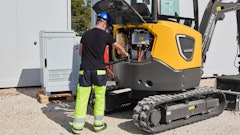
Compromises of the design include a heavier weight of the machine as well as harder-to-reach maintenance points. Many manufacturers are trying to minimize these compromises. For example, JCB offers gull wing doors for easier access to service points.
"Most manufacturers are expanding their product offerings by offering several ZTS models now," says Chaney.
The size of things
According to sources, the most popular size class over the last five years has been the 2- to 4-metric-ton machine. "This size class satisfies the largest variety of customers who use compact excavators," says Chaney.
This size machine offers many of the productivity-enhancing features mentioned earlier in this article as well as enclosed cabs or open canopies and various types of control systems. This size can fit through gates and doorways and can feature an expandable undercarriage to increase lift capacity.
For example, Deere's 17D hydraulically adjustable undercarriage retracts to a width of less than 40 inches. It extends to 50 inches for operating stability. "We understand that compact dimensions can only provide the operator with greater productivity if their equipment is maneuverable and versatile," says Wall.
Suppliers say contractors seem to be looking toward the larger models to get their jobs done these days. "We're seeing a trend of customers stepping into larger machines, especially in the construction market," says Rostberg with Bobcat.
The next step
Now that compact excavators have proven that they're a contender on the jobsite, what's the next step for these machines?
Operator comfort will continue to be a focus for manufacturers as they try to differentiate their offerings. "Competition is fierce amongst suppliers," says Chaney with JCB. "We each want to offer a difference to set us apart, and that's what is going to drive change. The main thing is offering productivity, but we need to offer productivity with comfort."
Manufacturers see the popularity of ZTS continuing to grow. They also see more machine controls, such as GPS and lasers, for compact excavators because those systems are becoming more common on jobsites.
Fuel costs will also drive change, says Chaney. He speculates that you might see electric or hybrid systems, perhaps even hydrogen systems, on compact machines.
"Compact excavators have advanced quite a bit in the last 10 years," says Chaney. "Manufacturing efficiencies and volume have driven costs down, but customers will continue to give us challenges to meet. Compact excavator technology will be driven by trying to meet those challenges, so who knows what the future might bring?"