
All family-owned companies eventually face an important decision: To continue as a family business, in which case control, accountability, and responsibility remain within the family; or to transition from a family business to a corporate structure in which family members relinquish control and employees assume a greater degree of accountability and responsibility.
A few years ago the family owners of Roberts Traffic Marking, Hollywood, FL, recognized they were nearing this crossroads. Owners Linda and Don Levine were ready to transition out; their daughter, Lisa Birchfield, was transitioning in; and Lisa's husband, Ari, also wanted out. That meant that all responsibility and accountability would fall to Lisa Birchfield, and she and Linda Levine, current treasurer, knew that wasn't going to work.
"One person cannot do it all, and even a husband and wife can only accomplish what each can do in a day," Birchfield says. "When I became involved 12 years ago I knew that this would not be healthy or a profitable way to support additional employees including my own family."
So Roberts Traffic Marking (RTM) decided to make the move from family owned business to corporation. Birchfield, who in January became president and 100% owner of the company, and Levine have spent the last few years taking the steps necessary to remove family members, including Birchfield, from the day-to-day business - while maintaining the relationships and job quality that has made the company one of the dominant pavement marking contractors in south Florida.
"You can't transfer experience"
One of the most difficult aspects of running a family business is that the knowledge of the business, and the expertise of the company, all reside within the family unit itself. As family members begin transitioning out, that knowledge must be passed along or the company will fail. Too often, as in the case of RTM and Birchfield, the knowledge becomes more and more centralized.
"The most serious issue is how to transfer all the knowledge from the people in our family, who built and who know this business, to the business itself as people transition out of Roberts Traffic Marking," Birchfield says. "You can't transfer experience - you can only transfer knowledge - so our biggest challenge is to make that happen."
Under Birchfield's guidance RTM has enhanced its value by successfully handling issues of accountability, control, continuity, training, expertise, quality control, and more as she and Levine structured an organization and created a system to encompass everything the family knows and everything the family has done - without losing a beat, a customer, or a job.
"Hiring effective individuals to 'replace' me in estimating, project management, operations, field supervision, maintenance and inventory control, was a necessity if RTM was to move on from the 'family' structure to an efficient and growing corporation - especially for the purposes of creating value for the company. RTM has done exceptionally well at transitioning from the 'mom and pop' to the corporate professional business we are today."
To make that happen Birchfield needed to relinquish some of her control within the company, and she was more than willing. But she also needed to then find the "right people" who could assume the responsibilities she was giving up. These people had to be accountable for their jobs, and they had to demonstrate a "family" commitment and work ethic - but within the confines of a corporate structure.
Airports "bread and butter"
But long before Birchfield faced the challenge of transforming RTM, Levine had the challenge of growing it. Initially the company employed only three people, but under Levine's guidance and with Don's and Ari's field expertise, Roberts Traffic Marking grew to five field workers (two crews). When Lisa came on board, and in order to support both families, RTM increased its business and currently runs five crews (two to three persons each).
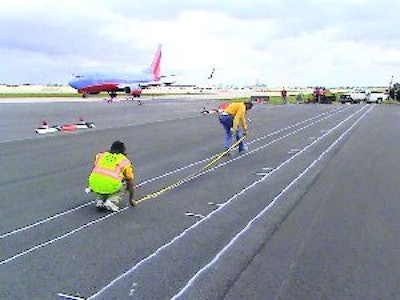
Unlike many traditional pavement marking contractors, Roberts Traffic Marking juggles as many as 40 projects at a time. Projects are often at different stages and frequently contracts tie RTM to a job for several years. Roberts Traffic Marking's specialty is applying markings to airport runways and taxiways, which requires special training, special clearances, and the ability to work around an airport's typically busy schedule.
"Airports were our bread and butter, and we had opportunities in that type of work to make greater money because we could produce more in shorter amounts of time," she says.
Today, while 40% of its work is on airports, striping parking garages has also become a business staple, generating another 40% of work. The remaining 20% is split roughly even between roadway and parking lot striping.
The transformation begins
That's the business today, significantly different, larger, and more complicated than when Levine took it over.
"Initially, it was a small business that we ran out of our garage, and our office was in our house. I knew that if I had enough money in the bank and had enough money to pay my expenses and my revenue exceeded expenses I thought I was doing well," Levine says.
As Roberts Traffic Marking neared $1 million in annual sales they realized they needed some outside help, so they went out and got it. They knew they understood the technical aspects of the pavement marking business, but none of the family members had the financial background a growing company needed.
"The group we brought in helped us better understand profit margin, helped us to do a better job of calculating overhead, and handle our overall accounting," Levine says. "They also assisted in creating job descriptions and accountabilities necessary for a growing company."
Along with job descriptions Roberts Traffic Marking is creating operations manuals unique to its business.
"Anyone can read an FAA manual, but to transfer the details in the manual to the pavement on the airfield takes experience. We're trying to show how to approach each type of job we do, where to begin the layout in the field, and how to proceed with each unique situation," Birchfield says. "We're not trying to create 'how to be a striper' manuals. We're creating an operational and procedural manual on how to approach various field installations. The completed manual and videos will include how to maintain and run each piece of equipment, how to accomplish different layouts in the field, and effective crew and truck set-up."
Birchfield says the manual covers, for example, why a crew needs a "lead person" as well as what that person's responsibilities are. Then it covers the B and C people on the crew, outlining what skills they need, what they need to do on each job, and what their overall responsibilities are.
"We're trying to create accountability," Birchfield says.
Transferring information
In 2001, Birchfield became a 45% owner in the company which had substantially surpassed the $1 million mark, increasing revenues over 50% from the prior year. Levine and Birchfield hired the company's first full-time office employee, payroll was outsourced, and the two husbands had already indicated they wanted to start transitioning out of the company, so it was clear the company as a family business would no longer exist.
For the longest time Roberts Traffic Marking did not concern itself with overhead related to labor because all family members were salaried employees.
"We worked in the office and my dad and Ari worked in the field, and if something needed to be done we just did it and that was that," Birchfield says. "If we had to stay longer to finish a job, we would, and it wouldn't cost us anything extra in payroll. Efficiency became critical when we began to hire outside 'hourly' employees."
And as they added employees they realized they had to start tracking things such as down time and drive time.
Birchfield says the husbands were the field producers, responsible for not only excellent work but for all aspects of field operations - maintenance and repair, inventory control, on-site project managers, field issues, and more. Don and Ari are demanding of themselves and of the finished job. "When the husbands were out in the field they produced extraordinary results," Levine says.
So Birchfield says transferring their knowledge and experience was essential.
"Neither of our husbands are effective or interested teachers," she says. "After more than 20 years of on-the-job training of hundreds of employees, both Don and Ari have been frustrated for years by turnover in labor along with unmotivated, unproductive employees. So, they are no longer interested in making that effort."
Partly out of frustration Don had long ago returned to operating as a one-man crew on smaller jobs, and as of the end of April Ari is no longer involved in the business at all. Don remains with the company, operating more as a consultant. "Now we'll try to get all his knowledge and expertise transferred," Birchfield says.
Not only did their knowledge not get passed along on the job, it probably cost the company some good employees. "If the crew couldn't do it right the second time Don or Ari would just take the paint machine and do it themselves," Birchfield says. "So because of the way we operated we lost some quality people because we wouldn't let them do what they were probably capable of."
To manage this transfer of information, which Birchfield acknowledges will be an ongoing process as employees come and go, RTM created the position of operations manager. "We are training one competent individual as operations manager to develop manuals and implement 'training and procedures' for all aspects of operations, from set-up of crew and trucks, to 'how to' operations of each piece of equipment, to the methodology and approach of layout and installation," she says.
The operations manager is also heavily involved in inventory and equipment maintenance. The issue of inventory control rose its ugly head, when RTM began adding crews. Ari learned the business from Don, and the two shared the load. When materials or tools or parts needed to be ordered, each would order what he needed then pick it up for each job. The two men would order what they needed, but that didn't account for what other crews needed. Crews were often short of material, and the company even lost money because everyone wanted to use the new stock - up front in the warehouse - as opposed to the older stock buried in the back, which occasionally went bad.
"It became a question of who is responsible, and for a while we didn't have an answer to that question."
But they do now.
Carl Decatrel, operations manager, supervises and directs all field activities, controls the inventory, including placing orders and checking with the crews to see what they need. "We're training him to be a replacement 'me' out in the field," Birchfield says. "Once a project is awarded he checks the site, phases it out, plans which vehicles to use, and follows up on jobs to keep an eye on productivity and quality of work. He hires, fires, schedules crews, makes sure vehicles are maintained, manages the warehouse, and pre-checks all jobsites.
"Now we have weekly management meetings with the staff to discuss what jobs are coming up, how many bids have been awarded, amount of work in progress, in order to prepare for site visits and reviewing the status of on-going projects," Birchfield says. "The operations manager is an integral part of these meetings so he knows what's coming up, he knows what's likely to be needed, and he knows or at least can check on what we have in inventory and order what we need."
Utilizing information
As new people began working in the field, getting accurate information back to the office for billing became a challenge, primarily for specialty and aviation contracts.
"Some of the striping we do is very complicated. We bid the work, especially airport work, in a very specific way based on various contract requirements and bid sheets, so the client knows what's going to happen, and so we can cost the job as accurately as possible," Birchfield says.
Once the bid is accepted and contracted, the field crew needs to report back to the office what quantities and bid items were completed in order to match the work with the estimate for billing. "Because this work is so complicated you have to understand how the job was bid out, and that's how it's got to be reported back," Birchfield says. "But except for Don and Ari, the people in the field are not familiar with that. They don't understand or know how a job was bid or why it was bid a certain way. They're out there just putting paint down."
To help improve the flow and tracking of information Roberts Traffic Marking created the position of vice president of project management, staffed by Diane Salafia. The position handles all projects from award to completion, customer service, preparation of pay applications, and invoicing. In addition to signing contracts and coordinating projects on the administrative side, Salafia works with estimating so when field workers come in at the end of the day she can get accurate information from the crews.
Ready to stand on its own
Birchfield says that by creating positions to divide responsibilities, and by finding the right people to fill those positions, they have enhanced the value of the company because information, expertise, and operations are contained within the structure of the company and not solely within the individuals who work there.
"The never-ending circle of recruiting, hiring, training, and firing continues - until we now have a great core group of stripers and crew leaders who demonstrate our 'family' commitment and work ethic. This is where we are today," Birchfield says.
Bids and estimates now are handled by Star Lilly, who started at RTM as a receptionist/bid coordinator, researching new opportunities. Payroll and human resources is the realm of Debbie Kafka, who in addition to the complicated payroll handles owner/contractor controlled insurance programs, subcontractors, certificates of insurance, employee benefits, and certified payroll reporting. And a renewed approach to employees has encouraged people to stay and grow with the company. In fact one employee, Wade Hinds, a 10-year employee who the company found through a labor pool, has become an outstanding employee and "one of our most dependable, dedicated workers."
This restructuring has decentralized decision-making, broadened accountability, and freed up Birchfield. "Releasing control of the business to other people is scary, yet with the clear accountabilities in place, and with proper oversight, we are moving forward," Birchfield says. "We're moving literally from a mom-and-pop business to a corporation. That's what we want to do and need to do so I can have the freedom to grow the business and enjoy personal time like my parents never could."
Birchfield views her role as broader and less focused on day-to-day issues, which was the goal as RTM began its transformation.
"As we have grown, information - timely and accurate - is more critical, especially in our current economic environment where we must respond quickly to a multitude of issues including production and economic effects as they are happening to determine and identify opportunities as well as potential issues," Birchfield says. "With stronger financial expertise, the future can be directed more effectively and protected."
She says she hasn't always had the time to evaluate all the information, compare this year to last, and ask the tough questions, "Are we on track?" and "Where can we adjust to work smarter, not harder?"
"Within this corporate structure I will be able to evaluate these numbers more carefully in order to respond quickly to production issues and economic effects.
"By following policies and procedures with the same level of commitment as originally shown by family, RTM will stand on its own with dedication and structure supporting the foundation of success that has been built over the past 40 years."