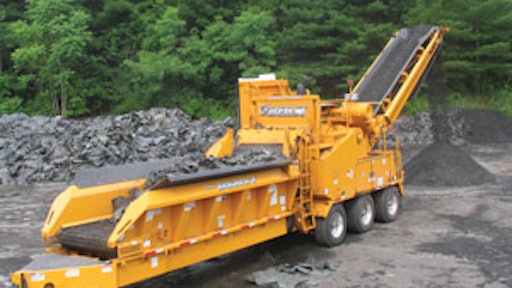
If you're looking to increase the productivity of your grinding operation, your initial reaction might be to upgrade to a higher horsepower machine so you can grind more product, more quickly. In the end, that may be exactly what you need. But you should first evaluate your maintenance program to ensure you're getting the most out of your existing equipment.
A poorly maintained grinder is less efficient, says Jason Morey, marketing, Bandit Industries. "When components such as teeth aren't maintained, the engine has to work a lot harder," he says. "It just takes more horsepower to grind with damaged teeth."
Dull, damaged and/or improperly rotated teeth can also become unbalanced, which can lead to excessive vibration, notes Mike Adsit, service manager, Morbark. "The hammermill is the heart of your machine," he explains. "If it gets out of balance and starts to vibrate, it will cause other problems. You will start to find cracks, and other components will start to fail. You can also have electrical issues."
Given the demanding tasks placed on a grinder every day - devouring everything from root balls with clods of dirt and small stones, to construction debris interlaced with metal and steel - components can quickly become damaged. If that damage goes undetected for an extended period of time, the end result is downtime and costly repairs.
To keep your grinders in peak operating condition, implement a preventive maintenance program that focuses on inspections that can alert you to damaged/worn components early. Manufacturers typically provide maintenance manuals that outline a timeline for when each component should be inspected.
"We want our customers to be familiar with maintenance tasks so they will have less downtime, and a lower cost of operation," says Jay Sarver, service manager, Vermeer.
Inspect prior to operation
Start with a visual walkaround of the entire machine prior to operation each day, suggests Sarver. This will alert you to problems with the machine, as well as any potential problems with jobsite conditions.
Look at conveyor belt tracking and infeed chains. In Vermeer tub grinders, pay special attention to the Duplex Drum, which performs the grinding. "Inspect the drum and cutter blocks," says Sarver. "The Duplex Drum is the money maker on the machine, but it could be a hole in your pocket if maintenance is not taken care of."
Teeth (inserts) are a wear item in any grinder, notes John Foote, vice president, sales and marketing, Morbark. "Those inserts are what pound against the material and grind it," he adds. "They receive all the wear."
Visually inspect the teeth and replace them as needed. "Check them in the morning, at lunch and then again at the end of the day," says Adsit. "And don't let them wear down to the point where you start to see wear on the hammer. If that happens, it's a costly repair."
Typically, teeth are made of tungsten carbide and are boltable to the hammer, so they can be easily replaced. To facilitate changeout in the field, many grinder manufacturers offer models equipped with an air compressor and all the necessary equipment to change teeth on site.
Maintain fluids and filters
Pay attention to greasing schedules for bearings for the cutter mill/hammermill, conveyor and infeed, as well as other components that rotate regularly.
In addition, check filters (fuel, hydraulic, etc.) routinely. "If you don't change the hydraulic filter when necessary, it can go into bypass mode, which allows contamination back into the tank," says Adsit. "Contamination is the biggest enemy of hydraulics. It doesn't take much dirt for hydraulic components to start to wear, or for the flow of oil to be blocked. That can create heat and fatigue the rest of the components."
Belt tension can be an issue in new machines, Morey notes. "Belts generally stretch when they're new," he explains, adding that Bandit horizontal grinders use Kevlar belts to cut maintenance costs. Check belt tension of a new machine at two hours of initial operation, then check it weekly. A properly adjusted belt will keep the grinder working longer, while reducing operating expense.
In addition, check the clutch to make sure it's lubricated and adjusted properly.
Sarver also advises implementing an oil sampling program to monitor clutch and engine oil. For best results, submit samples every 250 hours of operation.
"These oil samples for the engine and clutch are very important for seeing a change from the first [sample] through the last one," he says. "If you see abnormal metal content, contact the appropriate vender to get the component checked."
An oil sampling program can also prove beneficial if any warranty issues come into play.
Keep it clean
While it's difficult to keep a grinder clean, manufacturers recommend periodically power washing or blowing off the machine. "It will allow you to see upcoming problems much quicker," says Foote. "It also improves the overall value of the machine when you're ready to sell it."
Most importantly, check and clean the radiator. Several manufacturers have introduced reversing fans that will automatically blow debris away from the screen. "It will extend engine life because it won't overheat," notes Morey.
Also pay special attention to the "V" part of the engine and areas around the hydraulic components. "You can get a buildup of dust or dirt that can ignite," says Foote. "Always keep the area around the engine clean because it runs so hot. And if you don't clean around the hydraulics, the heat that should be dissipating will become trapped, which will cause the system to heat up and wear more quickly."
Designing in maintenance ease
Fortunately, manufacturers are continually working to make it easier to keep grinders in top operating condition. Maintenance tasks are becoming easier, and specific features make it less likely that an obstacle will render a grinder out of commission with costly repairs.
At Bandit, engineers have designed the cutter bodies to break away if they encounter something hard. In addition, a screen changing arm that fits on the fender of the machine makes changing screens much easier. All infeeds also swing away from the cutting mill to provide access for servicing the auger or other items below the cutter mill.
Vermeer utilizes a higher abrasive rating steel for some wear items and UHMW plastic for replacement wear items. Its grinders also feature hardfacing in high wear areas, such as the anvil. The introduction of the Duplex Drum on its tub grinders simplifies maintenance when replacing hammers and inspecting components. Bolt-on removable wear items simplify tooth replacement, and a lid on top of the drum and anvil goes across the width of the grinder.
Morbark utilizes a break-away torque limiter that acts as a direct disconnect from the drivetrain. If you encounter contamination such as a large piece of steel, it instantly disengages the engine and drivetrain from the mill. A hydraulic clutch further reduces the amount of damage that can occur when your grinder encounters serious contamination.
About four years ago, Morbark also introduced its Iqan feed system, which automatically adjusts feed rates, pressures and feed wheel positions to optimize production and engine efficiency. A cellular wireless data connection option for the system provides a wireless link between a service center and the equipment, so technicians can diagnose a problem via the Internet. It can also be set up so a customer can receive a text message or e-mail alert for problems or maintenance tasks that need to be completed.
"A contractor can diagnose a problem without even being on site," says Adsit. "The speed at which we can diagnose those problems is dramatically faster and the cost savings are tremendous. Contractors can also monitor equipment via the Internet to keep track of fuel usage, load factors on the engine, hydraulic pressures, etc.
"Contractors don't like to be down. The more they're down, the less money they earn," Adsit continues. "With features such as the Iqan system and a wireless data connection, we can minimize that downtime."
Match to the Material
Keeping a grinder in top operating condition is dependent on selecting the appropriate machine and features for the material.
"If you're grinding the wrong product, it will affect [machine] life. You will also lose production," says John Foote, Morbark. "If you know you're going to be [grinding] something with a lot of contamination, select 'protection' options or consider a low-speed, high-torque grinder rather than a high-speed grinder."
Selecting the right teeth and screens is also important, says Jason Morey, Bandit Industries. Screens range from 1 to 8 in. in diameter, so matching them to the task is relatively easy. However, Morey notes that Bandit offers about 20 teeth options, ranging from splitter and shingle teeth to pallet teeth. You can also use a combination of a couple different designs for optimum grinding ability.
As such, it pays to consult with your grinder equipment supplier to determine which teeth type(s) can give you top performance based on the material you plan to process.