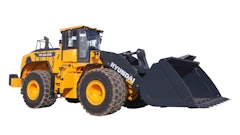
There's little in the way of a wheel loader that hasn't been affected by the introduction of electronics.
"Electronics ? play an important role in the overall value of our machines and affect all aspects of machine operations," says Alan Pumklin, Caterpillar Inc. "They provide tremendous improvements in the areas of safety, operator comfort, productivity, reliability and dependability."
What started as basic advancements with Tier II engines has progressed to greater precision and control in units equipped with Tier III power plants. Further advancements are likely as Tier IV engines are introduced.
"As manufacturers move toward more electronically controlled machines, operation becomes simplified, owning and operating costs may be reduced and hitting production targets becomes easier and more consistent," notes Nick Tullo, Volvo Construction Equipment.
Machine performance
Electronics have affected loaders in three key areas:
1. They have enhanced machine performance by controlling the engine and transmission for benefits such as reduced emissions and smoother shifting.
2. They have allowed greater utilization of operator features that make it possible to match operator preferences to the machine and the application.
3. They have drastically changed maintenance and diagnostics to simplify daily tasks and minimize downtime and catastrophic failures.
In the area of performance, electronics make it possible to meet increasingly strict federal emissions standards because they automatically provide the right amount of fuel for a particular job. Consequently, the machine burns cleaner, yet maintains consistent power.
"Without electronics, we wouldn't be able to get such fine control over how much fuel is used," says Mike Gidaspow, Komatsu America. "Emissions are reduced and fuel economy is improved."
Engine efficiency is much better today because electronics have improved timing and regulation of fuel, valves, etc., adds Tullo. "To achieve low emissions in today's engines, all manufacturers rely heavily on electronics, although to reach Tier III emissions regulations, different manufacturers have different solutions."
Electronics allow manufacturers to custom tailor power torque curves for each machine to maximize fuel efficiency and provide flexibility in managing idle speeds for specific application requirements.
An example is the Engine Idle Management System that is standard on Caterpillar mid-sized loaders. "Four idle control speeds are available with this electronic feature," says Pumklin. "Combine this with our electronically controlled transmissions, and there is no doubt that most tasks performed by wheel loaders today are made possible by electronics."
Electronically controlled transmissions enable Caterpillar to offer features such as Variable Shift Control, which allows operators to select between three transmission shifting patterns to better match application requirements. Other features, such as the Automatic Differential Locking system available on the 938H/IT38H, continuously monitor the operation of the machine and aid in tractive effort to adapt to changing underfoot conditions.
Other manufacturers offer similar systems. For example, Komatsu's Variable Traction Control allows you to reduce tire slippage by adjusting the motor speed. "That helps save wear on the tires and it improves the control of the machine," says Gidaspow. "It makes it easier to operate and improves your productivity."
On John Deere models, electronics monitor speeds and loads. "With our transmissions - which are clutch-pack style - we can control oil flow and engagement adapting," says David O'Keeffe. "It makes adjustments based on the speeds and loads it sees on the machine. It allows for smoother shifting, gear wise and directionally."
Newer electronically controlled machines also feature proportional fan drives. "You need electronics to run the fans proportionally," O'Keeffe points out. "They sense system temperatures and only run the cooling fan drive as needed. The benefit is that if, for example, the fan only needs to run at 60% to provide needed cooling, the noise level is reduced and it doesn't pull extra power off the engine."
Electronics also provide much smoother shifting. With conventional transmissions, they allow you to more efficiently adjust the shift points via the position on the throttle. "For our larger wheel loaders, there's an economy and power mode," says Gidaspow. "At the flick of a switch, you can reduce the maximum engine rpm and even change the torque curve on some machines to save fuel."
Electronics are especially beneficial for hydrostatic transmissions. "We could have hydrostatic transmissions without electronics, but they would lose most of their benefits," says Gidaspow. "With hydrostatics, you don't have to worry about shifting because there are no gears. It's all done through the hydraulics. You can get a quick response, and there's no need to kick down or shift gears.
"Electronics control the piston pump which controls the piston motors," he continues. "Without electronics, you wouldn't be able to disengage one motor and reengage it as needed. It would be much more difficult to make it a smooth transition - maybe almost impossible."
Operator features
Loader operators are faced with performing numerous tasks throughout the day, many of which are repetitive and monotonous, or need to be done simultaneously with other tasks. "Many of our electronic features assist operators in performing these tasks, and increase the comfort of the operator, resulting in less fatigue," says Pumklin.
Some of the functions found on electronically controlled machines include return to dig and return to carry, as well as ride control and adjustable gains. While these features could often be found on older models, they were mechanically controlled. "You went out and physically set the threshold," says O'Keeffe. "Now you can make some adjustments through a button in the cab. You have more flexibility, and you can change it from the seat relatively easily. Electronics allow you to dial in performance a little better."
Features such as return to dig and auto kick-down to first allow the operator to focus solely on the bucket, rather than trying to manually shift the loader while using levers/steering wheels at the same time, notes Tullo. With return to dig, the bucket can be set to a predetermined position, and at the press of a button or pull of a lever, it automatically returns to that height. With auto kick-down to first, the operator can charge into a pile of dirt in second or third gear without stalling the engine, since it will automatically kick down to a lower gear.
"These features lead to quicker cycle times, lower fatigue and, therefore, more production and income at the end of the day," says Tullo. "From a wear-and-tear standpoint, the machine will understand when to shift for best rimpull and, in the case of Volvo machines, smoother downshifts than a standard manual kick-down. This decreases driveline wear and tear and lowers tire wear due to low wheel spin."
With a return-to-carry feature, once you've dumped your load, you can simply back away from the truck, fully depress the lever and the boom will automatically reset to the predetermined carry height. "You can look behind you and concentrate on backing up, rather than on where your boom will stop," says Gidaspow. "It will stop your boom wherever you have it preset. And you can set it and make adjustments in the cab."
For jobs that require load and dump target heights, Caterpillar loaders are equipped with lift and tilt kickouts. "These provide flexibility and improved productivity by returning the lift arms and bucket tilt positions to predefined positions set by the operator," says Pumklin.
For even greater control, the Caterpillar 950H to 980H loaders offer Aggregate Autodig. "This feature controls the lift and tilt functions while loading the bucket," says Pumklin. "This means the operator can set the machine to repeat a bucket loading cycle consistently and precisely."
Volvo machines offer infinite in-cab adjustability of boom and bucket settings. "Now, the operator can adjust these detents throughout the entire range of height, rollback and tilt at any time," Tullo says. "This makes adjusting height and angles of your attachment easier and safer, and the operator no longer has to use a wrench to physically change sensor positions. They merely press a switch and hold until set."
Maintenance and diagnostics
Perhaps the most valuable benefits electronics bring to wheel loaders is in the area of maintenance and diagnostics.
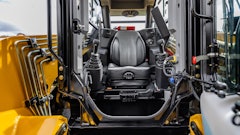
To ensure preventive maintenance is performed routinely, electronics enable you to enter service interval information into the in-cab system, which then alerts operators via the screen display when routine tasks such as engine oil changes, air filter changes, etc. are due. Critical performance information is also displayed on the screen, so operators can easily and quickly monitor machine health.
"Electronics allow you to be more precise because of the data it provides," says O'Keeffe. "You don't have to rely on tools such as pressure gauges, which if used incorrectly, can have variances. Now you can look at a screen to get accurate readings. All the information is at your fingertips."
For example, on Volvo loaders, the in-cab system constantly tracks fluid temperatures, pressures, etc. and alerts the operator if any levels become unsafe or detrimental to the machine. "The operator can either observe low-level warnings such as 'low washer fluid' and fill at his convenience, or idle the machine in the case of, say, high axle temperatures," says Tullo. "In extreme cases, such as low oil pressure, the machine will go into a 'limp mode', where it will not allow high engine speeds until the machine is reviewed or repaired. This prevents engine seizing or otherwise extreme damage to the machine."
Electronics can also save time in diagnosing and treating problems. "An operator can relay code information displayed on the screen in the cab to a service technician," O'Keeffe explains. "The technician can be prepared to fix the machine and get it up and running quickly, as opposed to having to go back and forth between the machine and the shop to get the right tools and repair equipment."
Many in-cab diagnostics systems can be taken a step further. Wireless technology can be used to transmit data from the loader to a computer or other electronic media where, say, the equipment manager can monitor the machine via a secure web site.
With JD Link, it's possible to identify information as detailed as which gears a particular machine spends the most time in. It can also tell how often, for example, a machine has overheated and when it last occurred.
"It gives you information that may be able to help you avoid a catastrophic event on a major component, which could then minimize any collateral damage within systems," says O'Keeffe. "It really opens up a whole new opportunity to better understand what's going on with your machine to get the most life from it as possible."
The beauty of these wireless programs is that machine health can be monitored remotely. "We've heard of stories where the dealer salesperson will get to the office and see that one of his customer's machines needs an air filter replaced," says Gidaspow, in reference to Komatsu's Komtrax system. "He can call the customer and alert him to that fact before his day even begins. So before the owner even knows there's a problem, the dealer can send someone out to try to resolve it."
The Product Link system uses satellite technology to provide two-way information flow between machine onboard systems and the Caterpillar network operations center. "Multiple types of information can be collected and tracked - from machine location and service meter hours, to health and productivity information," says Pumklin. "Information is accessed by a subscription to EquipmentManager, allowing contractors to optimize asset utilization, reduce security risks, improve maintenance management and implement before-failure repair strategies. The result is more uptime, lower operating costs and a higher return on equipment investment."
Care Track is Volvo's solution to satellite machine tracking, where information can be viewed by owners to ensure high performance, proper operation and even set barriers and perimeters for where the machine can operate. Owners can allow dealers to help them maximize uptime by understanding when a service is due and when maintenance or repairs may be needed. Owners can then take a proactive approach and plan downtime.
Using Care Track in parallel with Volvo's MATRIS (Machine Tracking Information System), the owner can also download information for a specific machine that includes its entire history, such as fuel consumption, shifting patterns, idle times, etc., from a desktop. "This system not only helps resale values, but Care Track coupled with MATRIS allows convenience and consistent performance," says Tullo. "It can help you train operators, log maintenance issues or even optimize productivity of your operation.
"With electronic systems constantly watching and optimizing performance, machine life can be maximized," he continues, "but only if the operator and owner apply diligence to the feedback the machine gives them."