
When bidding state, county, or municipal work where low bid gets the job contractors need to be efficient and they need to be accurate. Inaccurate estimates, crews that take too long, or crews that perform low-quality work that requires call backs leads to a company operating in the red, or maybe not operating at all.
AnnSeal Inc. understands that so has established processes that enable the company to be accurate in its estimates, efficient in its operation, and successful in the big picture. Located in Bible School Park, NY, six-year-old AnnSeal is able to mix and match employees and equipment to thrive, generating 100% of its sales from cracksealing work (including construction and repair of joints in concrete) throughout the Northeast. It is prequalified to bid in New York, Vermont, New Hampshire, Massachusetts, Maryland, Maine, and Pennsylvania.
The contractor?s crews hit the road for days at a time, staying in hotels during the week and heading home for the weekend. A woman-owned business lead by Nancy O'Brien, president, AnnSeal employs more than 40 people from April through November - and many of those people have been with the company since it started.
"Our people do quality work, we are extremely efficient, and the crew members anticipate each other's needs. It's really artistic if you watch them do it," O'Brien says. "We think that's a strong testament to the way we run our business. We couldn't do what we do without these people."
True. But there's a lot more going on behind the scenes that enables AnnSeal to be as successful as they are.
Asphalt & concrete
O'Brien says that AnnSeal is the primary contractor on roughly 80% of the work it does, operating as a subcontractor on the remaining 20%. Almost all the contractor's work is done on roads or runways; very little is done on parking lots.
AnnSeal bids work that includes spall repairs on concrete runways and roads, jet fuel resistant joint sealing on airports, silicone joint sealing, and hot rubberized asphalt repair and joint sealing. While the breakdown varies year to year depending on what work is available to bid, most work (90% in 2007) is done sealing cracks in asphalt using hot pour material. The remaining work (10% in 2007) is construction and repair of joints in concrete pavements.
Jerry O'Brien, consultant to AnnSeal, says the number of jobs performed also varies year to year, but is consistently in the area of 30 jobs annually. "The jobs vary in size quite a bit," Jerry O'Brien says. "Our jobs can run anywhere from a few thousand dollars to more than $1 million, but most are in the area of $100,000 to $200,000."
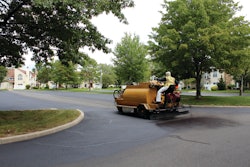
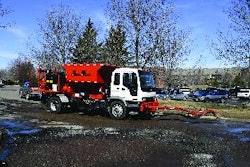
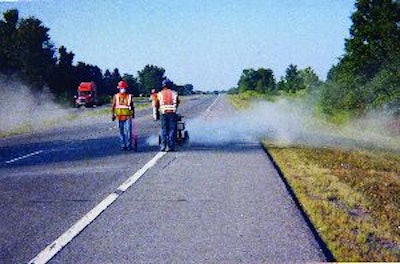
To get the jobs done AnnSeal relies on nine Crafco melters ranging from 100 to 400 gallons, and most melters are outfitted with auto loading because it's safer and quicker. AnnSeal also operates a dozen Crafco routers, six Sanders pavement saws, and four truck-mounted attenuators. Stake rail trucks tow the melters and the trucks are also rigged to carry traffic control signs and cones. Support equipment includes compressors, designed to send air to the front of each truck where the crew, using a quick connect, can attach a blow wand or heat lance to clean cracks ahead of the truck.
Cross-trained employees
O'Brien says AnnSeal loses only two or three employees each year. "I think they actually like what they're doing, they make decent money, and they like being outdoors," she says. "The crews work so well together because they feel camaraderie with one another."
Doug Luke, vice president, says the company treats its employees in a professional, respectful manner. "We treat them the way we expect and want to be treated," Luke says. "A lot of the people we have working for us were referred by other workers. One guy we hired last summer had been trying to get to work for us for two years."
Luke says AnnSeal's approach to its schedule has a positive affect on its employees. "We set up the schedule as much as possible so there is no waiting time between jobs. That way they can move from one to the other so they're out there making money instead of waiting around," Luke says.
Even their approach to equipment helps employees. "We work hard to keep it in as good a shape as possible so they don't have lost time or nerve-wracking problems of trying to get it fixed in the field," Luke says. "That way when they come to work they can work."
But as important as how they treat their employees is the fact that they cross train them, and the fact that AnnSeal's management team knows its employees and their capabilities so well. O'Brien estimates that 80% of AnnSeal's workers are trained in both asphalt and concrete work, which provides a great deal of flexibility in bidding and scheduling. "Since we started 95% of guys are still here and over past six years all our people have done quite a bit of work on both types of pavement," Luke says.
So he is able to juggle crews and equipment, mixing and matching to obtain the optimal combination to get all the company's work done. Crews can range in size from four people up to nine or 10 people, all depending on the size of the job, the type of work, and what other work is scheduled for the same time. All crews have a foreman or crew manager.
AnnSeal's four-person crews assign one person to blow cracks clean, one person to drive, and two people dedicated to sealing cracks. The contractor's nine-person crews devote as many as four people to traffic control, one person to blow cracks clean, one driver, two people sealing, and one person opening boxes of material and feeding the melter.
Luke says even the way the crews work is more efficient than many other cracksealing contractors. "By combining top-of-the-line equipment with well-trained, quality people we have developed a process that's very efficient. We use a lot of four-person crews because we can do with four people what many contractors need six people to do."
Managing bid details
AnnSeal's efficiency starts with a "devil's in the details" approach to each bid. The contractor does not rely on the engineering specs as they develop their bid.
"Someone looks at every road we bid," O'Brien says. "One of us will look at each and every road or job, even if we have to drive 10 or 12 hours to get to that job. We think it's essential to know the field conditions of each and every job before we can make an intelligent decision about it. How else can we know if the job can be a profitable one for us"
"At least three of us and sometimes more go over it and decide how we want to bid it and how much we'll bid it for, by what the road looked like. We have a lot of experience being out there ourselves so we have a pretty good insight into what's going to happen on each job. That's one reason we go out and look at each one."
Once the bid specs are received and the job has been viewed, Jerry O'Brien takes over starting with a QuickBooks contractor software program to help develop the bid. AnnSeal also has developed its own software that helps fine-tune the bid. He studies the job and specs, incorporates information from the site visit, then estimates the amount of material and hours of labor the job will require. To enhance crew efficiency the team pairs people up according to their abilities so each crew is balanced and can handle just about any situation. Plus, he makes sure there is at least one person with mechanical ability on each crew.
"That way if something does break down in the field there's someone out there who has a good chance of being able to fix it," he says. "We're a very flexible operation so it's not an issue to get the jobs done. It really is a dance. Things can change anytime, jobs pop up, and we have to put the right combination of people and equipment together for the right job."
He says the guys are flexible, too, which aids scheduling.
"We're very good at scheduling and dispatch, but there's no one thing that we do that makes it work," Luke says. "It's a combination of a lot of different things that come together."
So the sales and management team matches the crew to the equipment to the job, puts a dollar figure on the work, adds the necessary profit to the cost figure, and the bid is complete - provided the management team signs off on it.
"If the team isn't satisfied we hash it out and go back over the items and we keep making changes and keep working things out until we get a number we want to go with," Jerry says. He relies on his Excel program which makes it easy to add and subtract all the various elements of the bid. "That program gives us our cost per day on that job and we go from there to get us to a point where we think the bid will be competitive and the job will be profitable."
If they can't agree on a bid number the team re-examines all the information and works to increase or decrease the bid.
"Sometimes we just can't make it work, and that's where experience on Doug and Jerry's part comes in," says Nancy O'Brien. "Maybe we'll discuss it and present another avenue the customer hadn't thought of that will help bring it up."
Luke says that in some cases changing personnel on a job can make the difference.
"Instead of just putting a regular crew on the job we can put our key people, our more experienced people, on that job," Luke says. "That would increase the labor cost but it might also increase the productivity enough so we can be more competitive in the bid. It really depends on a lot of different things."
If the management team still can't agree on the bid, or if Luke can't make the schedule-and-worker combination work out, the team steps back from the bid and tries to look at it from a fresh vantage point.
"Maybe what's causing us to be too high is that they want the job done during a busy traffic time, and maybe we can suggest switching the job to a time period when traffic conditions are more favorable," Luke says. "We might even suggest working on Saturday and pay overtime because, number one it's safer, and number two we can be more productive because there are decreased traffic concerns. There are a lot of variations we can consider."
Tracking each job
Once AnnSeal is awarded the bid the team develops a start-to-finish schedule for the job. The schedule is finalized at a preconstruction meeting with the inspector. Luke says the schedule is important because it is based on the particular combination of equipment and labor he's assigned to that particular job.
"We know how much each individual employee is capable of producing and we know what each piece of equipment is capable of producing, so when we put that into the bid we know how much work we can expect to get done each day on each job," Luke says.
That information and detailed approach not only helps determine the bid and helps AnnSeal stay profitable, it helps the company track its production per job per day to make sure they're on track.
Jerry O'Brien says AnnSeal tracks job costs each day for each crew. "That way we know whether there was a profit made that day or not," he says. Time sheets are turned in each night, and Jerry enters the information on each job into his own program in an Excel spreadsheet format. "If I find out we're not where our schedule says we should be then I need to find out why because based on the bid we know where we have to be each day to both meet our deadline and have a profitable job. If we're not doing that well I let Doug know and he talks to the crew manager right way so that the next day we're up to where they need to be," Jerry says.
When Luke talks with the crew manager his aim is to improve productivity the next day, to get back on schedule, but first he needs to know what happened. "There might be a good reason so we don't fly off the handle," Jerry says. "So Doug calls and finds out why. If it's reasonable excuse we'll let it go and wait another day to see how those numbers come in. If it's not reasonable we try to give them some pointers on what they're not doing or what they need to do to get where we need to be."
A good example is if the morning is moist and the crew had to add a heat lance to the process, which enabled the crew to work on the job but slowed production. Another example is if there was an equipment breakdown so they weren't actually working all day. If that's the case Luke offers tips on how to increase production the next day to get the crew back on schedule.
"A couple of years ago we bid a job and our bid was considerably lower than the next-lowest bid. They called and asked 'Are you sure you can do the job' You're considerably lower than other bids" and so we looked at our bid again and told them "Yes, we could." And we did," O'Brien says. "We just work quicker and we put the right people in the right place. We have that luxury."