With the ?green? movement starting to build momentum in the asphalt industry as an environmentally sustainable approach to serving the road paving needs of this country, a Minnesota asphalt producer/contractor continues to promote that concept by incorporating waste roofing shingles into the hot mix it produces and places.
Bituminous Roadways Inc., based in Inver Grove Heights, MN, recently completed a 2.7-mile stretch of Trunk Highway 149 in Eagan, MN, using a mix design containing a low percentage of roofing shingles.
The project consisted of reconstructing an existing two-lane road into a four-lane divided highway with upgraded controlled intersections and an additional controlled intersection.
The City of Eagan, in partnership with the Minnesota Department of Transportation, wanted to improve traffic flow and increase safety along this project. The original project scope included approximately 105,000 cubic yards of common excavation, 63,000 tons of Class 6 aggregate base and 70,000 tons of bituminous pavement. Park Construction Co. of Hampton, MN served as the general contractor of the $9.1-million project, with Bituminous Roadways serving as the asphalt paving subcontractor. Bituminous? portion of the project represented $3.4 million of the contract.
Some of the more notable benefits of the shingle mix design used on the 149 project included:
- BRI achieved an average International Roughness Index of 34.18 inches per mile.
- The project owner saved an additional $100,000 by allowing shingles to be used in the mix versus only allowing recycled asphalt pavement (RAP). Using five percent shingle content generated $1.43 per ton savings.
- BRI also received a density incentive of approximately $50,000 determined by core samples pulled from the project.
- The composition of the waste shingles used on the project consisted of approximately 20 percent asphalt, 70 percent granular material (mineral filler and high quality aggregate), and 10 percent backing (cellulose or fiberglass).
For MnDOT new construction projects consisting of three or more lifts of HMA, full bonus incentives are awarded when the IRI does not exceed 30 inches per mile. BRI received a ride bonus of $21,000 on this project.
Project challenge
Since Hwy. 149 serves as a major connection between State Hwy. 55 and State Hwy. 3, providing access to several major businesses, the road needed to remain open to traffic during construction.
?Since the project called for converting and existing two-lane road into a divided four-lane highway with controlled intersections, it was basically a total full-depth reconstruction requiring reclamation of the surface asphalt and removal of some of the concrete roadway,? notes Dusty Ordorff, quality control and materials manager for Bituminous Roadways.
?Our portion of the project (asphalt placement) required us to place four 2-inch lifts of Traffic Level 4 Superpave (four inches of non-wearing base and four inches of wearing course),? he continues. ?The mix design is what MnDOT specifies for high-volume roads (over three million ESALs).?
The non-wearing course consisted of a PG 58-28 binder with 12.5mm nominal aggregate size and 3 percent air void. The wearing course consisted of a polymer modified PG 64-34 binder, 12.5mm nominal aggregate size and 4 percent air void when compacted.
?On the non-wearing mix design we were allowed to use 15 percent reclaimed asphalt pavement (RAP) content and 5 percent recycled roofing shingles,? Ordorff notes. ?On the wearing course mix design we had to limit the RAP content to 5 percent, but we were still allowed to use 5 percent shingle content ground to 5/16-inch minus and ground just-in-time to avoid re-agglomeration.
?A year ago, MnDOT changed the specs for mix designs containing recycled shingles, stating that 70 percent of the asphalt cement binder in a mix had to be new,? he continues. ?That restricts the amount of RAP in shingle mixes.?
?We now treat waste shingles the same as RAP,? notes Roger Olson, research engineer for MnDOT. ?If we award a project that allows the mix to contain 30 percent RAP content, the contractor can place a mix that has 25 percent RAP and 5 percent waste shingles. As long as the performance characteristics meet our spec requirements, we consider shingles to be the same as RAP. I do think we?ll eventually develop similar specifications for using tear-offs (old shingles).?
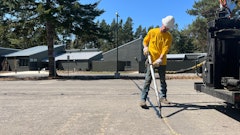
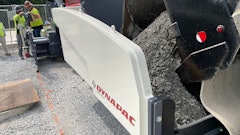
For the Hwy 149 project, the equipment Bituminous? paving crew used to place the mix included a Weiler E650 windrow pickup machine, a Blaw Knox PF5510 paver equipped with a Smoothtrac sonic averaging ski and a Blaw Knox drag style ski, a Cat 634 84-inch vibratory breakdown roller, a Sakai SW 850 79-inch vibratory breakdown roller, a Sakai GW 759 vibratory pneumatic intermediate roller, and a Hypac 766 66-inch finish roller.
The paving crew used a Seaman nuclear gauge and a Transtech PQI non-nuclear gauge to monitor pavement density.
10 years of experience
Bituminous has been recycling waste shingles since 1996 and has produced over two million tons of HMA with shingles added since then, recycling over 100,000 tons of scrap shingles. A bulk of Bituminous? shingle supply comes from a local shingle manufacturer that generates 30,000 to 40,000 tons of rejected shingles annually.
?They (shingle manufacturer) were sending their product to another company that was stockpiling the waste shingles and the manufacturer wanted the material to be recycled, so they started sending their factory rejects to us 12 years ago,? Ordorff says. ?What we don?t use for our own production we give to an asphalt producer out of our market area.?
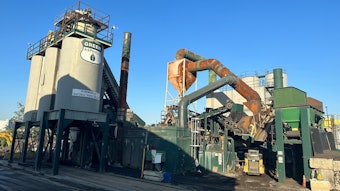
Bituminous Roadways operates three asphalt plants in the Twin Cities, producing over a half million tons of HMA annually.
Ninety percent of what the company produces is used to support its own paving crews.
As the company grew from a parking lot paving contractor to one that now paves city streets, county roads and state highways, Bituminous began to incorporate shingles into the mix it produced in the mid-1990s as a way to lower production costs and become more competitive in the market. The Minnesota Office of Environmental Assistance helped Bituminous to have the shingle content specified as part of the mix design it would supply road agency projects. The company processed 1,000 tons of waste shingle in 1996 and 27,000 tons in 2007.
?Until MnDOT changed the specification on shingle content about five years ago, we had to have approval from a project engineer in order to use shingles; and that was a major roadblock over the years in trying to increase usage,? Ordorff says. ?We did quite a few demo projects over the years, and Hennepin County has been a big supporter by executing some major test projects using a shingle mix.?
?We conducted our first test project using hot mix with shingles added in 2002 on a typical county road with medium traffic volume,? notes Steve Peterson, technical coordinator for Hennepin County?s road department. ?At the time we were interested in the cost savings (approximately $1 per ton) of buying mix with shingles to supply the projects we handle with our own paving crews. Since then we?ve purchased approximately 56,000 tons of asphalt mix that contains waste shingles and the projects have performed well. We award material contracts based on each individual project bid. We?ve been happy with the asphalt performance, we like the fact that it does save us some money, and we?re also happy that using shingles in hot mix does reduce the waste that?s sent to landfills.?
A recycling commitment
Ordorff admits it was not easy to convince project owners to allow a shingle mix design, since there was no historical experience to benchmark performance.
?MnDOT tweaked the specs a few years ago regarding shingle usage and now it?s treated like RAP,? Ordorff says. ?Shingles are a consistent product that contains valuable components used to produce HMA. Eighty-six percent of the mix we produce at our company now contains roof shingles. Pound per pound, a roof shingle is twice as valuable as RAP, and definitely saves money for us and our customers. I think you?re going to see more asphalt producers/contractors working to recycle shingles just as they do with RAP.
Dan Krivit, a recycling consultant who has been promoting the benefits of shingle recycling in hot mix, says that as more federally and state funded projects prove that mix designs with added shingle content can perform as well as designs with virgin material content, similar to what asphalt producers/contractors have done to incorporate RAP into road agency specifications, the cost-savings and the environmental benefits will be realized.
?Manufacturer scrap (new shingles) has clearly been the leading recycling effort in demonstrating the benefits of using shingles like RAP content and convincing road agencies that the high-quality components that make up a roofing shingle can be used in producing a quality hot mix asphalt,? Krivit says. ?Now we want to expand that recycling effort to include tear-offs. It?s simply a matter of having control over the quality of material you add to the final mix a project requires. Like RAP, the process used to grind, screen and mix the shingle content allows producers to control the quality of the shingle content they can add to a mix. There?s economic value in the components of a roofing shingle, whether they are new (rejects) or old (tear-offs), so it just makes sense to find a way to recycle that resource.?
?The next step will be to expand shingle usage to include tear-offs,? Ordorff adds. ?Nationally, one million tons of new (manufacturer rejects) shingles are available each year for recycling purposes and 11 million tons of tear-offs. There is no reason why those shingles can?t be recycled as well. They contain the same valuable components found in new shingles, so there is no reason to send that type of product to a landfill.?