New diesel engine technology designed to meet the latest Environmental Protection Agency (EPA) emission regulations will make a big difference to the environment, but manufacturers of lower horsepower engines say, for the most part, rental businesses will not experience change in their day-to-day operations.
In 2004, the EPA announced a rule to reduce emissions from nonroad diesel engines. Specifically, emission levels from construction equipment, agricultural equipment and industrial diesel-powered equipment will be reduced by more than 90 percent. (The rule also removes 99 percent of the sulfur in diesel fuel by 2010. Sulfur not only contributes to particulate matter formation, but can damage advanced emission control technology.)
Tier 4 regulations are to be fully phased in by 2015. Different size engines have different emission standards and different deadlines. Standards for new engines start with the smallest engines (less than 25 hp) needing to be compliant this year (2008) and continue until the very largest diesel engines meet nitrogen oxide (NOx) and particulate matter (PM) standards in 2015. (Special provisions in Tier 4 regulations give nonroad manufacturers additional flexibility and lead time to transition to the new Tier 4 standards.)
To gain the greatest emission reductions, the EPA rule specifies integrating engine and fuel controls similar to those already used in highway trucks and buses. While there are only a few engine models for trucks and buses, there are many engine models and ratings for relatively lower volumes of specialized non-road machines, such as track-type tractors or industrial power equipment. Caterpillar alone, for example, offers more than 200 engine models and ratings used to power its own equipment.
It only makes sense then that engine manufacturers with diverse models and ratings are taking different approaches to integrating engine and fuel controls and meet Tier 4 EPA standards.
Hatz
Hatz engine models ranging from 3 to 72 hp meet Tier 4 requirements, reports David Priestley, president of Hatz Diesel of America Inc. Most Hatz engines will comply with Tier 4 by internal mechanical methods, which include higher injection pressures, new injection pumps and injectors, combustion chamber changes, valves, camshaft timing and lift, etc. The four-cylinder models in the L and M engine families (4L and 4M, which are 60 hp and 65 hp) will have a system that includes an electronic gas recirculation (EGR) valve that's controlled by an ECU (electronic control unit).
Maintenance on Hatz engines will remain basically the same with the exception of the four-cylinder engines, which because of their EGR valve and ECU are a little more complex.
But, Priestley adds, "This is a relatively simple system so it should not be too difficult to work on."
Hatz engine components are expected to last just as long as the company's Tier 2 engines. "Hatz engines will be just as reliable as they have always been," Priestley says.
Caterpillar
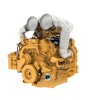
Caterpillar's compact engines that are 2.2 liters (50 hp) and below are compliant with Tier 4A (Tier 4 Interim) with no visible differences.
Maintenance for Caterpillar engines in this range is going to be very similar to engines designed to meet the requirements of previous tiers. Oil change intervals will remain at 500 hours, which is standard on Caterpillar products.
No changes are expected in component lifespan.
"Our compact engines are recognized for durability and reliability," says Mike Reinhart, marketing manager, Caterpillar industrial power systems. "Going from Tier 3 to Tier 4 Interim, there's no impact on componentry. What we're trying to do when we go from one emission level to the next is improve the overall content, processes and parts' reliability."
Maintaining or improving cost of ownership also is important, he says. Caterpillar engines in Tier 4 will be cleaner while maintaining the company's set standards in fuel economy, reliability, durability and service intervals, he says.
Emissions in this horsepower band do not change again until 2013.
OEMs and end-users aren't going to see major changes to content or serviceability, Reinhart says.
"It's going to be business as usual," he says. "We're concentrating on providing power to the equipment so they can be productive."
Reinhart adds it's business as usual with a nice twist. "Everyone is required to become compliant, but we believe that it's a transparent issue to a lot of folks, especially in the rental market," he says. "They need the confidence that they have the most productive machines and that they're compliant with emission levels."
Cummins A Series Tier 4 Interim engines, 31 to 48 hp, are meeting emission requirements using an in-cylinder solution - and avoiding the need for exhaust gas recirculation (EGR) or aftertreatment - says Clint Schroer, Cummins Off-Highway Communications manager.
Cummins Tier 4 A Series engines are built upon the same industrial engine platform range launched for Tier 2 in 2002. The A Series configuration ensures equipment manufacturers have long-term platform stability in the face of regulation changes for more than 10 years, he says. This platform commonality and simplicity extend beyond 48 hp to the Tier 3/Stage 3A A2300, which is available up to 60 hp.
"This is a major achievement considering Tier 4 Interim represents a 50-percent reduction in emissions of particulates vs. Tier 2," Schroer says.
Going from Tier 3 to Tier 4, day-to-day maintenance and fluid maintenance intervals remain unchanged.
"Cummins understands that the rental market values total cost of ownership and a solution that is easy to maintain," Schroer says.
Tier 4 is also not expected to change component life and repair frequency.
"Our base engine and added components will have the same robust design and durability as our current Tier 3-compliant products, which are achieving outstanding levels of reliability," Schroer says.
Overall, Schroer says the new technology will not impact how the rental business manages its inventory for these lower horsepower bands. "Everything regarding these engines below 49 hp will remain the same," he says, noting the emission changes in these bands are not as complex as the higher power bands and future emissions changes.
A Series engines will have no packaging changes on their engines until 2013.
Looking at higher power bands, Cummins engines between 49 and 173 hp are already Tier 3 certified and will not undergo emissions changes until 2012. For engines in the 174 hp to 751 hp powerband, Cummins this past November was the first in the industry to announce a Tier 4 Interim technology solution in preparation for 2011, the first year for which standards apply in that power band.
The future, off-road
For the lower horsepower engines in the rental market, new engine technology means cleaner engines and slightly higher costs. The anticipated costs vary with size and equipment complexity but are in range of 1 to 3 percent of the total purchase price for most equipment categories, according to the EPA.
Tier 4 interim emission regulations and technology solutions will be more complex for engines above this low horsepower range and will require a form of aftertreatment, similar to the technology used on EPA 2007 on-highway engines.
According to EPA mobile sources inventory projections for 2007, the nonroad sector contributes 46 percent of the nitrogen oxides and 70 percent of the particulate mass. The nonroad sector has become a larger source of pollution as compared to the highway sector despite the higher population of trucks in comparison to off-road equipment.
Reducing harmful emissions from nonroad diesel engines will provide tremendous health benefits. When all of the older nonroad engines have been replaced (by 2030), the nonroad diesel program will prevent up to 12,000 premature deaths, 15,000 heart attacks and 6,000 asthma-related emergency room visits by children, and 1 million lost work days every year, according to the EPA.
Associated Equipment Distributors (AED) recommends phasing in the cleaner, Tier 4 equipment as soon as practical, and points out a number of states and local metropolitan areas offer monetary incentives for the purchase of new model low-emission off-road equipment or for retrofits of existing equipment. AED points to the Texas Emissions Reduction Incentive Grants Program as an example. This program is for nonroad equipment powered by an engine 25 hp or greater.
Phasing in the cleaner equipment demonstrates buy-in to Tier 4 emission controls, says AED, "and the commitment of your business to clean the air in your community." Moreover, AED says customers can try out the new equipment at their next jobsite and attract new rental business.
AED's "Tier 4 Regulation Handbook," a roadmap to navigating the EPA's new diesel rules, is available for purchase through its website (www.aednet.org). AED dealer members can receive one free copy if they request it before March 1.