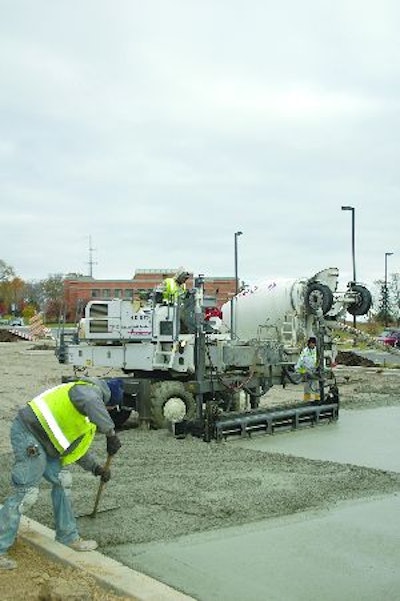
Concrete contractor Len Swederski isn't content doing the same ol' same ol' when it comes to the concrete industry. Len is owner and president of Swederski Concrete Construction out of Spring Grove, Ill., and he holds true to his philosophy on business. "I want to have the most innovative equipment out there and be on the leading edge of demands in the industry," he says. With laser-equipped screeds and the latest in robotic layout technology, he's on the leading edge of demands in the concrete industry. Len and his company are pushing architects, engineers and decision makers to recognize the benefits of concrete in road paving, parking lot jobs, whitetopping and a host of other applications.
Len started his business in 1985, during what he calls "the dark years of construction." When the company he was working for started downsizing, Swederski started his own concrete business doing residential and light commercial flatwork and foundations. Over the years the company grew out of its first office - a rebuilt corn crib on a neighboring farm - and into today's 40-employee, $8 million a year business. With his son Joe as estimating and contracts manager, his other son Scott as operations manager, and Len's wife Patti and sister Sharon Caulfield pitching in along with other dedicated staff, the family business is succeeding and has grown beyond the residential flatwork and foundations business it started out as. Now performing a larger percentage of its work in the commercial and industrial sectors, Swederski Concrete Construction offers industrial foundations and floors, concrete paving on roads and parking lots, and whitetopping along with traditional concrete work.
The business of concrete
A lot of Swederski Concrete's success stems from Len's business management ideals and philosophies. "We look at all our business relationships as a partnership - customers, suppliers and ourselves," Len says. "If all three partners don't make a profit, something isn't right. That leads to satisfied customers and repeat business, and suppliers are eager to refer us to potential new customers."
In addition to believing in investing in equipment, Len feels strongly about education and training. Two-thirds of his employees are ACI-certified Finisher/Technicians, 25 employees have First Aid/CPR certification, and his foremen and managers have all been through OSHA safety training. Len himself has been teaching the ACI finishing course for 10 years.
Swederski Concrete has a strong workforce of 30 people in the field, and half of them have been with the company for more than a decade. When hiring, Len looks for career-oriented employees and in return offers above average wages, health, dental and life insurance, and 401(k) profit sharing contributions. Len also implemented a substance abuse program in his company more than 10 years ago that has contributed to better productivity, less absenteeism and safer jobsites. "My employees are mentally sharp and training is much easier," Len says.
One of the most important characteristics a business owner can possess is foresight. "You always have to take risks in business, and you need to be prepared should a serious risk materialize," Len says. "You have to ask yourself, 'Can I absorb the risk if this job goes sour? Is this job going to threaten my business?' If so, you have to reassess your risks or walk away from the job because you never know when a 9/11 is going to hit your business."
Swederski Concrete experienced a "9/11" of its own and Len's business management foresight was put to the test three years ago when his son Joe suffered a broken neck from a skiing accident. "There were three months after the accident when my wife and I and our son Scott were gone, basically living in the hospital in Chicago with Joe. It was a tough time for the business with all four of us gone," Len explains.
Luckily Len had placed some great people within his business to ensure it would run if he wasn't there. That plan was strained with not only Len gone, but the four main leaders in the business out; however, the company kept on running successfully. "Everyone was a little more conservative in bidding and work slowed down some, but by the end of the year the business had recovered," Len explains.
Swederski Concrete Construction was in a period of transition at the time of Joe's accident. A few years earlier Len had recognized an opportunity for his company in moving from 75 percent residential to concrete paving and a commercial-focused work load. "The decision to head in this direction was an easy one," Len explains. "We were not working to our potential in residential. The equipment and training available in our company allowed us to take on unique concrete projects that are found in the commercial and industrial sectors. It was just before Joe's accident that this transition was taking place and our business was stepping up into new markets."
Since Joe's return to the company in October 2006, he has succeeded in securing the commercial bids and paving projects he set out to get. "Now I feel like we're back in a better position than we were before the accident," Joe says.
Paving the town white
One of the commercial areas Len identified as a growth potential was concrete paving on new parking lots and roads and also concrete whitetopping over existing asphalt pavements.
"With growing environmental concerns with toxic runoff and heat islands, combined with the durability and life cycle of concrete pavements, concrete paving became a product of choice for owners and developers," Len says. "Raw materials for asphalt have been increasing as much as 30 percent a year for the last few years. That puts asphalt and concrete in competition for initial cost."
Swederski Concrete has been aggressively promoting concrete parking lots for seven years. Len realized his only competition for this type of work in his market would be asphalt. "I used to have to beg architects to let me in on the bidding process, but then it started to snowball," says Joe. "Now they reach out to us." Joe adds that when he bids concrete work on a commercial job, he also asks if he can send an estimate for a concrete parking lot. He is successful in converting about 50 percent of Swederski Concrete's customers into using concrete as pavement.
Even with the successful history Joe has in selling concrete parking lots, Len says there is still a long way to go to educate the designers and decision makers on the benefits of concrete. "I hear from my customers, 'If concrete parking lots are so great, why don't I see more of them?'," Len says. "This is the struggle the industry has to overcome because asphalt has been the product of choice for 50 years. Many architects and engineers do not understand concrete paving design and life cycle costs."
Len works with an industry alliance of associations all working together to educate the public and designers on the benefits of concrete parking lots and roads. Today, less than 10 percent of parking lots in the United States are concrete, but the National Ready Mixed Concrete Association (NRMCA) expects that number to increase to 15 percent by 2010. Len adds, "As the demand for concrete parking lots increases, there will be more contractors needed to construct them."
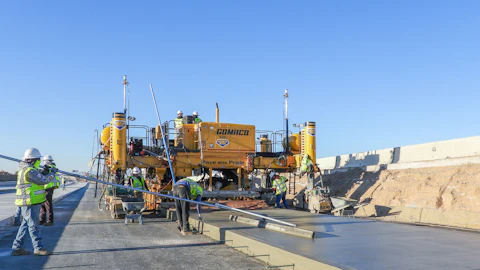
Swederski Concrete's parking lot business has been growing at a fast pace for years. The key to a successful parking lot paving job is its laser screeds.
"Our sales have increased every year but our labor force hasn't because of the labor saving technology we have with the three laser screeds," Joe says.
Swederski Concrete recently finished a 90,000-sq.-ft. parking lot at a funeral home in McHenry, Ill. Joe was the only concrete guy bidding the job against the asphalt competitors.
Swederski Concrete isn't just going after parking lots - they've been constructing residential streets since 1990. Since then they've converted eight subdivision jobs that were originally specified for asphalt. "A concrete residential street has a lot of appeal for developers. It adds 'curb appeal' and a feel of permanence to a prospective homeowner," Len says. "Municipalities like concrete roads due to the very low maintenance costs. The low installation cost of asphalt has been the pavement of choice for many builders. Today, local concrete streets are initially cost competitive with asphalt of equal structural design."
Whitetopping is like an armor plating over an existing asphalt. Swederski Concrete sees this as a growing market, and the company encourages property owners to rejuvenate old asphalt lots with whitetopping instead of ripping up the old asphalt and replacing it. Len says rural roads are also an excellent use for whitetopping.
Industrial work
Another strong market for Swederski Concrete is in the industrial sector, performing projects from simple slab-on-grade frost wall designs to heavy industrial, highly reinforced foundations for large machines used in the steel industry. They also do a few floors each year with defined tolerances, which they are able to easily perform with the use of their laser screeds, riding trowels and workforce expertise.
Swederski has built a strong customer base in machinery foundations. Although there have been several jobs throughout the country, many of his foundation projects are close to home. Three years ago, Swederski Concrete constructed a foundation for the largest open dye forging press in the United States at Scot Forge in Spring Grove, Ill. The foundation and floor for this single machine required in excess of 3,000 cu. yds. of self-consolidating concrete and over 50 tons of reinforcing steel. The 16 anchor bolts were 2.5 in. in diameter and 8 ft. long and had to be set to a precision of +/- 1/16 of an inch.
One of the tools Swederski uses to attain accurate foundation layout and bolt placement is the Trimble LM80 Layout Manager. "This equipment contributes to labor savings and accuracy enhancement, especially in windy conditions or inclement weather," Len says.
Looking ahead
Len says he expects future company growth to come from the concrete paving market across the Midwest and into the Southeast. He would like to eventually see Swederski Concrete offices in other parts of the country.
Len is also planning for a time when Joe and Scott will take over the family business. "I'm positioning myself to be less active in the day-to-day operations of the business and to focus more on developing long-range business planning. A priority of mine is to make sure our team of employees follows a path of leadership and mentoring."
Despite the busy days one encounters with a growing company, Len still holds true to his philosophies in business. He says it's important to pace your company with steady, controlled growth and to keep in touch with your employees. "Always put your family first," he adds. "It should be written into the business plan."
At A Glance
Company:
Swederski Concrete Construction
Spring Grove, Ill.
Employees: 40
Founded: 1985
Gross annual sales:
8 million+
Industry affiliations:
ACI, ASCC, NFIB, ASA, IRMCA, NRMCA
Services offered:
Concrete road and parking lot paving; whitetopping; commercial and heavy industrial foundations; flatwork; custom residential; and light excavation.
Key products and equipment:
3D laser-guided Somero screeds, Trimble robotic geodimeters and LM80 layout manager, Allen 12/27 slip form paver, Curb Fox, Gomaco G3200 slip-form curb machine, Soff-Cut saws, proprietary ground thawing/radiant heat equipment, Symons forms, Western Forms, Wall-Ties and Forms, Mar-Flex waterproofing, Master Builder accounting program.