
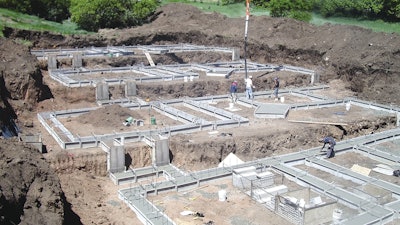
There are many different footing form systems available, but the majority of them share a common thread: non-wood forms. With the concrete industry moving in the "green" direction, and with an emphasis being placed on the materials used, the trend to use aluminum or plastic forms instead of wood is growing.
These new forms have multiple benefits, including a longer life span than wood, which results in less construction waste. The trend has been growing, and new footing products are gaining popularity among contractors who want to explore alternatives and reap the benefits these new footings systems offer.
Making The Switch
Tri-State Builders, N.Y., spent nearly 22 years using standard 2 by 12 wooden planks and stakes to create footings, says Skip Collins, owner. But three years ago the company switched to using Fine Line Footings. This aluminum form footing system requires no stakes, which was exactly what Collins was looking for.
"We were doing a pour in a rock quarry, and the bottom was all solid rock," Collins says. "We really couldn't stake any planks so I was looking into other systems that would accommodate that, and Fine Line fit it perfectly."
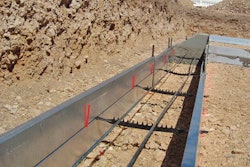
 Fine Line Footings aluminum form system does not require stakes, which makes it easier to form footings on less than ideal ground conditions such as rocky areas.
Collins says there is actually a lot of rock in that area of the country, so those situations can be common for his company. On the other hand, he says they also have pours in river valleys where the ground is very silty. Both situations make it difficult for stakes to hold in the ground. The Fine Line Footing forms work great on both ends of the spectrum, Collins says.
Del Greco Project Management, Ontario, was also using conventional wood footing forms until three years ago when a local supply company introduced it to CertainTeed's Form-A-Drain, according to Ray Del Greco, owner. "The advantage of the plastic Form-A-Drain is the fact that you have coverage both on the interior and the exterior of the house because the footing is formed on both sides," he says. And the Form-A-Drain drainage system starts working immediately after it is placed, he adds.
The first time Del Greco used this new footing product was on a job with a high water table. He says Form-A-Drain works well for footings done in high water table areas. People tend to think that if the outside water that comes from snow melt and rain is handled there won't be any problems, he says. However, with large houses, water can creep up the middle of the slab and cause problems. "By having the Form-A-Drain you get virtually 100 percent more coverage. And you can also independently drain off the inside part and the exterior part to wherever you wish," Del Greco explains.
Another reason the Form-A-Drain products work well in areas with high water tables is because of the height of the forms. "A typical drain is 4 in. high, and these pipes come in 8- and 10-in.-high sections," Del Greco says.
The footings Del Greco Project Management installs are split fifty-fifty between using Form-A-Drain and wood forms, Del Greco says. "It's basically a client to client decision," he says. Often, if a site is excavated and there is a higher than expected water table, Del Greco's clients will opt for the Form-A-Drain.
If he had the opportunity, Del Greco says he would use Form-A-Drain for all his footing projects, and he is finding it easier to convince clients to use Form-A-Drain when it falls under the "green technologies" category. "I have had a customer use the Form-A-Drain because it saves in cutting trees. That reason alone was good enough for him," he says. However, some clients are still hesitant to use the Form-A-Drain because the product is new and it requires certain tools that may raise labor costs.
Watterson Bros. Construction, Utah, also switched from wood footings to an aluminum forming system three years ago, according to Josh Watterson, part owner of the company. Watterson Bros. Construction uses the EZ-Footings aluminum forming system from Concrete Forms Services for all of its footing projects now.
One of the main reasons for this change was the EZ-Footings system helped solve some issues outside of the actual installing of footings. DOT requirements are one example. Built into the cost of the EZ-Footings system is a trailer created specifically for transporting these forms. This trailer, which has designated places for the different forms, does not require a commercial driver's license to drive, Watterson says. The trailer is also easier to get into poorly accessible work sites, he adds.
 Unlike wooden planks, EZ-Footings has no overlapping forms, resulting in less wasted concrete. A skin panel is also available to fill in gaps less than 30 in.
Easy To Use
These versatile reusable or leave-in-place systems are also easy to use. Collins says it didn't take his workers much time at all to learn how the Fine Line Footings system works. "The sizes are very similar to our wall panels. So the guys that are used to setting wall panels and figuring out individual fillers to make up whatever length they need are already pretty adapted to figuring the separate filler sizes," he says. "They [Fine Line Footings] fit right in naturally with our system."
Unlike traditional wooden planks no nails are required when connecting these forms. They just slide together and are held in place by pins and wedges. The forms also come apart and strip very easily, Collins adds. It has allowed his company to do footings in almost half the time with fewer workers needed. Plus, the forms accommodate different sizes of footers, which is another benefit of the system.
Collins says the Fine Line Footings system is especially helpful on commercial projects. "We do quite a bit of commercial work also, and they are very easy to box out for pier footings. They are certainly a little bit handier than plank, and they hold together much better," he says.
Form-A-Drain is a three-in-one concrete footing form system, foundation drainage system and sub-slab perimeter radon reduction system that stays in place after the footings are poured. The forms are inserted into couplings, corners or outlets and then pinned together with a metal pin to hold the forms together. This metal pin is easier to drive into harder ground, Del Greco says.
Because Form-A-Drain stays in place after the footings are poured, the system does not require any stripping. "There's one step less. Once you put the Form-A-Drain on it stays in place and away you go," Del Greco says. "The advantage would be one day's savings for sure at a minimum in your process of getting your work done."
Watterson definitely found an ease of use when it came to transporting his EZ-Footings system. But the benefit of having an organized, easy to transport footing product wasn't the only thing that attracted him to this footings product. "The first time looking at the system, it seemed like you'd really have to put a lot of thought into how the forms are laid out so that everything would work," Watterson says. "It really doesn't take that much. It's just really handy. It couldn't be simpler. It doesn't have to be any more precise than with using lumber. You kind of just lay them out and you can go with it," he says.
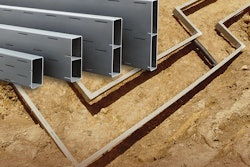
The EZ-Footings system consists of forms from 6 in. to 12 ft. long with hinges on both ends. A 3/4-in. stake is used anywhere there is a joint. One of Watterson's favorite features of the system is the skin panels. A skin panel can be used to fill a gap less than 30 in. by placing it in the gap, wrapping the top lip around the forms and staking it in. "They also have a skin panel that goes into a corner which allows you to use two forms instead of three," he adds.
And the lighter aluminum forms make carrying and placing them less labor intensive. Plus, he says he can get more work done in less time with the same amount of workers using the new footing system than with wood planks. Watterson also says EZ-Footings creates a better looking and a better quality footing than standard wooden planks.
"It's not very often you get compliments on the footings, but that's what we get," Watterson says. "Footings never have been professional. It's always been get them done and then the foundation comes in after, and that's the professional part. These look as good as the foundation. They do look professional," he adds.
 The stay-in-place Form-A-Drain system saves contractors time with its simple assembly and no stripping required.
Ways They Save
The Fine Line Footing system has helped save time and money for Tri-State Builders. Collins says they can do footings in almost half the time using this system with fewer workers. And, replacement costs are lower with the aluminum forms than with wood planks. "We're not buying plank on a regular basis," he says. "Right now, the way things have been going, I can see an easy 10, 12 or even longer years life expectancy on them."
Collins admits that a footing system can be a substantial investment at the beginning, but one of the key factors with reusable aluminum forms is that components don't need replacing year after year. In fact, Collins says he thinks over the course of three years his Fine Line Footings system has certainly paid for itself.
Since Form-A-Drain stays in place instead of being stripped like conventional wood forms, Del Greco says he has seen a savings of at least one day's time when using this footing system. This savings can be especially important if you are on a tight schedule. "Once an owner calculates what one day in saved time costs him - construction management team, laborers, rental of site facilities, site trailers, etc. - that is the true savings, not just the differential between wood forms versus Form-A-Drain," he says.
Financial savings is also possible with the Form-A-Drain system. The initial cost may be more than lumber, but that isn't the only factor Del Greco considers. Not only can you save on the lumber you don't have to constantly replace, but you also save on labor because Form-A-Drain does not require stripping, Del Greco says. "In the long run it's probably not too much more expensive but has way higher performance, which to me is more important," Del Greco says. You have to measure on value not just what it costs to pour footings, he adds.
Watterson admits to having had some concerns about switching to the EZ-Footings forming system. "When we bought them they hadn't been around long enough to know what the life expectancy was," he says. But, so far Watterson hasn't needed to replace any forms, and after using one set of EZ-Footings for six months, the company decided to buy another set so it could run two footing crews.
When Watterson Bros. used wood planks, the boards would often overlap which created extra concrete. Watterson says with the EZ-Footings he no longer has to worry about wasting concrete. Using a system like this also helps to keep your employees around, Watterson says. "Once somebody has used these they don't want to go back to doing it any other way. It does keep your help around," he says. And that can be a major savings for any concrete contractor.
"It's really the best thing we've ever done," Watterson says about switching to the EZ-Footings system. "We're kind of against change - you know if you've been doing something the same for 25 or 30 years. This is the only time we've ever gotten away from the same way we've always done things, and it's certainly been an improvement."