It's been said that eating breakfast is the most important meal of the day. Incorporating it into your morning routine refuels your body, jump starts your day and lays the foundation for life-long health benefits.
The morning routine you perform with your full-size excavator is equally important to the health of your machine. What you do during the first 15 to 30 minutes of each day pays big dividends in terms of increasing productivity, maintaining residual value and lowering operating costs. Incorporating additional weekly, monthly and annual scheduled maintenance only adds to machine longevity.
Key areas for preventive maintenance fall into three main categories: engines, hydraulics and undercarriage systems. A detailed and specific time line of scheduled maintenance for each area can be found in your owner's manual.
"A lot of money goes into research, development and engineering to determine at what intervals filters are to be changed, what items are to be greased and at what hour interval," notes Bill Metzger, product sales instructor, Doosan Infracore. "Also, using a maintenance checklist will help identify any items that need to be addressed. Planned maintenance is always less expensive than reactive maintenance."
Maintain the engine
Maintenance has become increasingly important with the move to Tier III engines.
"These new engines are more susceptible to damage caused by contamination," says David Pooley, Hyundai Construction. A filtration system for today's high-pressure fuel and sensitive pumping systems goes down to as low as 2 microns, compared to no limit for earlier models. "The maintenance schedule in the manual lays out a very comprehensive change-out period, and contractors need to stick with those recommendations," he says. "If they do, they will get the best life out of the engine, as well as fuel and hydraulic systems."
Make sure the oil and fuel are kept clean by changing filters and fluids as recommended. Between changes, check fluid levels daily and top off as needed.
Many manufacturers have incorporated features to make fluid checks quick and simple, and changes easy enough to be done on site.
"We've done a lot to make daily checks simple so contractors can easily perform maintenance tasks," says Adrian Hall, market development manager, JCB, Inc. "They're all available from ground level. Our oil checks are part of the startup sequence. Everything can be done from the comfort of the operator's seat or by walking around the machine and opening the various bay doors."
Oil sampling is also crucial to keep today's engines functioning at peak levels. "The greatest asset to any contractor is to get their excavators on an oil-sampling program," says Metzger. "When an oil-sampling program is implemented correctly, the analysis you receive from the lab will let you know ahead of time if something needs to be addressed. It also allows any potential problem to be addressed before the situation is catastrophic, and keeps repair costs to a minimum. Most oil sampling is done at the scheduled maintenance intervals or as specified by the oil sample report."
Maintaining good records, including oil sample reports, also adds value. "Not only has maintenance cost been kept to a minimum, but when it's time to look at replacing or updating a customer's fleet, the price received on trade or outright sale has increased due to the value added back into the machine by the oil sampling program," Metzger states.
As part of daily engine maintenance, be sure to leave sufficient time to properly warm up the machine, especially in Northern climates at this time of year. "It's never good to draw huge rpms or power out of an engine when it's cold," Hall says.
"We have an auto warm-up system that registers the external temperature and the temperature of the machine," he continues. "It will run itself through a cycle that's up to 20 minutes long to warm the hydraulics and engine prior to operation. You can override the circuit if all you need to do is load the machine onto a truck. But if you're working to dig a trench, letting the machine warm up will reduce the dangers of damaging the engine."
In high ambient temperatures, pay attention to engine temperature to ensure it doesn't get too high.
"If you run repeatedly in the overheat mode, you will start damaging or distorting costly engine and hydraulic components," says Hall. JCB excavators have an automatic cool down mode to prevent overheating. It reduces the power demands from the hydraulic pumps, thereby automatically bringing the machine cooling system back to normal levels.
However, you still need to make sure coolers are kept debris-free. "If coolers don't get cleaned and become impacted, or if the system registers above normal operating temps, the machine will go into a shutdown mode to prevent it from overheating," says Hall.
The best way to keep coolers clean is to blow them out with an air hose. "If you use water, you run the risk of dirt turning into a solid when it dries," says Pooley. "Washing out the radiator with water can also push the dirt into the middle. If it doesn't all get washed out, it can accumulate between the coolers to the point where it restricts air flow."
If you work in a very dusty environment, coolers should be blown out every day. For general applications, clean them at least once a week, or as needed.
How can you maximize the chances engine service will get carried out as recommended? Many manufacturers have incorporated "reminders" into the CPUs of their machines. "You can set the hours, per the manual, for every oil change, filter change, etc.," says Pooley. "Then you will get a reminder when a certain task needs to be performed."
Check hydraulics
If an engine can be equated to the "heart" of the machine, then the hydraulic system could be seen as its "circulatory" system. Though hydraulic fluid doesn't need to be changed as often as engine oil, fluid levels must be checked frequently and change-outs performed as recommended and/or needed.
"When you're dealing with servo lines feeding up into the joysticks, any form of contamination can cause the machine to not work as efficiently," says Hall. "Clean oil equates to reliable hydraulics." He adds that JCB's range of excavators are fitted with the Plexus filter system, an ultra-fine in-line kidney filter that eliminates debris greater than 1 micron and extends hydraulic oil changes to 5,000 hours.
Many hydraulic oils have service intervals of roughly 2,000 hours. But if you mount a breaker and use the unit in a demolition application, you will need to change hydraulic fluid more frequently - at around 1,000 hours. "Hammering causes a lot of shock and damage to the oil as it's being used," says Pooley. "If you're using a hammer occasionally, it's not a problem. But if you're hammering continuously, the oil breaks down twice as fast."
If you live in a climate with extreme temperature fluctuations, you may also have to change hydraulic oils more frequently to ensure you're using the optimum oil for the climactic conditions. "Where temperatures drop to well below zero, a normal oil would be too thick," Pooley explains. "In these situations, you need an oil with low viscosity so it flows at lower temperatures. If it's too thick, your machine takes longer to warm up to operating temperatures. It may also be slower to operate, and you run the risk of cavitation in your hydraulic system and damaging the main hydraulic pump."
Also pay attention to hoses. Be aware of the burst pressure of any hoses you replace. Your best bet is to buy OEM components to ensure a proper fit.
Maintain torque and tension
The undercarriage of a full-size excavator accounts for about 20% of the total cost of a new unit. Maintenance and replacement costs considered over the unit's life account for about 60% of total costs.
"Therefore, it's mandatory to preserve the undercarriage for as long as possible," says Guido Bottin, engineering and quality manager, Berco of America, Inc. "Furthermore, the downtime to replace/repair components is usually long and customers may not be able to afford it."
Checking bolt torque, track tension and alignment of the components and guides are key areas. Checking bolt torque is most important during the first 100 hours of operation, then every time you change track pads, or shoes, although you will want to check periodically to ensure no bolts have worked their way loose.
Use of shoes wider than necessary can cause breakage to bolts and/or shoes. "The shoes are what come in contact with the ground," says Bottin. "Just like the tires for your car, they have to be in perfect efficiency all the time."
Track pads are most vulnerable in hard rock applications. And once the pad is gone from the track, so is protection for the chain surface. "If it's left for too long, you will get damage to the track chain surface where the pad is supposed to mount," says Pooley. "If there isn't a flat surface for the pad to mount, you won't be able to tighten the bolts to hold it on and it will keep coming off."
Check track tension to ensure tracks aren't too tight or too loose. If too tight, components will wear out prematurely; if too loose, the track chain may slide out of the guide.
Typically, you want a sag of about 1 to 2 in., but this will vary according to site conditions. In rocky situations, they will be tighter, while in soft or swampy conditions, they will be looser. Check your owner's manual to ensure the proper sag for your particular conditions. Most machines can be easily tightened or loosened on site.
"To maximize the life of undercarriage components, track chain tension should be maintained within the machine specifications at all times," stresses Tony den Hoed, marketing communications and product launch specialist, excavators, Volvo. For Volvo machines, three different adjustments are allowed for various conditions: hard, smooth ground; medium ground; and soft ground.
Keep an eye on track components
The rollers, idlers, springs, chains and sprockets should work as one entity. For example, the front wheel might not be in perfect alignment with the rollers. Rather, it may be twisted or tilted, and the chain won't follow in a straight line. At that point, you will get uneven component wear. "Usually, the heavier the machine, the greater the risk of misalignments," notes Bottin.
Have your dealer check the alignment when it's serviced. As the excavator ages, you should also have the dealer check to ensure the chain maintains proper guidance within the undercarriage.
"You don't want it to go outside of the roller or the idler," says Bottin. "You essentially have steel working against steel or cast iron. When they rub against each other, the guides will wear. If they're too worn, they lose their function and need to be replaced. You will also want to pay extra attention to them if you're working in rock or demolition, because these guides can be damaged and may not provide the proper alignment and guidance for the rest of the undercarriage."
Also keep an eye on lubricated components. Although some are sealed for the life of the undercarriage, periodically check for leaks since they can cause long and expensive machine downtime. Components that aren't life-sealed will require more frequent checks of the oil level of rollers and idlers.
Cleaning the tracks also goes a long way toward extending undercarriage life. "If they don't get cleaned on a regular basis, material will build up and it can prevent the rollers from turning, especially on the carrier rollers," says Pooley. "If they stop turning, they will get a flat spot on them and then the roller isn't usable."
Use a shovel to remove any mud and dirt buildup. Pay special attention to the top, which is more susceptible to buildup. Clean them at the end of every shift and before traveling long distances.
Severe applications
While a preventive maintenance program can increase the life expectancy of an undercarriage, there are certain applications where you may need to enhance that program and reduce the lead time between checks.
Use in very abrasive environments, such as in wet, sandy conditions, can shorten the life of components. For example, river or ditch clearing can expose tracks to water carrying sediment and other materials that can damage the undercarriage over time.
"When traveling, the undercarriage components will naturally increase in temperature," notes den Hoed. "If the machine enters water on a jobsite, there will be a rapid change in component temperature (expansion/contraction). This is very hard on moving joints."
Working in these more severe applications may require more frequent maintenance and greasing. "A machine working below the water surface or in heavy lifting applications may put it beyond its maintenance intervals and greasing intervals will need to be changed," says Metzger. "Installing an auto lube system will increase the initial cost of the machine, but in the end [it can] reduce the maintenance cost over the life of the machine."
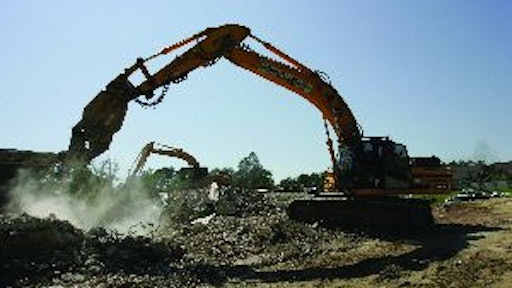
Excavators used in demolition are working in very severe conditions with severe-duty attachments. "This type of work puts a lot of stress on the undercarriage because of the breaking and loading of heavy and unbalanced loads," Metzger says. "In addition, because the attachments... are working at capacity most of the time, and the hydraulic temperatures tend to be higher, the hydraulic system will need to be maintained more often. Heat is the biggest enemy of any hydraulic system.
"Because this type of work requires heavy loads," he continues, "this will also put a lot of stress on the structure of the machine and cause pin and bushing, boom and arm fatigue that you would not see in normal operation."
Selecting the right machine and tailoring your preventive maintenance program to the application can help you overcome such negative effects.
"Overall, if the machine is designed and sized right, and the operator does the daily checks, there aren't many applications where an excavator can't work and perform efficiently with great reliability," says Hall. "When you've spent the dollars that a large excavator costs, spending a few dollars looking after your investment pays dividends in terms of productivity, residual value and operating costs."
A Daily Commitment to Service
In Marcus Thompson's line of work, preventive maintenance is critical to keep machines running smoothly. Thompson works with his father, Hiram, his uncle, Glen, his brother, Tyson, and his cousin, Paxton, at Thompson Wrecking, a third-generation demolition/asbestos abatement firm headquartered in Augusta, GA.
The types of jobs the company performs can be tough on excavators. For example, crews are currently tearing down a hospital in Georgia, as well as an incinerator plant in South Carolina that was used to burn medical waste.
"We try and compensate for [tough jobs] by putting a good preventive maintenance program in place," says Thompson. "We have a couple of full-time mechanics who keep our excavators serviced."
Frequently changing air filters is one of the most important things the company does do to keep the engine clean, he adds. "It helps the oil last longer so we don't contaminate the engine. We're getting a lot of trouble-free hours for the maintenance we do," he states.
Air filter maintenance includes a change-out every other time the oil is changed. However, the filters are checked every day during the pre-inspection program conducted before the engines are fired up. Typically, they are blown out at least two to three times a week because of the dusty working conditions.
Making sure that all moving parts are greased is another key component in the maintenance program. "There are so many moving parts," says Thompson. "There isn't a machine that gets cranked up and used until the operator has gone over every grease fitting. If we keep them greased regularly, the machines will last a long time. We've been down that road before and we haven't always placed as much importance on maintenance as we should. But when you start to spend a lot of money in fab shops to have things repinned, it adds up. A $2 tube of grease can save you thousands in the long run."
Six JCB excavators comprise the Thompson Wrecking fleet, including a
JS 200, JS 220, two JS 260s and two JS 330 models. One JS 330 is equipped with a Genesis LXP300 for cutting steel and crushing and pulverizing concrete.
"This attachment is unbelievable to watch," says Thompson. "It can cut through 1/2-in. plate steel. With a 15-minute jaw change, you can go from cutting steel to pulverizing concrete. It's helped us in a lot of ways by allowing us to dismantle a building, then recycle any metal that is inside the concrete. In the past, we weren't able to retrieve that metal. But now we can pulverize the concrete beams and recycle the rebar inside. We can generate a lot more salvage steel than we used to be able to."
Since this attachment is costly - about half the cost of the excavator itself - maintenance to the host is critical. "We work the machine hard," Thompson says. "We change the hydraulic oil more often because we depend on the hydraulics so much. If the oil breaks down, the attachment won't perform as well, so we keep it changed out regularly."
Onboard Diagnostics Tell All
The onus of engine maintenance has always fallen onto contractors. But with the advent of computer diagnostics, that responsibility becomes even more important since, with sophisticated techniques, engine manufacturers can easily determine exactly what went wrong in an engine.
"Computers can tell the engine manufacturer how many times the engine overheated, how many times it had a fuel problem, etc.," says Dave Pooley, Hyundai. "They can tell the story in a lot of detail.
"It's up to contractors to do everything they can to maintain the engine," he continues. "For example, if an engine manufacturer analyzes that the oil went beyond its useful life, they may not warrant it if something goes wrong."