
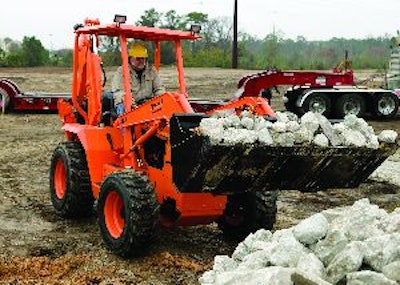
When it comes to using a backhoe-loader, the most skilled operators are usually the ones with the most seniority. After all, optimum proficiency is something that typically evolves over time.
Yet, even a relatively new operator can become more efficient given the right tools and techniques to do the job. Whether you're building up operating experience, or trying to break some time-consuming habits, you can achieve the productivity you need by using the right equipment for the application, and taking advantage of features designed to promote ease of operation.
Start with proper sizing
Some productivity issues can occur before you ever set foot in the cab of the machine. Get off to the best start by spec'ing the right size backhoe-loader for the task.
"Size does matter," says Doug Dahlgren, product manager, Allmand Bros. "The width and depth of the trench and how much material needs to be excavated will determine whether a compact machine with an 8.5-ft. backhoe and a 16-in. bucket is appropriate vs. a larger piece of equipment."
It's about knowing which piece of equipment will be more productive in a given situation. "Obviously, you can move more dirt in an hour with a larger piece of equipment," says Dahlgren. "But you wouldn't want to take a full-size backhoe into a backyard to [install] a sprinkler system. It can destroy the turf or the yard. Instead, you may be able to take a compact model into the yard and not do any damage. Taking a full-size machine into that situation can create more work than picking the right piece of equipment initially."
That being said, you also don't want to select a unit that is too small for the job. "A lot of people may try to get by with a less expensive machine, which typically equates to a smaller model," says Jim Blower, mid-range product marketing manager, JCB, Inc. "It might not necessarily do the job. You run the machine to its limits all the time."
That scenario is not good for equipment longevity. "You make the machine work pretty hard," Blower points out. "A smaller machine won't be as productive because it doesn't have as much power. And the size of the bucket may be too small, so you have to work hard and fast to keep moving and doing the job that needs to be done. Maybe size up so you're not running at full throttle all the time, so you can get a little more productivity out of it."
Spec the right attachment
The attachments you put at either end of the machine can also play a role in backhoe-loader productivity.
"One of the more common mistakes is not selecting the correct size backhoe bucket," says Lowell Stout, product manager, Terex Construction Americas. "Many times, a contractor will complete a job with a backhoe bucket that is either too large or too small for the task at hand."
Perhaps the contractor only has one bucket, or maybe he or she was unable or unwilling to take the time to change to a bucket more suitable for the job. Either way, it adds up to inefficiency.
"A bucket [that is] too small will often require more passes to complete the excavation, which can make it take longer to complete the job, and can burn more fuel," says Stout. "If the operator uses too large of a bucket, he/she can end up removing more material than necessary, and can increase the job time by returning the unnecessary material to the trench - again, burning more fuel as a result."
An integral part of bucket sizing is the density of the material you're trying to move, especially when using the loader end of the machine. "You can put a 2-cu.-yd. bucket on and try to move heavy material, but you will overload the machine," says Blower. "This size bucket is designed for lighter-density materials, not heavy soils such as wet sand."
If frequent bucket changes are required, a quick coupler can make selecting the right bucket - or any attachment - faster, easier and more efficient.
"You can just drop off one bucket and pick up another that is the right size to do the job as productively as possible," says Blower. "Quick couplers can be used on both the front and back of the machine, so you can match the bucket to the job and mount it as easily and quickly as possible and get back to work."
"If you're in an operation where you're doing a lot of changing of attachments or buckets on the loader or backhoe, a hydraulic coupler is a critical piece to have," adds Jim Hughes, brand manager - loader-backhoes, Case.
On the loader end of the machine, productivity can often be enhanced with the use of a multipurpose bucket. "Standard general-purpose loader buckets are somewhat limited in the tasks they can do. A loader-backhoe is used most often as a utility tool, whereby the type of jobs it is asked to do are unlimited," Stout comments. "A multipurpose bucket makes a loader-backhoe more versatile because of the many functions it has available - dozing, scraping, loading and grabbing objects. It can be even more versatile by adding a pair of flip-over forks that remain attached to the bucket even when not in use."
Smoother operators
Several features found on newer backhoe-loader models are designed to take some of the "work" out of using the machine, plus make it easier to become a smooth operator, which is key to proficiency.
One of the most influential changes is the move to a precision hydraulic control valve. "As soon as an operator moves the control valve, it meters fluid to the backhoe so it smooths movements," says Dahlgren. "That has a real affect on productivity."
For example, let's say you scoop up a load of dirt, swing it over and dump it onto a pile. "The smoother the bucket comes back, the better the chance of getting it down into the same hole," Dahlgren states. "It's a smooth operation and you have more control. If movement is too fast and jerky, you may not hit the hole, and that can add up to lost productivity [because you will need to make time-consuming adjustments]."
How operators use these controls can have a profound affect on their performance. "A lot of inexperienced operators will get into the machines and crank the controls from one end to the other," says Hughes. "When they do that, they don't get any smoothness with the backhoe or loader. They end up with a lot of wasted movements. Instead, you want to minimize the amount of movements it takes to accomplish the task by feathering the controls."
However, take care not to feather the controls too much. With the open-center hydraulic systems installed in many backhoe-loaders, continual feathering of the controls results in unneeded oil being returned to the reservoir. This excess flow can be reduced by throttling back the engine.
"Anytime an operator is continually feathering the controls, [it] probably means they are running the engine faster than is needed for the job, and consuming more fuel than is necessary," says Stout. "There are some applications where an operator can throttle back on the engine and still achieve the desired productivity, resulting in greater efficiency."
On the loader end, ride control is an important feature. It cushions the load so the backhoe doesn't "porpoise" back and forth when roading. "It acts as a shock absorber to make the backhoe ride smoother," says Hughes. "You don't bounce back and forth when you're going down the road with a full bucket. It's a smoother ride, so it keeps more material in the bucket, which means you're getting done quicker."
Another feature that can enhance proficiency is a speed control switch. "You can reduce the speed of the hydraulics, so an unskilled operator has more reaction time to the [movement of the] backhoe or loader," says Blower. "A less skilled operator can do the jobs of a more skilled operator."
Case also offers Pro Control on all of its models to further smooth backhoe operation. It incorporates an anti-rebound swing and swing cushioning. "When you swing back to a trench after digging and placing spoil, if you release the controls right above the trench, the backhoe stops immediately," says Hughes. "It doesn't waggle back and forth. That means you can get down quicker in the trench to get your next bucket. It works quickly and easily to keep you productive."
Many of the newer features are also directed at improving operator comfort, which can further promote proficiency and productivity.
"We want to make an inexperienced operator feel as comfortable and productive as possible, as soon as possible," says Dahlgren. "Features such as cushioned hydraulic cylinders for the stabilizers, boom swing left and right, and boom up and down are part of a precision system providing smooth operation without components crashing against physical stops."
"A comfortable operator is a productive operator," adds Hughes. "The more comfortable we can make operators, the more productive they will be. They won't be fatigued. They won't be getting tired. Their arms won't hurt from operating the controls. They will be more productive throughout the day."
It's All in the Technique
When it comes to maximizing backhoe-loader productivity, operating technique has a substantial impact.
"Some operators waste a lot of productive time in how they operate a backhoe, as far as raising the bucket too high before they go into the hole," notes Doug Dahlgren, Allmand Bros. "Instead of going from point to point, such as from a pile back to a hole, they move up and then over and down. A coordinated control effort can have a huge affect on productivity. That comes with experience and time, and becoming familiar with the machine."
Operators also have a tendency to lift the machine high in the air with the stabilizers and loader bucket during operation. "This reduces productivity by reducing the depth of maximum cut," says Lowell Stout, Terex Construction Americas. "The machine is less stable, because as the legs are lowered beyond the horizontal, the feet become closer together. In addition, it takes more setup time to achieve this higher position. For optimum operation, the operator only needs to lift the machine high enough for the rear wheels to just clear the ground."
In hard digging situations, such as rocky soils and/or frozen ground, operators may need to further adjust their operating technique. "Hard soil conditions will make a difference, as will time of year," says Case's Jim Hughes. "In northern climates, you will have more difficulty breaking through during the winter. You have to be more careful with what you're doing. You can't just go in and dig and pound into the ground. You may have to take smaller bucketfuls. You might not be able to grab as much soil or material in one scoop. You may have to break it up before you grab a full bucket."
Reading the operator's manual can go a long way toward helping operators understand just how their particular machine works most efficiently. If you toss aside the manual, you may not know what all the switches in the cab do.
"There might be something operators may not be aware of that might make the machine more productive, more powerful or more economical," says Jim Blower, JCB, Inc. "A lot of people jump on a machine and run the engine at full speed because they think that's the way it will be the most powerful and productive. But that isn't always the case."
In fact, some models are designed to perform optimally at less than full throttle. "If you're just using the backhoe, you don't have to run the engine at full speed to dig a trench," Blower points out. "You can run it at about three-quarter throttle and move the same amount of dirt per hour, and burn about 25% to 30% less fuel.
"Technology is changing all the time," he continues. "It's definitely worth it to take the time to find out what everything does and how it should be used."