Electronic video technologies make it possible to operate your trucks and heavy equipment on crowded jobsites and roadways, while simultaneously lowering risk factors. Cameras and event recorders are tools that, when properly used, can lead to a safer working environment.
Camera technology offers several benefits. "While safety is the primary consideration, additional benefits include avoiding increases in insurance premiums resulting from injuries to pedestrians or destruction of equipment and/or other vehicles," says Sibyl Ringsdorf, manager of marketing and national accounts, Rostra Precision Controls. "In addition, downtime associated with damage to the vehicle or equipment could affect completion of a project, resulting in additional profit loss."
Tom Clark, account executive, Safety Vision, agrees, noting, "The advantage that gets the most publicity is safety. You are trying to give the driver an extra set of eyes. Another advantage that people don't really realize until they start using the cameras is just extra visibility. If you have a driver who has to maneuver through a tight situation and he is by himself, instead of getting in and out of the vehicle many times, he can use the cameras with the extra visibility to maneuver. That increases efficiency on the job."
In the case of Safety Vision, the cameras also incorporate microphones. "You can have communication from somebody behind the vehicle up into the cab," says Clark.
Many cameras are available with either black and white or color monitors. "We have black and white camera systems, which are the traditional cathode ray tube (CRT)," says Clark. "In the last few years, we have really seen a push toward the color liquid crystal displays (LCDs) just because they take up so much less space in the cab. You are also getting the advantage of color vs. black and white. On a jobsite, that comes in real handy, because a lot of the safety vests just jump out on screen."
Another consideration is low light conditions. "Our cameras have infrared illuminators to help them perform in low light situations," says Clark. "Even if it is pitch black outside, where they would be blind with just mirrors, it will help light up the area behind the vehicle just like broad daylight."
Keeping drivers in the cab
Cameras can do a lot more than provide rear visibility. "You can use them for lining up to a trailer," says Clark. "Some customers use them to watch conveyor belts. You can use them to check the load in the bed of a trailer. It is really unlimited what you can use them for - it is just wherever you need extra visibility."
This extra visibility is exactly what Vulcan Materials desired to help achieve its safety objectives. Vulcan Materials Company is one of the largest aggregate producers in the United States. Its Western Division has a total of about 390 ready-mix trucks. "Here, in Southern California, we operate about 120 ready-mix trucks," says Ed Luce, area operations manager for ready-mix operations in Southern California.
The company safety goal is zero injuries. "Some of the ways we achieve this goal in the ready-mix area is to require all drivers to review pre-job checklists before every job, and to have our job service reps go to the jobsites in advance to assess hazards before jobs," says Luce.
But the company is always looking for ways to improve. For example, Luce and his drivers were aware of the hazards posed for drivers at concrete pumps. "Risks exist because the pumps operate at high pressures." Elbows and areas along the hose line can burst under this pressure.
"In the past our drivers got outside their trucks to watch the flow of the concrete and make necessary adjustments in the rate of speed at which it came down the chute," says Luce. "Even though the drivers wear all required PPE (hard hats, glasses, shields, gloves, etc.) - protecting them from the debris of possible explosion - a pump explosion might also lead to other injuries," Luce notes. "Some drivers have incurred injuries to their knees and shoulders when they twisted or jumped to get away from a pump explosion."
Vulcan started looking for solutions to keep drivers inside their trucks and away from the pumps. Off-the-shelf solutions did not adequately meet Vulcan's demands. "Anybody can provide a camera for looking right behind you when you are backing," says Luce. "Depending upon the type of pump and how high or low it was, or the angle the driver backed in on, that one rear-view camera mounted somewhere near the hopper wasn't sufficient all of the time to keep the driver away from the pump."
This is where a partnership was formed with Safety Vision. "We purchased two cameras for every truck," says Luce. "We had the rear view. The other one is detachable. We attach it to the chutes. This development process took over a year."
To control the hazard, Vulcan's team considered several camera configurations and arrangements until it selected the best design, which included mounting an adjustable bracket for the camera on the chute. "Now, if the driver needs to adjust the camera, the driver can make the adjustment safely and return to the cab before the material begins to flow down the chute," says Luce. "The new arrangement keeps the driver away from exposure to potential pump failure. Drivers can sit in their truck with the windows rolled up and watch the concrete come down the chute."
The new arrangement also provides added protection to the drivers from noise exposure. "We require ear protection," says Luce. "But allowing the driver to return to the cab provides additional protection." To help minimize noise exposure for its ready-mix concrete truck drivers, Vulcan requires the installation of air conditioning in all of its ready-mix concrete trucks.
The results have been impressive. "My ultimate goal is to keep drivers away from the pumps 95% of the time," says Luce. Unique jobsites and other conditions make 100% nearly impossible. "So there are some constraints. But in working with Safety Vision, we have been able to greatly reduce exposure. In my perspective, it is only fair to the drivers."
Drivers report the rear-view camera is a useful tool to ensure workers on the jobsite stay clear of the trucks. "Our perspective is it is just another mirror - another tool for our drivers to use," says Luce.
Vulcan justifies the investment through increased safety and improved conditions for drivers. "We will do what needs to be done to keep the drivers safe and healthy," says Luce.
Currently, Vulcan is in the process of prototyping and evaluating several event recorder systems, as well.
Useful training tool
Event recorders can help identify risky driving behaviors so they can be corrected. "The intent is driver risk management," says Rob Bartels, general manager, DriveCam.
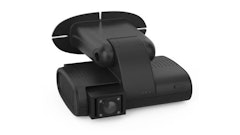
The device begins to record when set thresholds are exceeded. "The event recorder has a tri-axis accelerometer on it," Bartels explains. "The accelerometer is set at certain thresholds, so when there is a braking incident - hard braking, swerving - that triggers an event."
The system remains on while the truck is in operation. "The event recorder is basically recording all of the time - video and audio - in 10-second loops," says Bartels. "When the trigger threshold is met, it freezes that 10 seconds and records an additional 10 seconds. That is a 20-second video and audio clip."
This clip is captured in the event recorder and wirelessly transferred to a PC when the vehicle returns. The PC then sends this video back to DriveCam. "At DriveCam, we analyze that video for risky behavior, score it appropriately with our scoring system, then make it available for our customer to view it," says Bartels. "We have coach's notes. They coach the driver and, by doing so, change driver behavior."
The system is often mounted behind the rearview mirror on the windshield, with one camera pointed at the driver and one pointed out front. This allows DriveCam to view both the event that occurred in front of the truck and how the driver reacted. It becomes apparent if the driver was scanning the road or looking in the mirrors.
In the off-road environment, many things can trigger the event recorder - a lot of which is not really of interest to the owner, such as potholes. As such, DriveCam provides experts in driver safety who are trained to quickly sort through the data and identify areas of risk. "What you need to see are just those 'nuggets' of risky driving behavior that you want to identify and change," says Bartels. "We do that filtering, that weeding out, and apply our expertise."
There are additional uses for an event recorder. "The data recorder that sits up by the windshield has a manual trigger on it," says Bartels. "We have our clients educate their drivers that they can take video and audio themselves just by pushing the button." This becomes valuable when there are access issues at the jobsite. It allows the drivers to identify and communicate any dangerous conditions.
U.S. Concrete, based in Houston, TX, is the seventh largest producer of concrete in the country, running 2,507 vehicles over 12 states. It had a safety program in place that included behavioral observations. But claims were still impacting the bottom line. The company was averaging 172 vehicle accidents a year.
Rick Maidens, director of safety and risk management, U.S. Concrete, heard about the DriveCam event-based video recorders. The systems promised to pinpoint risky driving behaviors before they resulted in accidents, and help defend the company against false accusations.
By January 2006, DriveCam video event recorders had been installed in 95 U.S. Concrete ready-mix trucks in San Jose, CA, as part of a pilot program. Wireless access points in the yard would capture events from the vehicles as they returned at the end of the day. These events were then automatically uploaded to a local computer and sent back to DriveCam for expert analysis.
Although the event recorders began capturing data immediately, DriveCam driving risk analysts did not begin reviewing the events, assigning risk scores and delivering reports until July, when initial Union resistance to the recorders was resolved. "At the end of the day, the Unions saw the video event recorders for what they are - technology to increase the safety of our drivers and exonerate them in instances of false claims," says Maidens.
Despite the delay, U.S. Concrete saw an immediate improvement in driving behavior once the cameras were installed. From January through July 2006, it realized a 50% reduction in the total number of claims and a 61% reduction in cost per claim compared to the same period in 2005. Now the entire fleet is in the process of being outfitted with the DriveCam system. Full implementation across all vehicles was expected by the end of 2007.
Prior to implementation at any given location, there is an education campaign and a question and answer session to help employees understand the purpose behind the event recorder's use. "Nothing is done until every one of our employees - from the delivery professionals and safety teams to plant managers, supervisors and drivers of other fleet vehicles - is aware of what the solution is capable of, how it will be used and what our motive is for installing it in our trucks," says Maidens. Responses to the system have been overwhelmingly positive, particularly when it exonerates a driver.
For example, there was an incident in which a U.S. Concrete driver was making a left turn from a legal left-turn lane when a passenger car in the right-turn lane also proceeded left. After the accident occurred, the driver of the passenger vehicle reported to police that the U.S. Concrete driver was at fault. A laptop was brought to the scene to download the saved event from the video recorder, where it clearly demonstrated the U.S. Concrete driver's innocence.
Twelve months after installing the first systems, the results speak for themselves. U.S. Concrete is realizing a 65% reduction in claims costs and a 30% reduction in accidents.
"Prior to implementing DriveCam, all we could do once a driver left our plant was make sure he returned on time," says Maidens. "Now, we are actually able to manage drivers while they are gone, and can ensure they are getting the coaching they need to ensure the results we expect.
"More importantly," he continues, "when a driver sees the video, realizes the risky behavior exhibited and is coached appropriately, he becomes conscious of the behavior and is less likely to exhibit it again."
The key to successful implementation is trust. "At the end of the day, we are also earning our employees' trust because the solution does exactly what we said it would do, and the whole company is benefiting from it," says Maidens. ?
Survival in the Rough
Even the best technologies are useless if they can't live in the construction environment. Dust and moisture are significant hazards.
In the case of Vulcan Materials, cameras are constantly exposed to water. "If you take a typical driver, let's say he averages four loads a day," says Ed Luce, ready-mix manager, Western Division. After each load, the truck is thoroughly washed down. "Four loads a day over the term of a year, is a lot of... exposure for the cameras."
The cameras must be able to live in this environment. "I don't have time for our shop personnel to go out there and continually service or replace cameras. We have enough things to concentrate on other than the cameras," Luce states. So durability is a huge issue.
"All of our cameras are weatherproof, and we utilize a threaded O-ring sealed connector where the camera attaches to the video cable," notes Safety Vision's Tom Clark. "There are other ones on the market that are like a snap-type connector. That is susceptible to moisture or corrosion."
Shock and vibration resistance are also critical. Clark recommends looking for a high shock and vibration rating. For instance, LCD monitors are generally more rugged that CRT monitors. "With an LCD monitor, all of the transistors and capacitors are surface mounted to the board itself," he explains. "So in a high vibration application, an LCD will outperform a CRT for reliability over time."