When the Wisconsin Department of Transportation let a 13-mile long Interstate 94 resurfacing project earlier this year, the contract requirements included repairing the underlying concrete pavement and resurfacing the existing pavement, widening and lengthening the Wis. Hwy. 83 on-ramp to eastbound I-94, lengthening and reconditioning the westbound I-94 on- and off-ramps at County Hwy. C, and replacing guide signs and installing alternate route signs. All in all, a typical resurfacing project.
What proved challenging for Payne & Dolan, the project's general contractor that also performed all the milling and paving work, is the fact that two lanes of traffic had to remain open in both directions during peak travel times.
That required all milling and paving work to be done at night and weekends, with additional restrictions during holidays and special events. Generally speaking, travel lanes had to be open to traffic from 6 a.m. to 8 p.m. during the week to accommodate heavy commuter traffic going in and out of the Milwaukee metropolitan area. The $13-million (approximately $7 million tied to milling and paving work) four-lane divided interstate project, between the west Waukesha County line and County Hwy. T was started in late July and is scheduled for completion this month.
Project scope, execution
The resurfacing project entailed milling the existing asphalt overlay, patching the underlying 10-inch thick concrete base (the original roadway), reconstructing ramps, placing a new hot-mix asphalt overlay; as well as realigning existing culverts, and installing freeway traffic management signing, median mile marker signing and pavement markings.
To accomplish the resurfacing work required, the contractor milled and paved at the same time during the night when one of the travel lanes could be closed. Heading in an eastbound or westbound direction, the contractor would begin milling the outside 12-foot-wide travel lane, along with 2 feet of the adjacent paved outside shoulder after closing the lane to traffic in the evening and then place a new 2 1/2 inch 19mm HMA binder course (Type E-30, PG 64-22) over the milled surface before opening the lane to traffic the next morning. Milling and paving the outside lane and shoulder was done in a way to offset the longitudinal joint between the travel lanes by 1 1/2 feet, as well as eliminate a construction joint between the travel lane and shoulder.
Once the outside travel lanes were milled and overlaid with a base binder course, crews moved to the inside travel lanes to repeat the process by milling the existing pavement of the 12-foot-wide travel lane up to the new offset longitudinal joint established during the outside lane work, as well as four feet beyond the travel lane into the inside paved shoulder.
While the inside shoulder widths varied from 4 to 10 feet wide, the paving crew placed a new 2 1/2 inch 19mm HMA binder course over the milled travel lane and inside shoulder where it was only 4-feet wide. Wider inside shoulder areas were paved with a 12.5mm (Type E-1, PG 58-28) lower/leveling course and 12.5mm (Type E-1) surface course for the remaining width.
Following the base binder course, the contractor's paving crew then placed a 1 3/4 inch 12.5mm SMA (stone matrix asphalt with PG 64-22 liquid binder) surface course over the travel lane and 4 feet of the inside shoulder. Specifications for the SMA wearing course required cellulose fiber and mineral filler additives, and also allowed for a certain percentage of RAP (reclaimed asphalt pavement).
With the inside travel lanes and shoulders complete, crews then moved back to the outside travel lanes to complete paving with the SMA surface course. All longitudinal joints had to be reheated prior to placing adjacent mats. A special provision in the contract specified reheating the abutting edge of the previously compacted surface lift in the adjacent lane while paving mainline asphalt pavements.
Additional construction details
Along with the restricted milling and paving schedules Payne & Dolan had to follow to execute the resurfacing project, additional construction elements had to be addressed in order to achieve the designed project requirements. For example, the original roadway was designed with a crown slope to drain surface water in both directions away from the center point of the two travel lanes. The resurfacing design required a slope change to channel surface water from both lanes to the outside shoulder.
When milling and resurfacing the structure, crews achieved the slope change by tapering the milling depth of the inside travel a shallow cut along the inside shoulder and deeper cut along the longitudinal center point of the two travel lanes. A wedge leveling course was also placed in the outside travel lane to continue the new slope outward to the outside shoulder.
"During our milling operation we would mill from 1 to 2 1/2 inches deep to correct the slope," states Shawn Doherty, project superintendent for Payne & Dolan. "It was like putting in a reverse crown in order to achieve the drainage requirements the state specified."
Using a Wirtgen 2200 milling machine with a 12-foot milling head, the contractor's milling crew removed over 43,375 tons of old pavement on the 13-mile (52 lane miles) project. The milling operation also included broom operators who used a Broce broom and an Elgin pick-up broom to clean the milled surface directly in front of the paving crew.
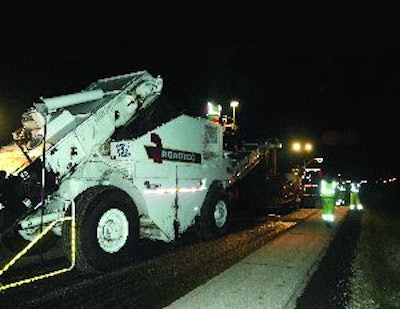
Using a Roadtec MTV (material transfer vehicle), a Blaw-Knox 3200 paver with Carlson EZ Screed IV, an Ingersoll Rand DD130 breakdown roller, a Caterpillar pneumatic roller for intermediate compaction and a Hypac finish roller, Payne & Dolan's paving crew placed approximately 125,000 tons of HMA during the resurfacing project.
According to Doug Buth, Payne & Dolan's area manager overseeing the project, Doherty's crews (milling and paving) did an excellent job of maintaining the schedule and producing the quality required to achieve the density and ride-smoothness (based on the International Roughness Index) incentives outlined in the contract. With over $150,000 tied to density and smoothness incentives, Buth anticipates that those specifications will be met.