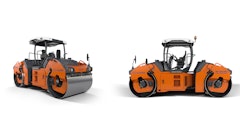
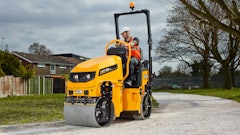
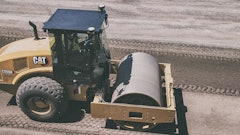
When it comes to using soil and asphalt ride-on compactors, manufacturers play a supporting role with the operator in keeping everyone on the jobsite safe. With each new model, it seems like more dedicated safety features are being incorporated into the machines.
It's no longer an anomaly to have ROPS/FOPS and seatbelts as options or, in some cases, standard equipment. "Sakai? includes ROPS and seatbelts as standard equipment on all roller models delivered in North America," says Dave Brown, vice president sales and marketing, Sakai America. "That's how important we believe these normally optional accessories are to operator safety."
Backup alarms and horns make it easy for operators to alert workers on the ground and in the surrounding areas to any equipment that might be moving in their direction.
And there are several systems available to control movement during an emergency situation or equipment failure, or simply when starting/stopping the unit. Emergency stop buttons - located within close proximity to the operator - allow the machine to be shut down in an emergency by simply pressing a button.
There are also brake systems that automatically stop movement in the event of hydraulic system or engine failure. According to Brown, Sakai rollers include three different braking systems: hydrostatic service brakes, SAHR brakes and combined automotive-type foot brakes.
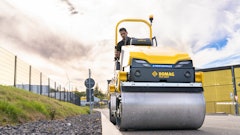
All new Bomag models also feature SAHR, or failsafe, brakes that are within both the travel motors and axles, says Dave Dennison, product manager, Bomag. "If you lose hydraulic pressure or engine function for any reason, these brakes have internal springs that allow the component itself to apply its brakes automatically," he explains.
In addition to SAHR brakes, Dynapac rollers are equipped with relay switches and interlock systems to prevent unintentional and/or unexpected vehicle movement when stopping/starting the machine. One such relay switch requires the operator to move the control into neutral to release the brakes. This prevents the machine from moving as the brakes are released, notes Nono Bauleth, service manager.
The same basic principle applies to the interlock system, where the engine shuts off within four seconds if the operator releases the brakes and stands up. "It doesn't allow the machine to move without the operator," says Bauleth.
Visibility and ergonomic features
Some of the newer features found on ride-on compactors benefit safety indirectly. For example, in models with cabs, tinted glass may be used to reduce glare and help maintain visibility around the machine.
Some asphalt rollers incorporate swivel seats that turn 90° or more. "Operators have a clear view in front and behind the machine," says Dennison. "For large, highway-class [asphalt] rollers doing road production work, they're pretty much standard. They can help reduce operator fatigue and ease operation, because he can turn sideways compared to turning all the way around. Also, by moving the seat to the furthest position left or right, he has a good view to the edge of the drum, as well as the front and rear.
"Good general visibility from the operator's platform is a must to be able to identify potentially dangerous situations," he adds.
Ergonomically designed control layouts improve not only safety., but also performance. "With good ergonomics and proper layout of the cab, you reduce fatigue. [You] give operators the ability to operate comfortably for a longer period of time, so they're more productive," says Dennison. "With good placement of controls, instrument panels, steering wheels, levers, etc., it's a lot simpler operation as well, so operators don't need to reach up, over or down. The more controls you can put in the 'cockpit', the more you can improve productivity."
Many manufacturers have made entry into the machine safer by addressing step height and position, as well as adding grab handles, safety railings, etc. Beyond the steps, features such as anti-skid plates and materials on the operator platform floor keep the operator from slipping once seated in the unit.
Keep it functional
Although there are a plethora of safety features, the components put in place can't do their job if they aren't working properly. "Operators should never operate their machine if any of the safety components or systems are not properly functioning," says Frank Martinelli, Volvo Construction Equipment.
Perform a walkaround of the roller before each shift, and check that safety features are in place and operating correctly. Also ensure proper operating pressures, etc., and monitor all gauges to ascertain proper functions.
Familiarize yourself with maintenance tasks that should be performed to keep the machine in safe operating condition and safety features intact. "Safe operation is directly related to following manufacturer guidelines for service and maintenance to keep the machine safely functional," Dennison stresses.
Read up for safety
Safe compactor operation actually starts with reading the operator manuals, which will alert you to the various safety aspects of the machine. For example, the steering hitch area is a danger zone that can put an operator's life at risk, especially when his or her attention is focused elsewhere, Brown notes
"Operators should never operate a compactor unless they have been trained by a qualified instructor and... have read and thoroughly understood the operator's manual," says Martinelli. "If there is something they don't understand, they should ask their supervisor for help."
"One of the biggest mistakes operators make is they don't take the time to read the manuals that come free with the equipment," says Brown. "A better understanding of the basic forward-reverse controls, braking systems and other machine features and functions will help them avoid mistakes that can injure."
Avoid rollovers
Reading the manual can also alert you to safe operating practices. Compacting on slopes is an area of particular concern.
Every machine typically has a gradeability specification, but not every manufacturer reports it. "Be sure to check," advises Dennison. "The gradeability limitation gives you a boundary or guideline for safe operation."
Even with this guideline, Brown cautions, "Slopes should always be compacted from top to bottom, rather than from side to side, regardless of the degree of the slope. Even with ROPS and seatbelts, rollovers of machines up to 30,000 lbs. are to be avoided."
Embankment work with a lot of uncompacted fill material is also very dangerous. "Operators should always roll longitudinally from the center of the embankment outward, making sure to overlap each pass by at least one-half of the drum width to keep the machine on compacted ground," Brown says. "When rolling along the edge of an uncompacted embankment or drop-off, always roll with the drum leading. Rolling in reverse with the tire leading is inviting trouble in the soft fill."
Also be aware of loose soil or rock on grades and embankments. "If you lose traction, or if material slides out from under the machine when you're on grade, the machine could slide down the embankment," says Dennison. "Be aware of anything that would cause them to break
traction and lose control."
That includes working in excessively wet site conditions. "If a drum or wheels are slipping, you don't have traction," says Dennison. "If you don't have traction, you don't have control. All materials have an optimum moisture level where you can attain the best compaction levels. If you go beyond optimum moisture and there's water laying on the surface, you won't get your density anyway."
Hazards on asphalt
Although operating on slopes and embankments is usually reserved for soil compactors, asphalt rollers aren't without hazards. "You might think that rolling asphalt would be one of the safest jobs around," says Brown. "But consider a couple of things."
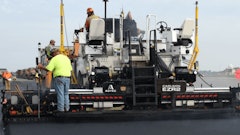
For one, the rule of thumb on most paving jobs is to keep the compactor close to the paver to achieve optimum density while the material is hot. "At the screed end of the paver are a couple of hardworking guys, who are focused forward on spreading a proper layer of material," Brown notes. "With the roller drum only feet away, the roller operator must remain absolutely focused at all times. This is when knowledge of the roller and its functions are key."
According to Martinelli, "Compactors tend to approach the paver-finisher too closely. This increases the likelihood that the compactor may strike the paver screed or one of the crew members operating on or near it."
He cites studies Volvo has conducted that show it isn't necessary to approach the paver closer than 50 ft. on a typical highway paving job. "Of course, if the paver stops because it has run out of asphalt, etc., the compactor will need to roll up close to the screed before the asphalt cools," he admits. "However, since the paving operation has stopped, there is no reason the paver crew members can't be cleared from the area before the compactor approaches."
Workers should be made aware of the job of the roller, be alert for sudden reversals and stay clear of the roller at all times. The roller operator should inspect the jobsite for potential holes and wet spots, and look for any overhead interference.
Seatbelts, if available, should be mandatory whenever the machine is in use. "Strictly enforce the usage of seatbelts on machines equipped with ROPS and seatbelts at all times the machine is operating," says Martinelli. "This means even on seemingly flat terrain.
"Rollovers and tipovers are potential hazards on ride-on compactors, just as they are on other types of earthmoving equipment, given the nature of the ground conditions on construction sites," he continues. "The likelihood of a serious injury is greatly reduced if the operator is wearing his/her seatbelt in the event of a rollover/tipover."