
A number of years ago when the North American Power Sweeping Association (NAPSA) was looking to enhance its member benefits, it hoped to offer an insurance program where the premiums and benefits would more accurately reflect the type of work sweepers perform.
NAPSA hoped to offer sweeper-specific insurance, available only to association members but was told by insurance underwriters that any such insurance would under the law have to be made available to all sweepers, NAPSA members or not - unless there was a different category of sweepers within NAPSA.
So was born the NAPSA Certified Sweeping Company (CSC) designation, a members-only program "to recognize those firms operating in a professional manner and contributing to the overall image of the sweeping industry."
"NAPSA was having trouble getting insurance underwritten, and we set about constructing a practice to set up a higher-quality product with a better class of companies based on specific business practices," says Mark Carter, owner of Bill's Sweeping Service, Orange, CA, which received its CSC designation in 2004. "The CSC designation gives us another level within NAPSA and makes a difference with underwriters."
Carter, who was on the committee that developed CSC and is currently head of the committee (with Debbie Jacketta, Jacketta Sweeping Service, and Gabe Vitale, C&L Sweeper Service) that reviews CSC applications, says certification has yet to translate directly into "a guaranteed X percentage off the premium," but underwriters tell NAPSA that will happen.
For now, receiving a NAPSA CSC means a company is one of the top contract sweepers who has worked through the certification process. Kerry Armstrong, Armstrong Sweeping, Arvada, CO, was the first company to be certified (he was also NAPSA's first president). Since then, 30 additional contractors have worked through the process and can now boast NAPSA CSC on their trucks, letterhead, bids, ads, and other marketing materials.
"So while the initial idea was insurance related, certification has become a marketing feature designed to give the industry and individual companies additional credibility," Carter says. "It's more a tool to raise the credibility of the association and individual companies."
Among the business aspects the CSC evaluates are safety, employee practices, business practices, vehicle practices, and industry education. In addition CSC applicants must sign NAPSA's Code of Ethics, which covers a variety of professional obligations covering the client, employee, and safety.
"People have gotten the impression that certification is only for the bigger companies, but that's not true. You can be a husband-and-wife team and can still be certified," Carter says. "It's the quality of the organization, not the size of the organization that matters."
To qualify for certification a contractor must meet either of the following two criteria:
- Generate more than 50% of business through sweeping, or
- If sweeping is not 50% of the business the contractor must generate $500,000 a year in sweeping.
"This is open to all NAPSA members who meet those criteria, and the intent is to make sure all certified contractors operate quality businesses and follow legitimate, sound business practices," Carter says. "That's most contractors."
He acknowledges, however, that there are legitimate business reasons for not becoming certified - for not putting the company name on the sweeper, for example.
"There are legitimate companies out there who don't want to put the name on their truck for legitimate reasons - noise issues are a perfect example - but if you're a professional you want people to know it," Carter says. "For the most part legitimate companies put their name on their vehicles, and they each have to make that call on their own from a professional standpoint."
Certification is good for three years, and re-application of the first CSC contractors has begun. "The re-application is similar to the first application but it's a much shorter process, much simpler paperwork, a streamlined process," Carter says. "It should be easier because contractors already have made any modifications to their business to qualify for certification initially. If they maintained those programs and processes it's simply paperwork."
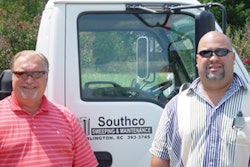
NAPSA President Dale McCaskill, Southco Sweeping and Maintenance, Camden, SC, emphasizes that the certification is not something to be taken lightly by sweepers or property managers.
"The ultimate hope is if you hire a NAPSA-certified sweeper you know you are getting the very best sweeper in your area," McCaskill says.
CAM Services: Improving industry's professionalism
Certified through the North American Power Sweeping Association (NAPSA) in 2005, CAM Services, Denver, decided to pursue certification because "we wanted to distinguish ourselves from the mom-and-pop sweepers in the area," says president and founder Butch Hartman. "Most of the requirements NAPSA had for certification we had been doing for years, so it was a fairly simple process and just a natural fit for us."
Hartman, who has more than 25 years experience in the sweeping industry, started CAMS in 1999 and has been a NAPSA member since 2001. The contractor generates a third of its work through power sweeping, a third through snow removal (CAM Services is the primary sweeping/scrub contractor for the concourses at Denver International Airport) and a third through a Special Projects Division that includes a broad variety of work such as replacing parking blocks, installing signs, and replacing lights. But everything starts with sweeping.
"The sweeping contracts lead to snow removal contracts, which lead to other work in special projects division," says Hartman. "Sweeping is the way in. Once we get that we go in and try to get additional work."
He says all their sweeping is off-road - parking lots and airports - and includes some construction site cleanup where a vacuum sweeper can be effective. The company's 50 employees (which jump to 150 including subcontractors for snow removal) service more than 200 accounts using 12 sweepers made by Victory, Schwarze, Tymco, Tennant, and American-Lincoln. CAM Services also runs a full fleet of loaders, backhoes, skid steers, dump trucks, and 30 plows to support the snow removal operation.
Hartman says he thinks its sweeper certification helps some customers feel more comfortable.
"I think that some people might feel a little more secure any time they're working with a company that is certified," he says. "They know we had to go through a process and meet certain criteria to get certified - safety, financial, insurance, record keeping - and so they feel more comfortable."
Hartman says he expects eventually to receive a discount on its insurance premiums for its $10 million umbrella policy as a result of being certified, and he has submitted the certification information to the insurance company. But he says that so far he hasn't seen direct results from certification, "but we've really just started pushing it and bringing it up."
"There are not a lot of certified sweeping companies in the Denver market, so property managers and owners are not aware of what certification is and what it means," he says. "Until we educate them they won't know what it is, but then hopefully we will see some impact."
To that end CAM Services makes the most if its certification, promoting it extensively, including enlarging the certification logo and applying it to all 12 sweepers.
"I think they look great on the sweepers," Hartman says. "They make a real impact."
CAM Services also displays the certification logo prominently on its website, includes it in its Yellow Pages ad and in brochures in a 7,000-circulation local real estate journal, and uses a foil sticker on folders with each estimate. "We have an ongoing marketing program that includes direct-mail flyers every quarter, and we make sure to use it in there, too.
"And it doesn't hurt when we bid municipal, city, or other government work," Hartman says. "I think it gives us a leg up on that." CAM Services performs work for the Colorado DOT, for example. "It's bid work, and low bid generally gets the job. But we were awarded one of the jobs recently, and they actually mentioned the certification." He says it's also been a plus for airport work. "We were asked what it means and that gives us the opportunity to explain it," he says.
"I think it always comes down to the bottom line. If your bid is close with a company that's not certified I think most property managers will prefer to work with a company that's certified?and maybe a bit more qualified," Hartman says.
Commercial Property Maintenance: Certification raises standards
Once I started hearing what NAPSA was doing I liked the idea," says Windell Brent, owner with wife Diane of Commercial Property Maintenance, Albuquerque, NM. "Certification adds credibility to the industry and those of us who have been with it a while and who expect to stay with it want to make it more credible."
Started in the fall of 1988, when a property manager friend said he couldn't find a sweeper to show up two nights in a row, Commercial Property Maintenance today generates 65% of sales from parking lot and construction site sweeping. Pressure washing generates 20% of sales, and landscaping generates another 20%. The contractor employs 35 people and runs 11 sweepers including seven Tymco 210s, one Tymco 600, and three Tennant 6650 broom sweepers. It services more than 400 accounts among all markets, and recently it acquired 2¼ acres and built a 10,000-sq.-ft. building to house the sweeping business.
"I gradually built it up and am kind of dragging my heels a bit because I don't want to grow too fast," he says.
Brent, whose company was NAPSA certified in 2005, says he expects NAPSA certification to help differentiate between contractors who sell only by cutting price and contractors who sell in a more professional approach to sales, focusing on quality, service, and longevity.
"We're already pretty well established with all the property managers and the players in town, but if we can get our customers to pay attention to the certification instead of just price it helps cement the relationship," Brent says. "For customers who pay attention to these things, certification is important, but there are always those customers who only want the lowest price."
He says he hopes certification will encourage customers to buy sweeping services based on something other than price, adding that eventually certification will help clients distinguish between the contractors "who think they're serious" but don't want to get certified or can't get certified and those who are certified.
"There are always people out there cutting their price, and there always will be people looking for the lowest price. But for customers looking for more than that, for customers looking for reliability, efficiency, service, and professionalism, certification will make us easier to identify."
Brent says he has incorporated the certification logo into his website and letterhead. "I use it everywhere I can because that's the only way we're going to get the word out there," he says, adding that certification probably won't have much impact with his current customers.
"Most of our customers have been doing business with us for years, and they do business with us because of who we are, not because we're NAPSA certified," Brent says. "But out-of-town customers and new customers see that [certification], and a number of them have asked what that means."
He says NAPSA's certification process took some time but wasn't difficult to go through. He says that basically the process requires contract sweepers to do some of the things they always felt were necessary but never did in a formal or scheduled manner.
"Certification raises the standards of the industry in general and raises our own personal standards," he says. "It makes us more aware and makes us implement some things that we may have known about but were too lazy to implement."
He says two areas Commercial Property Maintenance needed to upgrade to be certified were its safety meetings and its vehicle inspections. "Common sense told us we needed to do those things, and we were doing them to some extent, but to receive the certification we needed to be more formalized in those areas."
Brent says the nature of the sweeping business - running day and night, 24 hours - makes it difficult to schedule safety meetings for the whole company at the same time. His solution was to delegate some of that responsibility to shift foremen, and now the contractor has multiple day and night meetings to make sure to reach all employees. "Now we accumulate material and when we have enough, or when a specific need arises, we schedule the meetings," Brent says. "At the very least we hold scheduled safety meetings once a quarter."
He says another area that became more structured was the company's preventive maintenance program. Commercial Property Maintenance employs its own in-house mechanic and has always maintained a high standard for preventive maintenance. "We always took great care to make sure our equipment was reliable and operating efficiently, but we did have to formalize some of that operation to become certified," Brent says.
He says Commercial Property Maintenance doesn't do anything differently than it did before the company was certified. "But in the back of my mind it gives me something to live up to," he says. "I feel responsible to live up to the certification process and the criteria. If you believe in the process and want it to continue you work harder to live up to it."
Brent says he thinks the certification will come into play if not formally, then informally. "As I go to National Pavement Expo I am seeing more people getting certified and I feel proud of that," he says. "That means it's growing around the country, and eventually it will become something customers require. 'Are you a certified sweeper?' 'No.' 'Well, we need to hire a sweeper who's certified.' That's where this is headed."
He says that while he doesn't "push" certification on other contractors, he does highly recommend it when asked. "It's something that will help elevate our entire industry and make each of us a better operator," he says. "It's something than enables us as a group to give our customers more of what they need." He says certified sweeping contractors ultimately will be more profitable and will stay in business longer. "In the end the customer benefits when there's continuity in the industry," Brent says. "And continuity means the industry is stable, and if you're certified you're on the leading edge of the industry. All that makes us more valuable to our customers."
Hy-Tech Property Services: Stepping up to the plate
Over the long term it's always better if some organization is out there that can grade a company, that can indicate where you stand," says Marc Chimento. "Everything is graded by somebody, and certification gives customers a measurement tool that says you stepped up to the plate and got certified and that you take the profession seriously."
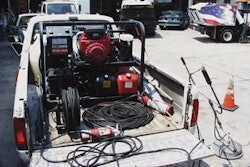
Started by Chimento and his mother, Shirley Apperson, in 1985 with one slide-in Tennant sweeper in a Ford F250 pickup, Hy-Tech Property Services Inc. was a sweeping-only contractor until 1997 when instead of subcontracting other services it brought them in-house.
Today, with 80 employees, Hy-Tech, Midlothian, VA, handles accounts with more than 250 shopping centers, spending 45% of its time sweeping; 40% doing paving, sealcoating, and striping; and the remaining 15% from landscaping, including irrigation which they added in 2005. The contractor also handles snow removal for 80 properties. Parking lot, road, and construction site sweeping is done using Elgin, Schwarze Industries, Victory, and Nite-Hawk Sweepers.
Chimento credits another NAPSA member, Karl Stauty, Commercial Power Sweeping, Suffolk, VA, with encouraging him to get his business certified through NAPSA. "We talk a lot and help each other out when we can," Chimento says. "He told me he went through certification, and he told me about how it went, and so I decided it was probably worthwhile. Being certified puts us head and shoulders above other companies that are not certified, and frankly a lot of the competition probably never will be certified."
A NAPSA member since 2000, Chimento called the NAPSA office and started the ball rolling. "It wasn't very difficult," he says. "There were some things we were doing, but we weren't doing them as much as I would have liked, and we weren't doing them enough to qualify for certification. So we had to structure those things a little more. But it was a pretty straightforward process."
For example, Chimento says the company had held safety meetings infrequently, and he needed to change that.
"I always wanted to hold those more often anyway so we had to step that up a little, but that's about it," he says.
Chimento says that once he decided to pursue certification he got together with David Worley, manager of the sweeping division, and started to work through the process. They put together a program for regular safety meetings, and now Worley, who works days, conducts safety training during the day. For the night shift either Worley comes in and conducts the meetings or the night supervisor conducts them.
"If we don't hold them nightly we hold them every time we get together to give out any changes in the sweeping schedule," Chimento says. "Sometimes we cover specific topics or issues that have come up, but sometimes it's just an awareness meeting to make our drivers more safety conscious."
He says the company also inserts safety reminders and other information in the pay envelopes. "Everyone has to sign for his paycheck so by putting the information in with their paycheck we know they received it," Chimento says. "We can track that they got it."
He says Hy-Tech just began to market its NAPSA certification this summer, letting prospects and customers know via a letter that Hy-Tech is the only certified sweeping company in the area and directing them to the NAPSA website for more information. Hy-Tech also includes copies of the certification certificates with all bids, and places a certification sticker on each sweeping-related letter going out.
"Hopefully certification gives us the little step we need above the competition to grab our customer's eye," Chimento says.
He says the certification also demonstrates a contract sweeper knows what's going on in the industry, which also helps the customer.
"You strive for knowledge in today's world, and knowledge is power," Chimento says. If you've got the knowledge you've got the power, and certification shows we've got the knowledge."
Bill's Sweeping Service: Clarifying the market
A fixture in the Southern California market since 1953, Bill's Sweeping Service generates 50% of its sales from on-call construction site sweeping and 50% of sales from scheduled street sweeping in gated communities and on other private streets. Bill's Sweeping runs 25 sweepers, primarily Tymco and Mobile machines, and employs 20 people. Brothers Mark and Mike Carter run the company, which their father bought from the original owner in 1962.
Mark Carter says the company didn't necessarily need to become a certified sweeping contractor, but they decided to gain the certification because the industry and the market need clarification.
Carter says that like many of the pavement maintenance industries, "anyone with $10,000 from their mother-in-law can get into the sweeping business," and that can really have a negative impact on the industry. He says that while many contract sweepers operate professionally, offering service and quality for a fee that can generate a profit for the contractor, other less-professional operations tend to drive prices and quality down, leaving behind dissatisfied customers.
"We need to continue to segment the industry because we do have to combat the fly-by-nights," Carter says. "Once a customer gets burned by a bad sweeping contractor, that leaves a bad taste in the customer's mouth and that affects all the rest of us out there who are trying to do a good job and run a legitimate business," Carter says. "Through certification we can show that there's a different tier of players out there."
Carter says applying for certification and working through the certification process was not difficult.
"There really shouldn't be many hoops to jump through to get certified," he says. "If you're operating at a fairly high level you won't have to do much. Most contractors have to formalize some processes that they already are doing informally, and a contractor might have to make some minor tweaks, but for the most part the hoops are only the paperwork of putting it all together."
He says he thinks certification for sweepers can be particularly effective with property managers who already understand the certification concept.
"Contract sweepers are always dealing with property managers, and many of those people have special designations after their name," Carter says. "They see value in that, they see value in advancing to another level within their own profession, and even if they don't award a contract based on certification they will have an intuitive sense that they're dealing with a certified company."
Carter says certification can't be expected to have an impact on all work a contract sweeper bids.
"When price is the only issue, certification likely won't have much of an effect, but when price isn't the only issue certification does have an impact," Carter says. "We know that because we often get jobs and we're not the low bidder. So while I'm sure certification is not the only factor, I'm sure it's one of the factors."
He says one job he knows Bill's Sweeping Service got because of its sweeper certification was for a small government entity that needed to certify that all its parking lots were swept and maintained from a stormwater standpoint.
"They had to document that, and once they saw our certification and NAPSA they just said 'Go do it.' There was no bid involved at all," he says.
Carter says he thinks a big benefit of becoming certified is an invitation to the Certified Sweepers Breakfast at National Pavement Expo, which is open only to NAPSA-certified contractors and NAPSA manufacturer gold sponsors.
"It's an awesome, standing-room-only event that's all about relationship building," Carter says. "When you're in this business and you can say those people are friends of yours, that's a pretty good feeling. It's with people who are doing what I'm doing, they're where I'm at, and we have something in common."
The breakfast is held in a roundtable setting, enabling each Gold Sponsor manufacturer to move from table to table to talk with the certified contractor sweepers seated at that table. "Each manufacturer had face time with each table, and candid comments were exchanged on both sides," Carter says. "Contractors talked about the challenges we're seeing, manufacturers discussed the challenges they're facing. It's a great opportunity to help us better understand each other's challenges."
Carter says it's essential to promote the fact that the company is certified. "NAPSA provides foil stickers and we use those. There's a stamp for every envelope we send out, we promote it in our Yellow Pages ads, and our bids contain an entire page that says simply "California's First Certified Sweeping Company."
Carter says this promotion is one of the biggest advantages of certification: certification is always working for the contractor - and the industry.
"Once we got certified and had access to the marketing materials that went with it, certification continues to work for us without having to spend any more effort," he says. "Once in place it keeps on returning dividends with very little effort on our part."
NAPSA at NPE 2008 in Nashville
For more information contact NAPSA at www.napsaonline.com or visit www.nationalpavementexpo.com. |
NAPSA-certified sweeping companies |