
On the specification sheets, most similar-size motor graders look much the same. "Length, width, height, weight and horsepower are all very comparable," says Bryan Abernathy, Champion Industries. The real differences can be found in the details.
Motor graders come with many different features, options and attachments. As such, you need to prioritize what is important to your operation.
"Obviously, the contractor needs to know the type of work he will be doing and purchase a motor grader to match his needs," says Keith Lee, research and development, VT LeeBoy, Inc. "A contractor can spend a lot of money on a motor grader that can do things he will never need. Conversely, he can find a low-cost motor grader that won't perform up to his expectations on the jobsite. Both choices may be costly."
Spec to conditions
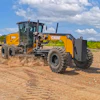
Autry Grading, Fayetteville, NC, has vast experience tailoring motor graders to meet its jobsite conditions and operators. Its fleet currently includes four Volvo G930s and one G720 model.
"We didn't just buy standard motor graders," says Ken Autry, owner. "We run 13-ft. moldboards instead of the standard 12-ft. moldboards. It just gives us a little more stick out beyond the wheel and the frame." Yet, the setup is not so long that it is difficult to control excess movement on the end of the blade.
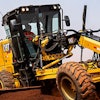
The contractor also specifies wider tires to handle the soft, sand conditions. In addition, a short cab includes windows that open in the bottom. "Some of our older operators still want to open the window when they get down to the last pass or two," Autry notes. "When they have a window in front of them, they start losing some of their depth perception. That distorts the grade."
Autry also pays attention to operator comfort. "They have the better seats in them," he says of the graders, "and they all have air conditioning."
Alpine Services, Gaithersburg, MD, is also proficient at spec'ing graders to its needs. The contractor constructs athletic fields across the country for organizations such as the National Football League and the National Hockey League. These confined-space projects require precision and speed. This is where the company's two Champion C80 motor graders and its discontinued Blade-Mor model earn their keep.
The units are equipped with hydrostatic drive. "The hydrostatic transmission is the only way to go. You don't have to stop and shift," says Grove Teates, owner of Alpine Services. "It changes speeds so quickly or you can change direction with just the simple movement of the pedal."
Power and visibility are also important. "We like open cabs so that you can see better," says Teates.
But what Teates values most is the factory support. "Champion was able to tweak everything just to suit us a little better and that helps," he says.
Clearly, selecting a motor grader goes beyond the options available. "The 'feel' of the motor grader is important," Lee says. "Key features such as operator visibility to the surrounding work area, visibility to the blade area, a quiet engine and power and traction all make a difference when it comes to safety and productivity."
Transmit power to the ground
Lugging capability through the use of a high-torque engine can be a desirable trait in a grader. According to Autry, the torque curve of the engines on its Volvo units helps his operators in fine grading applications. The really high torque at low engine speed allows them to keep the ground speed very slow, yet still supplies enough power to pull heavy loads.
Powershift transmissions are also an advantage on most full-size graders. For example, on its 120M through 16M models, Caterpillar uses a direct-drive countershaft transmission with electronically controlled shifting. "The full Electronic Clutch Pressure Control (ECPC) system optimizes inching modulation and smooths shifting between all gears and directional changes," says Wade Porter, marketing supervisor, Caterpillar Motor Grader Product Group. "This provides outstanding control and also extends the life of the transmission by reducing stress on gears."
All Volvos use a full powershift, direct-drive transmission designed to maximize fuel efficiency and eliminate surging or wind-up associated with torque converter drivetrains as the load on the grader comes on and off. In addition to the standard eight-speed forward/four-speed reverse transmission, the company offers a version with 11 forward and six reverse speeds. This has several advantages.
"It provides for slower ground speeds in fine grading applications, faster travel speeds and exceptional fuel efficiency in every gear, since the engine can be operated in the most economical RPM range in every application," says Brian Lowe, Volvo Construction Equipment.
Obviously, fuel efficiency is a primary concern. "The rate that fuel is consumed is a function of many factors," says Lowe. "Apart from the load, most influential is the engine speed. Selecting a lower engine speed and raising the gear can yield significant improvements in fuel economy, while allowing the operator to get the job done to spec and on time."
For its larger grader, LeeBoy uses a six-speed powershift transmission, which Lee indicates is better suited for long grading pulls or road work. But its two smaller models use hydrostatic drive for better speed and direction control when grading in confined areas.
Champion graders all use hydrostatic drive. "You are basically limitless in your speed-to-rpm ratio and can adapt your grader to any condition," explains Abernathy. "With powershift, you are limited to just how slow you can go and still have power to work. Also, the part count in a hydrostatic pump is a fourth of the count in a powershift transmission. The pumps are also very inexpensive compared to powershift."
Keep it tight
When fine grading, precise control is crucial. "Precise control of the motor grader extends beyond the actual levers the operators use to position the moldboard," says Lowe. "All of the systems and design elements must work in concert in order for the operator to be most productive and be able to produce an accurate finish grade."
For Alpine Services, everything revolves around precision. The majority of its projects require extremely tight tolerances. "For the National Hockey League, we are
+/- 1/16th measured over 304 ft., or we don't get paid," says Teates. "All of the fields we have done for the NFL are +/- 1/8th over 400 ft."
These tolerances require a tight machine. "Champions are very easy to keep tight because they are made with that in mind," says Teates. "You can adjust and shim out."
The older Blade-Mor unit takes a little more effort. This grader is used a lot due to its small size. "We rebuild that one every two to three years. We simply take it to a machine shop and re-machine everything. We actually redo the entire bushing," Teates explains. "There is nothing original on it."
According to Porter, a motor grader must have the ability to keep the drawbar, circle and moldboard extremely tight - removing any type of unwanted movement - in order to allow the operator to maintain the tightest grades.
For example, Caterpillar uses a shimless moldboard retention system and top-adjust drawbar wear strips. "The patented top-adjust wear strips dramatically reduce drawbar/circle adjustment time. By removing access plates on top of the drawbar, shims and wear strips can easily be added or replaced," Porter points out. "The unique shimless moldboard retention system reduces the potential for blade chatter. Vertical and horizontal adjusting screws keep the moldboard's wear strips aligned for precise blade control and dramatic reductions in service time."
Benefits of AWD
When working to tight tolerances, speed can also be an issue. Being able to run at virtually a crawl is sometimes an advantage.
For example, on Volvo's all-wheel-drive (AWD) models, there is a Creep mode where only the hydrostatic front wheels drive for precise fine grading control. "The operator can easily control his starts and stops via the foot throttle. He can attain a top speed of 2.5 mph and maximum aggression in Creep mode at 1,600 rpm," says Lowe. Volvo set the 1,600-rpm limit, since this is above peak engine torque and running the engine any faster just wastes fuel.
Likewise, the Hydrostatic mode on Caterpillar AWD graders disengages the transmission and provides hydraulic power to the front wheels only. "The ground speed is infinitely variable between 0 to 8 km/h (0 to 5 mph), perfect for precise finish work," says Porter.
Still, all-wheel drive is not suited to every situation. "We have looked at the all-wheel drive and maybe someday it would be nice," says Teates. "We would like to have it when we are handling sand or loose gravel, but that also has a price tag."
According to Abernathy, all-hydrostatic AWD means more power and control at the slowest speeds. "You don't find a situation where you want to turn the tandems off to finish the grade," he says. "You can take advantage of all the added traction and tracking that AWD offers, no matter what the operating speed."
Automated control
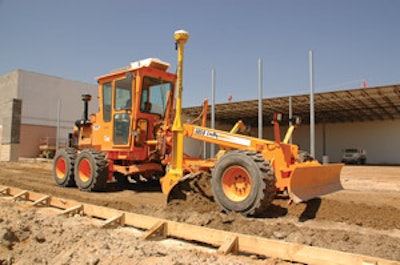
Automated grade control technology can also lead to tighter tolerances. "Automatic grade control systems give contractors the ability to control blade action to precise tolerances on jobsites with in-cab controls using laser or GPS technology," says Lee. "These systems can operate without stakes and grade to an accuracy of 20 to 30 mm (0.1 ft.)."
Even the most experienced operators can benefit from automated controls. "The automated system actually cuts a better grade than a well-trained operator on his own," says Autry. But this is not a substitute for a highly skilled operator. "The skilled operator just doesn't have to see grade as well if you are running automatics with GPS. But he still has to understand the fundamentals of what to do with the dirt."
Porter adds, "Automated blade control systems will ensure the tightest accuracies for finish grade applications, but can only control the blade as quickly and accurately as the hydraulic system is capable of responding."
In the case of Caterpillar M Series graders, a time-proven load-sensing system has been combined with proportional priority pressure-compensating (PPPC) electrohydraulic valves. "PPPC valves have different flow rates for the head and rod ends of the cylinder," Porter notes. "This ensures consistent extension and retraction speeds for each cylinder, and gives the operator consistent and predictable response every time an implement control is moved."
Load-sensing hydraulics can be a real advantage by reducing heat and power demands. "Load-sensing hydraulic systems are almost a given on the modern motor grader - it is the design of the systems that is key," says Lowe.
Side slope work
Having the ability to correctly position the blade is almost a given with motor graders.
"Most, but not all, modern full-size graders in North America can back slope to 90°," says Lowe. As such, blade positioning isn't that important - except you must consider not only the position of the blade, but where the heel of the blade is positioned. "Ensuring that a grader can cut a 2:1 fore-slope without also cutting the traveled portion of the roadway is an important consideration."
The criteria used to evaluate the side slope performance of a grader depends on what you are trying to accomplish. "For cutting side slopes, power and traction will be important," says Lee. "Features such as all-wheel drive, front-wheel assist, articulation for angles and a low profile for stability will increase efficiency."
Porter adds, "If you are talking specifically about side sloping, then the contractor should concentrate on machine weight balance and target a front to rear weight split of 30% to 70%. AWD systems can also help a motor grader hold a slope and achieve better traction, depending upon soil conditions and slope angle.
"Articulation capability will also enable a motor grader to hold a steeper slope and provide better overall machine balance and traction capability," he continues. "Caterpillar motor graders mount the cab on the front frame, in front of the articulation joint, to maintain maximum blade visibility when in an articulated mode."
Bank sloping or ditch cutting performance is closely tied to moldboard positioning. "Heel clearance is another criteria to measure, which will dictate the motor grader's ability to reach up the slope and increase the width of pass, translating into increased productivity," says Porter.
Operator comfort also becomes an issue when cutting side slopes. Lowe asks, "Does the seat offer good lateral support? Can the operator brace himself and still actuate the controls properly, so he is not overly tired by the end of the shift or suffering from muscle strain?"
The complete package
When selecting a motor grader, it's important to look at its overall construction.
"The overall design of the grader must 'work' together in order for the operator to have complete control over the motor grader," Lowe emphasizes. "From the placement of the transmission in the grader frame to the design of the blade lift system, the entire grader must be designed as a whole and not as a series of parts. For instance, Volvo positions the transmission ahead of the final drive. This increases blade down pressure and front end weight, which keeps the front wheels from sliding around, while keeping weight over the rear tandem drive wheels for enhanced productivity."
Of course, life-cycle cost also plays a major role. "Factors to be considered include the overall cost of owning and operating the motor grader over the life of the machine or ownership period of the contractor," says Porter. This includes maintenance/repair costs, fuel consumption, productivity, operator safety and ergonomic impact, and resale value.
Building Comfort Into Controls But even this familiar setup must be comfortable to use. "Overwhelmingly, operators have told Volvo that the eight levers that directly impact the grade must be easy to access and positioned in an industry standard arrangement," says Volvo's Brian Lowe. "Additionally, the relationship of the levers relative to the steering wheel is very important. There cannot be any guesswork as to where the levers are positioned or how they operate." Even manufacturers of compact graders tend to follow the standard control layout. "We have larger companies and states buying our product as well as other large motor graders," says Abernathy. "So we want commonality for these operators. The result is a grader that is half the size of the standard full-size grader that operates pretty much the same." Although the control layout itself may not have changed on most grader models, ergonomic refinements have taken place. "As a key design criteria, the Volvo G900 addressed ergonomic improvements, specifically lower control lever efforts and shorter throws," says Lowe. Some manufacturers have also taken steps to simplify controls. On its two smallest hydrostatic drive units, Leeboy places the drive functions at the operator's feet. "This allows operators to control forward and reverse with the foot pedal, while keeping their hands available for other grader functions," says Keith Lee at VT LeeBoy. Caterpillar has taken a revolutionary approach by replacing the eight-lever control system with advanced joystick controls. "Two electro-hydraulic joysticks reduce hand and wrist movement by as much as 78% compared to conventional lever controls for greatly enhanced operator efficiency," states Caterpillar's Wade Porter. "Logical grouping of hydraulic functions in the joysticks allow any operator to easily control several functions at the same time. This allows the operator to be more productive and remain comfortable throughout the work shift." Caterpillar's M-Series introduces Intuitive Steering Control. "This technology creates a direct relationship between the lean angle of the joystick and the turning angle of the steer tires," says Porter. "A brake tensioning system holds the joystick in position until the operator moves it. In addition, the steering control automatically reduces steering sensitivity at higher ground speeds for comfortable and predictable control." Regardless which control layout you ultimately choose, make sure the controls are positioned effectively for your operators. "This includes the gauges and switches, because they are a vital part of operating the grader," says Abernathy. |