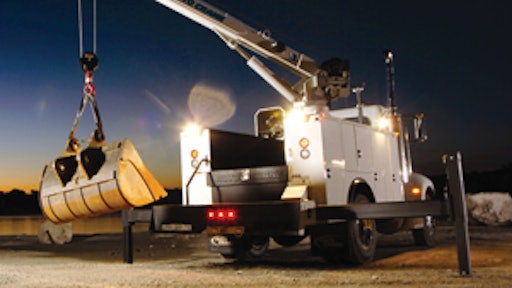
Whether you're spec'ing a mechanic's truck or a dedicated crane body, the proper crane and options make the difference between productivity and frustration. You need to carefully consider lifting capacity requirements, duty cycle and budget.
According to Tim Worman, product manager for commercial vehicles, Iowa Mold Tooling (IMT), "Finding the right crane really boils down to answering two key questions: How much lift capacity do you need the crane to have, and how often are you going to use the crane?"
There are really three types of cranes to choose between: electric, hydraulic telescopic and articulating. Then you need to consider the appropriate load moment rating. Be cautious that you really understand the true capabilities of what you are purchasing. While two cranes may be listed as 6,000-lb. cranes, the capacities may actually differ within the working load zones of the crane. Calculating the load moment capacity required, then comparing it to the load moment rating of the prospective crane, can eliminate problems down the road.
In addition to a service body crane, also consider whether a dedicated crane body might be a good fit for your operation.
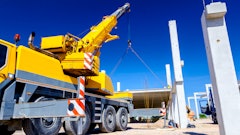
Archer Western has discovered the versatility of crane bodies while working in a crowded urban environment on the Valley Metro light rail project in Phoenix, AZ. It is utilizing two boom trucks equipped with National cranes. "We use them for running materials around - manhole sections, pieces of pipe," says Bob Fouty, senior project manager, Archer Western Contractors. "They have been real workhorses. We have those working both shifts."
Entry level option
Electric cranes offer a low cost of entry. "If you don't have a lot of money to spend, if your lifting needs are fairly light and if your duty cycle is intermittent, then an electric telescopic crane may be the best choice," says Worman. "Customers who know they only need to lift something once a week, or maybe a little more often, can save money by selecting an electric crane."
Walt Van Laren, sales/general manager, Service Trucks International, agrees, adding, "If the duty cycle is light, the lifting requirements are less than 6,500 lbs. and no hydraulics are available on the equipment the crane is mounted on, the electric crane would be the best choice for the application."
"They are really a good solution if you don't need any other hydraulic power," notes Jason Ollerich, Feterl Mfg. Corp. The complete unit will cost less because you don't need a pump, a hydraulic reservoir and a PTO.
In addition, an electric crane doesn't require the engine to be running for power. "An electric crane is the better choice when working in conditions that are not conducive to having your truck running during operation," says Kyle Whiteis, Auto Crane. "Hydraulic cranes obviously require a PTO/pump configuration to produce the necessary flow - which requires the engine to be running (often at higher than idle rpms) during operation."
Electric cranes have their limitations, however. For example, the power of the electric motors typically limits the size of an electric crane to 6,000- to 6,500-lb. gross lifting capacity, Van Laren points out.
There are also limits on operation. "I always caution customers against trying to save money by buying an electric crane if they are going to end up using it every day," says Worman. "They will be worse off because the life cycle of the crane will be reduced. Those cranes are not meant to stand up to that kind of use."
"Electric cranes are best suited for light duty cycle operations," Whiteis agrees. "Constant use throughout an operation will dramatically reduce battery life and add pressure to the electrical system. In addition, electric cranes are slower in operation than hydraulic cranes. More importantly, electric cranes are either on or off. There is very little, if no, opportunity for proportional control of the crane."
Heat buildup can also become a hurdle during operation. "Electric cranes are limited to the duty cycle (heat generated) of the electric motors that power them," Van Laren explains. "They are not intended for extended continuous operation periods. An electric crane will work well if there is enough time between operations for the motor to cool to ambient temperature."
According to Ollerich, "You can run [an electric crane] for 15 minutes every half hour or 20 minutes every hour, depending upon the system that is put in. I am not aware of anybody who has 100% duty cycle on an electric crane."
Hydraulic offers capacity, duty cycle
"Applications that require extended operation periods, shorter cycle times and higher lifting capacities are best served by using a hydraulic-powered crane," Van Laren asserts.
Whiteis concurs, adding, "Applications requiring continuous or high cycle counts are best suited for hydraulic cranes. Additionally, operations requiring greater control of the crane, as well as faster operation, are better suited for hydraulic models. In general, hydraulic cranes run faster, offer greater control (proportionality) and hold up to higher cycle counts better than their electric cousins."
The threshold for moving from an electric to a hydraulic crane depends on the lift capacity required and frequency of use. "If you've decided that your common lifting needs are to exceed 6,000 lbs., or that you will need to use the crane fairly often, then you should lean toward buying either a hydraulic telescopic crane or an articulating crane," says Worman.
The most common choice for mechanics trucks is a hydraulic telescopic crane. "It has a wide enough range of lift and reach capabilities to meet most field service needs," Worman states.
Unlike electric cranes, hydraulic telescopic cranes do not impose limitations on the duty cycle. "You can run them all day long," says Ollerich. You also have a larger selection of capacities to choose from.
However, there are a few downsides when compared to their articulating counterparts. "There is still a lift capacity limitation with hydraulic telescopic cranes because of the service bodies they are mounted on," says Worman. "The size of a hydraulic telescopic crane and the size of the truck go hand-in-hand. Telescopic cranes for service bodies are available as small as 2,000-lb. maximum lift and as large as 80,000-ft.-lb. (14,000 lbs. maximum lift). I advise against corner mounting any crane with a maximum lift of larger than 14,000 lbs. Anything over that and the service body will give under the pressure."
Articulation provides access
If your lifting requirements exceed the capabilities of a hydraulic telescopic crane, or jobsite conditions limit access to the work area, an articulating or "knuckleboom" crane can be an effective alternative.
"Knucklebooms are for customers who need more lift and reach than is possible with a service truck-mounted telescopic crane," says John Cheshier, director of sales for material handling systems, IMT. "Because articulating cranes can operate lower to the ground, they are helpful in avoiding overhead obstructions. They are also typically lighter than telescopic cranes of comparable capacity, so they enable you to carry more payload."
Articulating cranes enable more precise placement of material. "Articulating cranes are also better suited to placing material through narrow passages that are higher off the ground," says Whiteis. "Wallboard cranes, for example, are primarily a derivative of an articulating crane. These cranes must put material through a second floor window. A telescoping crane - because of the geometry - would not work as well."
But this increased dexterity comes with perceived complexity. "Generally speaking, they require two sets of controls - one on each side of the truck - to ensure proper visibility of the load," says Whiteis.
Yet, despite a higher level of complexity, operators should not be intimidated about using an articulating crane. "Many people who have seen knucklebooms, but never operated them, have a perception that they might be difficult to use," says Cheshier. "But a crane operator who is used to telescopic cranes will likely pick up articulating crane operation fairly quickly. The basic principles of operating knucklebooms and stick booms are very similar. And in reality, operating a knuckleboom is no more difficult than operating a stick boom."
The pricing is also comparable. "Articulating cranes are competitively priced when compared with similarly rated telescopic cranes," says Cheshier. "Keep in mind, articulating cranes come with stabilizers built into the crane base, whereas telescopic cranes do not come standard with outriggers."
With all of the different types of cranes and options available, choosing the correct setup for your application requires a little thought. So which crane will work best?
"The answer to that really depends upon the application for which the crane is being used," says Whiteis. "There are areas where an articulating crane may be better suited. However, there are others where a hydraulic telescopic crane is more appropriate."
Wireless Becomes Standard
When it comes to truck crane control systems, Jason Ollerich, Feterl Mfg., notes, "Pretty much everybody is going standard with some kind of wireless now. It is not just for the high-end customer anymore."
Kyle Whiteis, Auto Crane, agrees, noting, "FM controls are becoming more commonplace and offering greater flexibility."
Feterl's standard control system can be either wireless or umbilical cord. The wireless system can also be connected to the crane via an umbilical cord. "If your battery dies, you can plug it in and keep working," Ollerich points out. "If you are in an area where radio frequency is not allowed, you can plug it in."
Auto Crane offers a similar arrangement "Auto Crane provides a tether as standard alongside the FM control for use in areas where FM signals are not allowed," Whiteis comments. "Additionally, the tether may be used in cases where the batteries die in the FM transmitter."