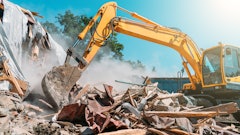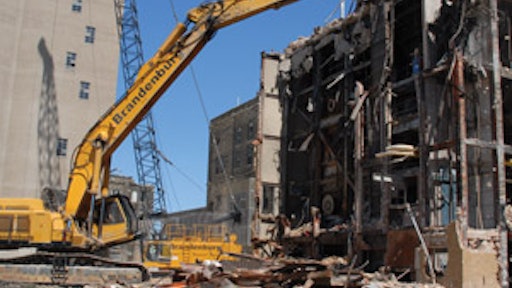
Implosion may be a more spectacular and dramatic way to bring down an existing structure. But it's not how most contractors complete demolition projects these days. According to the National Demolition Association (NDA), more than 99% of demolition work is handled with specialized equipment.
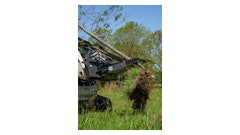
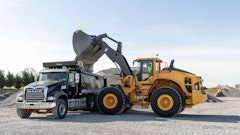
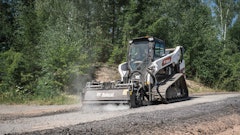
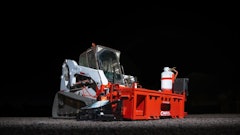
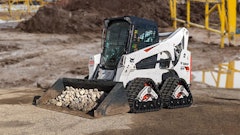
Oftentimes, excavators equipped with hydraulic attachments - grapples, shears, hammers, pulverizers, etc. - perform the work. Wheel loaders sporting 4-in-1 buckets and skid-steer loaders carrying hammers, buckets, etc. can also see plenty of demolition action.
The move to carriers equipped with specialized attachments has brought a host of benefits. One that directly affects the bottom line is the greater ability to recycle debris. With shears, pulverizers and grapples, you can cut, munch and pick your way to higher profits, since most steel, lumber and even concrete, once separated, can be sold for profit, or at the very least hauled to a recycling center to minimize landfill costs.
Value of recycling
Concrete removed from demolition jobsites can be used on site to fill basements or voids, or crushed into various aggregate mixes for use as roadbed or parking lot base. Lumber - large timbers, in particular - often finds a home in specialty markets, i.e., reincarnated as wood flooring. Bricks can be reused in their original form or crushed and used for secondary purposes.
King Wrecking Co. is currently sorting drop ceiling tiles, although Drew Lammers, president, indicates the market for recycling the product has yet to fully develop. "If you can't separate the debris to recycle it, you're paying for all of it to go to the landfill," he says. "The debris becomes a cost rather than a profit."
King Wrecking began using attachments 10+ years ago. The most useful have proven to be shears, grapples and hammers. "Attachments are a blessing for us," Lammers says. "They make our job easier and help us recycle more material."
Attachments are enabling contractors to more easily keep pace with demands being made by more states for recycling greater percentages of demolition material. And while Ohio has yet to implement any specific mandates, Lammers feels recycling is in his company's best interest. In addition, the Leadership in Energy & Environmental Design (LEED) projects King Wrecking works on require 50% of the debris to be recycled.
"We're not going to send something to the landfill that's profitable, or even that we can break even on," Lammers says. "Concrete isn't necessarily profitable for me to separate since I don't get paid for it. But at the same time, I'm not paying to dump it."
Lammers isn't alone in his desire to find ways to enhance the recycling process. At Brandenburg Industrial Service Co., recycling is nothing new.
"We have always understood the value of recycling," says John O'Keefe, marketing manager. "But more contractors are being forced to recycle because of the pressures on the environment. There aren't many places anymore where you see stockpiles of junk. It's definitely changed and recycling has increased."
Contractors are now taking the time to sort demolition debris. "At the end of a demolition project you used to have a bunch of wood, brick, concrete, etc. all mixed together, which wasn't of value. Now it's separated and shipped to different places or used for different reasons," O'Keefe points out. He believes this is a win-win situation for both the environment and the contractor.
Recycling can also be a "win" for clients. "When we know there's some steel that's worth something, we take that into consideration when we bid that project," says Lammers. "Ultimately, it can bring down the final cost to the client."
A labor saver
Another advantage to using specialized attachments relates to workers - their numbers and their safety. Mechanizing the demolition process with attachments speeds productivity and minimizes the number of workers needed on the job.
Jerry Carlson, project manager/estimator, Veit Companies, a specialty contracting and waste management company, estimates shears can shave as much as 30% or more time from a job (depending on its size) compared to more conventional demolition practices, such as a wrecking ball and crane. "With shears, we can efficiently cut the building apart," he says. "Labor hours are reduced, which in turn reduces the chances of someone getting hurt."
One of the biggest challenges associated with demolition - particularly with explosives and wrecking balls - is controlling where the debris falls. The use of attachments keeps the operator enclosed in a cab and working at a safer distance from that debris.
"We are able to maximize performance with attachments," adds O'Keefe. "Work is less labor-intensive and more operator-intensive, so we don't need to have as many people on the job. That's a big safety benefit. People who are operating the machines are more protected than those who aren't in the machines."
Although not an attachment, high-reach excavators have also changed the way demolition is done on some jobsites. Both Brandenburg and Veit use these machines in the demolition process.
"Without these high-reach excavators, we would have to put machines on top of the structures and work down floor by floor until you can reach it with a conventional excavator," says O'Keefe. "Now we can reach high structures without putting people at risk."
Veit recently took delivery of its first high-reach excavator, which Carlson expects will reduce the use of the crane and wrecking ball technique on its demolition projects. The high-reach excavator has a reach exceeding 125 ft., compared to about 45 ft. for a more traditional excavator.
"That gives us the ability to reach about 10 stories high," Carlson says. "And the high-reach excavator has several features that make it ideal for high and tight places. Unlike cranes, the excavator does not require a significant amount of space in which to operate, and it's able to demolish a structure in a very controlled manner with minimal vibrations."
An excavator is also more versatile. "A crane and wrecking ball sits idle when there isn't any more demolition for it to do," he continues. "But if you have an excavator on the jobsite, we can use shears for demolition work on a structure or we can switch out the shears for a bucket to load material, remove slabs and dig out footings."
Getting creative
Contractors are quick to point out enhancements made to both attachments and carriers in recent years.
"The shears used today are improved over those used just 10 years ago," says Carlson. "Manufacturers have improved cycle times and speeds of attachments, so contractors can get more production in a day. Carriers have also improved, with different settings on excavators to control each attachment. Technology has really improved the tools. These modern attachments definitely have helped our recycling efforts. The use of attachments has allowed us to achieve project specific recycling rates in excess of 90%."
O'Keefe agrees, noting, "Every time a new attachment is introduced, it has really increased productivity within the industry in general. We look forward to new introductions."
Of course, many contractors have developed their own specialized attachments. Carl Bolander & Sons Co. has done its fair share of fabricating its own tools. "Early on, we designed a 4-in-1 bucket for rubber-tired loaders before they were commercially available," says Mark Ryan, president. "We also designed a rake attachment for cranes. It resembles a long leaf rake with three to four teeth. It gives our operators a little more control and can grab onto structural components."
Brandenburg Industrial also fabricates its own attachments and modifies others in an effort to gain maximum efficiency and productivity. For example, it has self-fabricated brick picks for demolishing brick structures, and "whip/whap" hammers to break up concrete. "We can quickly work through concrete in buildings and on bridge decks with the whip hammers," says O'Keefe. "They work much faster than a hydraulic hammer with a small point. We are always looking for quicker ways to accomplish demolition."
The company also makes all of its own grapples. "They're typically based off of other designs," O'Keefe admits. "But we make modifications and develop models with varying numbers and widths of teeth.
"We feel that by fabricating our own we can build them to our own specifications," he adds. "Experience tells us what we need most. Our operators are invaluable resources for finding better ways to use demolition attachments. Plus, we can beef them up and make them as strong as possible. Downtime is money for us. We have to keep equipment running as much as possible."
Ryan believes the increasing demand for such specialized tools is what's driving the attachment market. "As the years have progressed, so have the demolition tools," he asserts. "There have been many contractors who have designed their own processing tools. But now the industry has seen the need for more mass production of demolition attachments."
Brandenburg Industrial Service Co. Processors with up to 800 tons of force work like pulverizing jaws to crush concrete exteriors, columns and foundations. Hydraulic hammers ranging from 1,200- to 20,000-ft. lbs. of impact energy are mounted on excavators, small wheel loaders and skid-steer loaders to demolish floor slabs and foundations. "Instead of having to do that job by hand with a jackhammer, we can use a hydraulic hammer to make the job go a lot faster and smoother with less labor and less risk for injury," says John O'Keefe. As far as steel structures are concerned, shears have reduced the need for personnel with torches. Models with up to 15,000 tons of shear force can cut through steel up to 1-in. thick. "Although we still do some hand cutting for precision work, shears can cut through I-beams and fairly large steel," says O'Keefe. "They're precise and accurate. You can pick up a pop can, yet cut through an I-beam." All of these attachments are currently being used on the Pabst Brewery Project in Milwaukee, WI. "We're tearing down multiple structures at the old Pabst Brewery facility," O'Keefe explains. "We're also salvaging some of the properties and doing some renovations. In the end, there will be 'work and live' places with shops on the bottom floor and condos on top." Another recent project was the demolition of the Chicago Sun Times building to make way for the Trump International Towers. Brandenburg was also involved in the demolition of Veteran's Stadium in Philadelphia, PA, and demolition and environmental remediation at Soldier Field in Chicago, IL Carl Bolander & Sons According to Mark Ryan, the 360° multi-purpose processing attachment has been instrumental in changing both the demolition industry and the way he handles many demolition jobs. "It's a multi-jaw attachment where you can change the jaws to handle everything from shearing to pulverizing," he says. "It gives contractors a lot more versatility without having to use multiple carriers. One hydraulic machine can do all those jobs by just changing the jaws." For Bolander, attachments are a way to control the demolition process in tight confines. One recent job included demolishing a grain elevator that stood in very close proximity to existing structures. "One end of the elevator sat adjacent to an alley with residential garages," recalls Evan Mackey, demolition division manager, Bolander. "We had to bring down that 130-ft.-tall structure in less than 8 ft. of space." In the end, crews processed an estimated 8,000 to 10,000 tons of concrete. While work up high was accomplished with a wrecking ball and crane, concrete pulverizers and hydraulic hammers mounted on excavators were used to break up the footings and thicker concrete. Attachments also assisted Bolander in the demolition of Stroh's Brewery, which sat just 5 ft. away from Minnehaha Ave., a major road through the Minneapolis area. Veit Companies Jerry Carlson notes that the Genesis shears included in the company's fleet have made a very positive impact on demolition projects. "For us, shears increase productivity by reducing hand labor activities involved in taking down a structure," Carlson says. "We used to have to go in with a standard excavator and just start pulling it apart. What you couldn't pull apart, you'd have to torch by hand. Now with shears, we can go in and efficiently cut the building apart." Shears were recently used for demolition of a 74,000-sq.-ft. parking deck located above a river. They also came in handy during demolition of a five-story hospital and its four-story parking ramp. The parking ramp was surrounded on three sides by existing structures. To the north, sat the emergency room, which could have its entrance closed for just five days. The neonatal care unit, intensive care unit, cardiac catheterization labs and an active loading dock were located to the east. To the west, active construction of a new hospital building was taking place. Shears enabled Veit to carefully control the demolition process and maneuver in and around the tight work site as needed. King Wrecking Co. Drew Lammers indicates the majority of demolition is performed by machines. However, one current project - taking down a cooling tower in the middle of a lagoon - requires crews to resort to hand demolition, since there is no way to get equipment to the site. But for most projects - like the recent demolition of a high school - the use of specialized demolition attachments, such as shears, grapple buckets and hammers, make demolition easier and safer. Attachments also give the contractor the ability to recycle more material. "Before attachments, we had to do a lot more hand labor," Lammers says. "But now we can take an attachment such as a shear and cut through steel like butter. "Also, one of our biggest challenges in demolition is controlling debris - both where it falls and how it's collected efficiently," he states. "Attachments have really helped us manage these areas." |