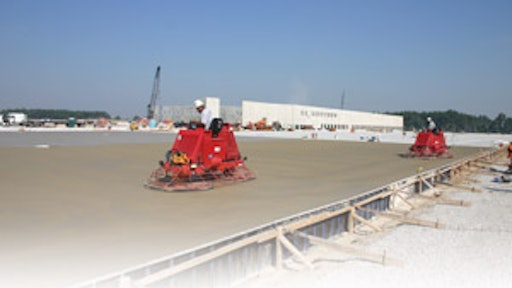
Whether you specialize in concrete work, or self-perform this aspect of your projects, careful matching of power trowels to the job size and specs can make the difference between profitability and loss.
"Most of the time, if something happens to the floor, the owner and the general contractor are going to blame the concrete contractor," says Jay Allen, president, Allen Engineering. "He's the guy that's probably bearing the most risk in the process. So he needs to be sure that he has the tools and the equipment to do his job."
Both walk-behind and ride-on trowels can be used for floating and finishing large slabs. However, a number of factors can determine which trowel will be most effective in a given application.
Walking the floor
Most walk-behind trowels come with a single four-bladed rotor. Sizes run as small as 2 ft. (24-in. rotor diameter) with as little as 5 hp, and up to 4 ft. and roughly 13 hp. The majority are powered by gasoline engines, although some manufacturers offer specialized electric-powered models. These trowels are commonly found on residential or light commercial pours involving less than 10,000 sq. ft. a day and/or numerous obstacles or tight spaces.
Baker Equipment & Materials, Monroe, Ohio, has walk-behind units from Multiquip/Whiteman and Husqvarna's Superior Power Trowel Division, as well as Whiteman and Allen ride-on trowels in its fleet. These units are rented out to its sister company, Baker Concrete, as well as other area contractors.
According to Jammy Anglin, purchasing manager, walk-behinds are generally specified for the smaller jobs, but there are some larger projects that may call for a more compact unit. For example, certain projects performed by Baker Concrete already have walls in place prior to pouring the floors. "Some schools they're doing right now require a 2-ft. walk-behind machine to get through the doorways," he notes.
Tight spaces and obstacles in the slab certainly influence the type of trowel Ahal Contracting, Bridgeton, Mo., uses on a project. Ahal Contracting does a variety of concrete flatwork and concrete tilt-up projects, as well as foundation work. It has roughly 25 walk-behind and 25 ride-on trowels consisting of both Allen and Multiquip/Whiteman units in various sizes.
"The equipment we're able to use really depends upon the type of work - how much we're pouring, access to the area (in other words, if we are pouring multi-story buildings), any obstructions in the floor," Keith Ahal, president of Ahal Contracting, explains. "If we're pouring 10,000 sq. ft. and it's wide open with no pipes or anything sticking up, that would be one thing. If there are numerous electrical conduits, plumbing drains, etc. in the slab, it would also influence the size of the equipment."
In cases where obstacles are numerous, Ahal will typically bring in the walk-behind units.
Bigger slabs call for ride-ons
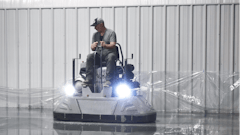
Ride-on trowels feature dual rotors with four to six blades each. The smallest production models typically have dual 36-in. rotors, and may be referred to as a 3-ft., double 3-ft. or 6-ft. trowel, depending on the manufacturer. The largest ride-on models typically feature two 60-in. rotors, and are known as 5-ft., double 5-ft. or 10-ft. machines. Allen Engineering also offers a 12-ft. "stretch frame" model incorporating 2 ft. of space between two 5-ft.-diameter rotors.
Ride-ons can be powered by gasoline or diesel engines and offer power ratings from 20 hp or less to nearly 100 hp.
When it comes to finishing large slabs, ride-on trowels are really the only option. "You need a machine that can cover as much ground as possible as quickly as possible because you do have a finishing window with concrete," says Allen. "Most contractors that are doing large pours are probably going to err to the conservative and get bigger, more productive machines, because the incremental cost of the machine is much lower than tearing out concrete."
The labor savings with a ride-on vs. a walk-behind can also be substantial. "Typically, a ride-on can cover three to five times as much concrete compared to a walk-behind unit," says Jim Lewis, national product specialist (concrete), Wacker Corp. "Depending on the jobsite conditions and operator proficiency, one ride-on model can replace three to four walk-behind units."
Personal preference also comes into play, says Scott Brening, vice president - operations, Superior Power Trowel Division of Husqvarna. "Some finishers will only use riders no matter what the [job] size," he comments. "Others prefer using walk-behinds because they feel more comfortable with it."
Steve DeGraeve, general superintendent - flatwork, George J. Shaw Construction, Kansas City, Mo., definitely prefers ride-ons over walk-behind models. Despite having roughly 15 walk-behind trowels in the fleet, he intentionally sets up most flatwork jobs to allow use of the ride-on units.
"Over the last four or five years, everything we pour, we try to make big enough so we can put double trowels on it," DeGraeve says. "Walk-behinds might be used 10 percent out of the year for really small stuff. But we try to design everything to go with a ride-on trowel."
George J. Shaw Construction performs a range of concrete work, from schools, hospitals and shopping centers to "big box" stores such as Target and Wal-Mart. Its approximately 25 ride-on units consist of 10-ft. Multiquips, several sizes from Allen Engineering and six new Wacker models.
The 10-ft. ride-ons are usually brought in for any job over 20,000 sq. ft. "For anything under 20,000 sq. ft., we will use the smaller machines - the 8-ft. [ride-ons]," DeGraeve notes. "Then if we get in a small area where we have a lot of stuff to work around, we'll throw in some 36-in. (6-ft.) double trowels."
Baker Concrete takes a similar approach. "When they're doing jobs like a Wal-Mart distribution center and they have a large area, the bigger the better because they will pour 50,000 sq. ft. a day," Anglin points out. "But if they're just doing an 'in and out' place/finish job, they may only be pouring 10,000 sq. ft. at most, so they don't need the big machines."
More power to meet specs
Historically, 10,000 sq. ft. has been viewed as the cutoff between using ride-on vs. walk-behind trowels. However, ride-on models are seeing more and more action on smaller projects. The main reasons are the reduced labor costs and floor profile (F-number) specs.
"One thing that influences [our trowel choice] is the tolerance requirements for how flat and level the slab needs to be," Ahal states. "With the larger equipment, by putting more weight on the floor, you can wait longer before you have to trowel, and therefore you do get a flatter floor."
The higher horsepower generated by ride-on trowels also makes them more conducive to panning. "Everything we pour, we pan it before we start finishing it to get it flat," DeGraeve says. "On probably 85 percent of our jobs, we have a floor profile we have to pass. So our tolerances are real critical. You need a lot more horsepower to get pans going."
More horsepower is also required for certain mix types. "If there are accelerators in the mix, that definitely is an issue," says Allen. "The accelerators make the set time go faster, which is going to require a bigger, more powerful riding trowel in order to keep up."
DeGraeve agrees, noting, "Horsepower does have a lot of difference in the mix. A lot of the mixes we use now, we have to wait until the last minute before we can get to it. We have to let it lay as long as possible."
Weather can be another factor, affecting both the size and number of machines required. "When you're pouring right out in the open, maybe during the day, with sun and wind and different factors, that can cause the concrete to set faster," Ahal points out. "The faster the concrete sets, if you have room to put bigger machines on it, that would be the preference. But I would say it may influence how many you put out there rather than what type."
"Square footage is a huge factor, but weather is also a consideration," Brening adds. "If it is extremely warm or windy, it would be necessary to have more than one machine."
Cost vs. benefits
Even given their advantages, the price difference between a ride-on and a walk-behind trowel may cause some contractors to pause before taking that next step.
"[A ride-on] costs more than two walk-behinds, and a lot of people struggle with that," says Allen. While a walk-behind may cost $2,000 to $2,500, a ride-on trowel typically starts at $9,000 to $10,000.
"You do have a bit of a jump for the technology - the larger engines, the more robust gearbox, the control panel and all the different things that go into a ride-on," Allen admits. "It becomes more expensive."
Yet, clearly there are rewards for your investment. The labor savings alone can make up the cost difference. "When you take into account current labor rates, rider trowels can really pay for themselves even with their higher initial cost," says Mark Hein, territory manager, Superior Power Trowel Division of Husqvarna.
Allen agrees, adding, "Typically, [contractors are] paying for that machine - with labor savings - within six months of purchase."
How Crucial Is Comfort? For walk-behinds, controllability is perhaps the biggest concern. "Basically, what we look for in a walk-behind is the ease of use," says Steve DeGraeve, George J. Shaw Construction. "How easy is it going to be for the finisher to run it?" When you move up to ride-ons, the control levers themselves become the issue. "If you're riding them every day, and particularly when it's the same people, fatigue and comfort are definitely a factor for them," says Keith Ahal, Ahal Contracting. This is one reason his company switched from mechanical to joystick steering controls. "We use riding trowels every day. The joystick-type steering is more expensive, but they are a little more operator friendly," he points out. "If we used these machines once in a while, then we'd go back to the stick steering because it just wouldn't be cost effective to spend the extra money." "Joystick steering is going to cost you $2,000 to $4,000 more per machine, depending on the manufacturer," admits Jay Allen, Allen Engineering. "But for a lot of people who do this six or eight hours a day, it's a big deal." Of course, comfort goes beyond controls. The type of seat, position of the armrests, location of the control panel, balance of the machine and even visibility to the slab can all play a role in how operators feel at the end of the day, and how productive they are while on the machine. "It's really all about production," states Jim Lewis, Wacker Corp. "The longer an operator can use a trowel without fatigue, the more productive he or she will be." |
| RELATED ARTICLES |
| Easy Steps to Maintain Concrete Walk-behind Trowels |