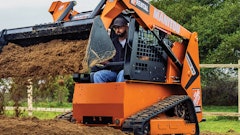
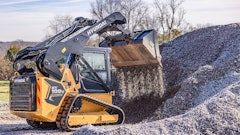
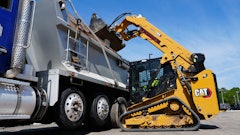
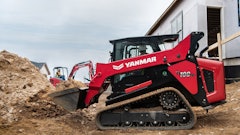
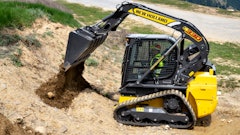
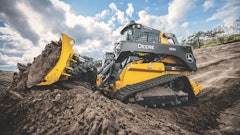
Standards have changed. The compact track loader you use today isn't anything like the one your father used. In many cases, it isn't even like one an older brother might have used. The most current models highlight marked improvements in operator comfort compared to those available even five years ago. While operator cabs may not fully replicate the interior of your pickup truck, they are worlds ahead of the rustic, minimalist "after-thought" cabs of the earliest models.
And why shouldn't these machines be more comfortable? Operators are spending an increasing number of hours behind the controls. With that comes an increasing expectation that the work environment be as comfortable as possible.
The true cost of climate control
Creature comforts do, in some cases, add to the overall cost of the machine. But manufacturers indicate the return on investment is also higher, since a comfortable work environment can help reduce operator turnover, while allowing operators to work more comfortably for longer periods of time.
"Contractors are putting in longer days," says Mike Fitzgerald, Bobcat Co. "They are working more hours to utilize the equipment better. [That means] operator comfort features are getting more critical all the time.
"It's harder and harder to find good operators," he continues. "Those you do find, you want to keep happy. That keeps them productive, working and on the job with the same company."
Fitzgerald cites the payoff determined by one customer, who broke down the per-day cost of an air conditioned cab to be less than the price of a soda. "When we averaged the cost of air conditioning over the time frame he would use the machine, he determined it cost him less than $1 a day," he says. "He figured... it was more cost effective to spend the money on air conditioning than buying a drink each day, because it would keep his operator happy all day long rather than just the few minutes it would take to finish the soda."
Climate-controlled cabs are becoming increasingly popular even in areas where air conditioning or heating may not be perceived as necessary. "In Northern climates, we can have 90°, 95°, even 100° days with 90%+ humidity at any time during the summer months," Fitzgerald says. "And in the Southern tier, when it gets 40°, 50°, even 60°, having a heating system allows operators to work on days they might not otherwise.
"Heating and air conditioning systems are becoming so popular," he adds. "The vast majority of our track loaders go out with cab enclosures. They make the operator more productive during the day because they're less fatigued and sharper for longer."
Many compact track loader models will also feature sliding windows for ventilation in favorable weather conditions, and moveable vents to enhance cab climate when using heat and air conditioning. "Sometimes, it may only be little features that we build into the machines that make [operators] more comfortable," Fitzgerald points out.
"Overall, the general business climate and environment require that operators work longer in the machines," he continues. "They're looking to get more done in a shorter time, so we need to accommodate workers for that environment. That's the ground work for us to develop machines. Long days and repetitive tasks lead us to try to minimize operator fatigue and maximize comfort."
Enhancing the ride
Climate control in the cab is just one of many features aimed at keeping operators comfortable. Some other notable features focus on enhancing the ride.
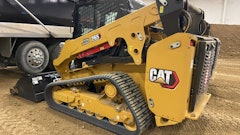
By their nature, tracks will inherently offer a smoother ride in off-road rough terrain compared to wheels because they bridge the gaps between ruts and bumps on a work site. But many manufacturers take it a step or two further by adjusting and/or adding features to their tracks and track systems. For example, Takeuchi offers tracks with an offset lug pattern that helps to even out the ride on hard surfaces.
ASV's undercarriage features a large number of wheels that spread out the weight and keep the wheels closer together. "When the wheels are closer together, you don't feel every one when you run over something," explains Brad Lemke, ASV. "That also reduces the overall weight per wheel, which reduces ground damage and increases traction."
The track system on John Deere models also offers several rollers that lengthen the amount of track on the ground. "The longer the track, the smoother the ride going over rough terrain," says Gregg Zupancic, John Deere. "More rollers help absorb the rough ride." The company also designs its tracks with dual flange idlers on the front and back that ride on the smooth surface, or outer portion, of the rubber to help smooth out the ride.
In addition to track and undercarriage enhancements, many manufacturers also offer adjustable suspension seats and arm rests. "Proper seat adjustment will affect productivity, and it is very important that the operator adjust his seat correctly for his height, weight and arm length," notes Mike Ross, Takeuchi.
ASV also offers a suspension between the chassis and undercarriage. When an operator hits an object, curb, etc., the suspension flexes and absorbs the energy before it is transferred into the machine and the seat. Some models feature a dual suspension where individual wheels inside the undercarriage are also suspended. "As you go over an object, the wheels themselves flex and hug over the undercarriage," says Lemke.
"Track machines naturally get brought into rougher areas than those where you would use a wheeled machine, because of their ability to handle the terrain without getting stuck," Lemke notes. "Running on rough ground - such as when you're brush cutting and running on stumps and over logs, or in construction, where you're running over curbs and concrete blocks - can be tiring and hard on your body. If you're not in a machine with a good suspension, it can leave you beat up. Physically, you can get jostled around and bumped inside the machine."
Effortless controls
Controls in many models are also changing to make it less physically demanding to run the machine. "Some of the most tiring functions for an operator are if the lever effort is high," says Zupancic. "Operating the machine can become a workout."
Many manufacturers offer options beyond mechanical hand and foot controls. For example, John Deere's machines feature servo controls, which Zupancic likens to power steering in a car. "It helps reduce the efforts to turn the machines, especially under heavy loads when lifting or digging," he says.
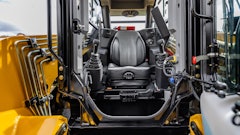
To further reduce fatigue, the industry is moving to low-resistance joystick controls. "We're going to low-effort controls, whether they're hydraulic pilot or electronic-over-hydraulic controls, where you're using wrists and hands rather than the whole arm to function the machine," says Lemke.
Bobcat offers three control systems. According to Fitzgerald, the joystick control has the least amount of fatigue. "They're easy and light to move," he says. "We find that more of our large track loaders are going out with joystick controls because operators can run the machine for a longer period of time with less fatigue and less physical input."
Ross also emphasizes the comfort of joystick controls. "Easy-to-operate pilot controls are in huge demand," he says. "Pilot controls are effortless compared to outdated mechanical linkage controls, which require the operator to physically stroke the pumps and mechanically open the boom [lift arm] and bucket valves with foot pedals via linkage.
"Pilot-operated joystick controls put the travel, boom [lift arm], bucket and auxiliary controls at the operator's fingertips," he continues. "These allow the operator to control the machine using only his hands with minimal efforts. These features really help to extend the work day and keep the fatigue factor at bay. Control systems continue to evolve into easy-to-operate/easy-to-reach features that operators now expect on their equipment."
360° visibility
While good visibility may not be readily identified as a comfort feature, manufacturers explain that optimum visibility reduces body contortions that can occur in a machine with poor visibility.
"Visibility is something you may initially think of in regards to safety. [You need to] know your surroundings so when you back up, you don't hit anything," says Lemke. "But visibility is also key for comfort so that at the end of the day, you're not strained."
Purchasing a machine with near 360° visibility is important, adds Zupancic. "It will reduce the amount of body stretching and neck turning," he says.
A machine with lift arms that rest lower can prevent overexertion. "It keeps the operator's head above the linkage. He doesn't have to strain to see over the side," says Zupancic. "And when doing reverse operations, selecting a machine that doesn't have high rear towers will minimize stress. Finding a machine with arms that rest low in relationship to where the operator sits will help reduce operator discomfort. Being able to see the bucket cutting edge without having to lean far forward is also important."
Keep it quiet
Noise is another indirect factor related to operator comfort. "High noise levels in the cab are physically tiring," says Zupancic. "It's difficult to harness and reduce the noise level because basically you're sitting on the engine compartment. But the industry is doing a lot to reduce it."
Most standard noise reduction packages include sound absorption materials, such as foam and padding strategically placed throughout the cab and in the engine compartment. Some manufacturers also offer noise reduction kits that can be retrofit onto existing machines.
Additional noise reduction methods are also available from some manufacturers. In the case of John Deere, its optional package includes noise reduction for the hydraulics, which brings decibel levels down into the low 80s, compared to the mid-80s for its standard package. "To dampen hydraulic noise, we use something called a hydraulic attenuator," says Zupancic. "It's like a muffler for the hydraulics. It significantly reduces the hydraulic whine that a loader puts off when using multiple functions at the same time."
Bobcat mounts a stiffening rim on the outside of the cab to minimize vibrations, which can contribute to noise. And ASV incorporates a pusher fan that pushes air away from the back of the machine, instead of a puller fan that blows air and engine noise back into the cab. "Having a pusher fan cuts down on the noise from the operator's standpoint," says Lemke. "We also work with our engine manufacturer to keep the noise level down for outside noise.
"On louder machines, people can wear ear muffs, but they aren't comfortable," he notes. "Operators would just as soon not wear them. They like to listen to their iPods or music and they can't do that if they're wearing ear muffs or ear plugs."
The overall operating experience
Many manufacturers have also added "convenience" features that may not directly affect operator comfort, but certainly enhance the operating experience. While too numerous to mention all of them, they include interior dome lights to extend the work day; cargo nets to hold small tools and notes; and 12-volt receptacles for cell phones, small air compressors and laptop computers. Anti-theft packages offer peace of mind, and hydraulic quick connectors can hook and release attachments at the push of a button.
"Basically, operators can stay in their machines longer and be more productive without having to stop work in undesirable conditions," says Zupancic.
"Some of these convenience and peace-of-mind features may not necessarily enhance operator comfort directly," adds Fitzgerald. "But they allow the operators to do their work more easily and focus on what they're supposed to be doing."