By the time you can visually detect low air pressure in a tire, it's already too late. You have likely shortened its life, and could potentially cause a tire failure at an untimely moment.
"Contractors can identify if a tire is flat," says Wayne Birkenholz, manager of global field engineering, Firestone. "But relying on visual inspection is a matter of degrees."
For example, let's say the optimum inflation pressure for a tire is 100 psi. "Can you tell when it's 20 lbs. underinflated?" he asks. "The tire may not look low at that level. You can tell that it has air in it, but you can't tell if it has 70 lbs. or 100 lbs. But that much difference could certainly affect performance."
DOT regulations indicate that a tire is considered flat at 20% below the recommended inflation pressure. However, Doug Jones, Michelin customer engineering support manager for North America, notes that detrimental affects can be experienced at much less than that. "At just +/- 5% above or below the recommended inflation pressure, you can start sacrificing tire life," he says. "A tire that is underinflated by 10% will experience about a 10% decrease in service life. A tire that is overinflated by 10% will experience about a 5% decrease in service life."
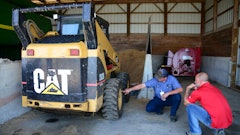
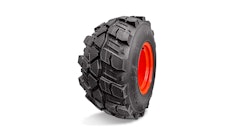
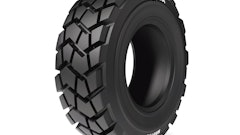
The tire and wheel assembly is simply a container that holds air. How much load you can carry with that container is dependent on the size of the tire (i.e., how large is the air cavity) and the inflation pressure. For a given load, if you reduce the air cavity, you have to increase air pressure. Conversely, if you increase the cavity, you can decrease the inflation pressure. "For a given load, a larger tire requires less inflation pressure," says Jones. "A skid-steer loader tire is a relatively small tire with heavy loads, so we have to run relatively high inflation pressures."
Overinflation
Contractors may be tempted to overinflate tires, since this has a positive affect on fuel economy in tires used on the road, says Kevin Lutz, Michelin. But that fuel savings comes at a cost, especially for tires used off road.
"Overinflation will give you better fuel efficiency on the road," says Lutz. "But overall, it will cost in lost productivity. That is especially apparent in equipment such as a backhoe. It costs in productivity because it takes you longer to the do the work. You can spend an extra 10% to 15% more time doing the job, and that costs in fuel."
Plus, overinflation of both on- and off-road tires makes them more susceptible to punctures. "If you hit a rock, you're more likely to break the body plies," says Birkenholz. "It can also affect the wear pattern of the tire - you can have more rapid, less uniform wear. It's harmful because it changes the way the tread goes into the footprint."
The telltale sign of an overinflated tire is wear in the center of the tread. The excess inflation pressure rounds out the tire and reduces the size of the footprint. That in turn sacrifices flotation and traction, and increases the possibility of getting stuck.
"With overinflation, you affect your ability to get through soft, wet soils," says Lutz. "More footprint on the ground gives you better traction. If you shrink that by overinflating the tire, your tractive effort is less. You may not be able to fill your bucket as full or it may take longer to fill it."
Underinflation
Underinflation tends to be more common in off-road vehicles, because it can give you the larger footprint needed for extra tractive effort. But like overinflation, it can wreak havoc on tire life and severely sacrifice durability.
Underinflation shows up as excess wear in the shoulders at the outside edges, because the center of the tread tends to concave. "It doesn't contact the footprint area," says Birkenholz. "With proper inflation, you get good, uniform contact pressure across the face of the tread for nice, even wear."
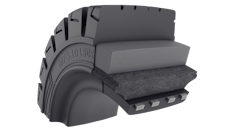
While uneven wear is a concern, more critical is the negative effect of underinflation on tire durability. It can produce excess fatigue in the tire and excess deflection, which leads to heat generation. The excess heat can cause failure in several areas, including the bead area and sidewall. Commonly, it will result in "zipper" ruptures.
"Underinflation is one of the main reasons for tire issues," indicates Dan Steltmann, vice president of research and development, Titan Tires. "For on-road tires, speed is an issue. But with off-road tires, heat generation is more of a problem because the thickness of the tread is greater for abrasive off-road conditions. When you have that much rubber in a tire, heat can be harder to dissipate."
"If you overinflate the tire by 5%, the tire will experience irregular wear in the center," adds Jones. "It will be more susceptible to road hazards and sidewall damage. At 10% below the recommended inflation pressure, the casing has a tendency to flex more in the sidewall. If it's severely underinflated, you will run on the shoulder of the tire and get irregular and rapid wear on the shoulder. Excess flexing in the sidewall can result in a zipper rupture."
Jones equates the cords in the tire to a clothes hanger. "If you bend it beyond its yield position, it will break. The same thing happens with the cords in the sidewall of the tire," he states. "They flex beyond their bearing capacity. One wire will break, then those on each side will break. Eventually, you will have what appears to be a 'zipper.' "
A bias tire is particularly susceptible to failures caused by overinflation since, by design, it resists flexing, says Birkenholz. While it's not advisable to run any tire underinflated, a radial is a bit less susceptible to these types of failure. "Because of its construction, a radial tire likes to flex in the sidewall," he points out. "It likes to bulge, so you don't create that friction."
Develop a checklist
Because maintaining proper inflation is so critical to tire life and wear, tire manufacturers advise fleet owners and managers - regardless of fleet size - to implement a tire maintenance program. Following are some checklist items to include:
Pre-trip inspection - A pre-trip inspection, which includes vehicle and tire inspections, is required by the DOT for equipment operated on-highway. However, it makes sense to perform a similar inspection on equipment and tires operating off-road, as well.
Fleet inspection check - Appoint someone to inspect the fleet periodically when vehicles are domiciled. Fleet managers can perform the checks themselves, outsource them or do a combination of both.
"However it's done, make sure the dealer understands what your tire maintenance system mandates," says Jones. "Even if you outsource it to your dealer, don't take a hands-off position. You still need to be actively involved."
Look for nails, cuts, scrapes and deep gouges. "Also check valve caps," suggests Steltmann. "For starters, make sure you have them. They are usually well hidden, but they can get damaged or packed with mud, which can lead to a tire failure."
Monitor inflation pressures - Ideally, someone should check inflation pressures on a weekly basis. To determine proper pressure, refer to load and inflation tables, which are available on manufacturer web sites or in tire handbooks.
Michelin also offers stickers that identify proper inflation pressure for individual tires. These can be affixed to the vehicle for handy reference.
Conduct a scrap analysis - Determine why tires are coming out of service. It could be because you're running a tire that isn't the best option for the application. Many manufacturers offer a selection of tires specifically designed for on- or off-road or a combination of both.
Use an accurate tire gauge - Options include digital, dial and stick gauges. Verify your gauge periodically to ensure you're getting accurate readings.
While stick gauges are the most popular, they're mechanical, so they can wear out. "Digital gauges are a good option, because if they fail, they fail completely," says Lutz. "They won't give a false reading."
Maintain a written history - By keeping a written history of air pressure checks, you can determine if any trends develop. "If you notice that you have to keep adding air to the same tire, you can identify problems," says Lutz.
Implementing a tire maintenance program will generate dividends quickly. "Maintaining proper air pressure will help eliminate downtime on the road or on the job," Jones states. Unexpected failures are costly when you consider the expense associated with a road call, as well as the potentially higher cost of purchasing a single tire in an emergency situation.
"[Maintaining air pressure] will also take advantage of downtime of the vehicle to change the tires if needed," he adds. "Overall, it will extend tire life and cut down on the money you have to spend on an annual basis to replace tires."
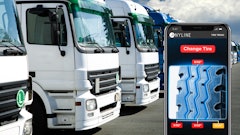
Monitor Pressure Automatically To help reduce tire costs, some contractors are turning to tire inflation monitoring systems such as the one offered by Doran. It's one of several systems that are beginning to make their way into the construction industry. Doran's system includes two basic components: a sensor and a dash- or cab-mounted display (receiver). The sensor screws directly onto the end of the valve stem of each tire you want to monitor. When you tighten the sensor, it depresses the valve core enough to allow consistent air flow into the sensor. The display provides access to tire pressures at any point. Drivers simply push a button to check each tire systematically, one at a time. "Normally, it becomes a passive system as they're driving down the road," Nau says. "There are no flashing lights, nothing to distract them." If there's a drop in pressure that goes 12.5% below the baseline (optimum tire pressure), drivers will receive an initial three-phase warning that includes a beeping sound, a flashing LED and a digital readout of the actual pressure in the tire that is potentially low. "The driver will know what tire is causing the alarm and what the tire pressure is so they know how to react," Nau points out. If immediate attention is not needed, they can put it into a remind mode or silence mode. If they do nothing and the tire pressure drops below 25%, the same warning will occur at a much faster rate to signify a more urgent situation. "The system is designed to allow drivers time to get to a service center or to pull off the road out of traffic," says Nau. "It's essentially an oil gauge for your tires." Doran's system can monitor up to 34 wheel positions on any given vehicle. It can be installed on both on- and off-road tires that have a standard size valve stem. Larger size tires can be monitored with the use of an adapter. "The system really excels in dump fleets that are weight sensitive," says Nau. "The lighter they make their vehicles, the more cargo they can carry and the larger the return on investment per load. One way to save weight is to run single tires, which eliminates the weight of almost an entire tire per location over running duals. But then it becomes even more critical to maintain those pressures." If you run a tire low, the tire will flex more than it should and increase the amount of heat buildup within the tire, which is what typically causes a tire to fail. "While there is an up-front cost associated with the system, it will pay for itself if you have just one lost tire on the road... that you could have saved if you would have known that tire pressure was going down. That isn't even counting the fuel you can save by not running tires underinflated, or the wear and tear on the tires themselves. There are advantages that reach beyond simply saving a tire." |